


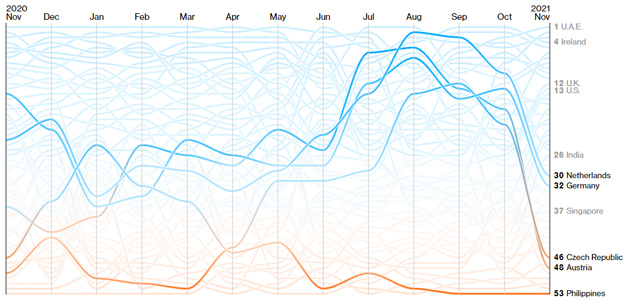
(SPOT.ph) It's been almost two years since the lockdown started and we're finally seeing steadier signs of the number of new COVID-19 cases in the Philippines decreasing. The country logged 425 new cases on Tuesday, November 30—the lowest since July 2, 2020. Up to 32.6% of the population have been fully vaccinated, which is around 35.7 million of Filipinos. Now while these numbers seem to be reason for optimism, they still don't fare better compared to how the rest of the world is battling the global pandemic. In the latest COVID Resilience Ranking by Bloomberg, the Philippines still places last out of 53 countries.
Also read: The Philippines Is the Worst Place to Be in During COVID, Says Bloomberg
Bloomberg's COVID Resilience Ranking is released monthly with their most recent report published on November 30. "Southeast Asia continues to populate the bottom of the ranking, with the Philippines remaining in last place," the article said. The countries are ranked based on 12 data indicators, including virus containment, the quality of healthcare, vaccination coverage, overall mortality and progress toward restarting travel, and easing border curbs. All countries considered are supposedly the "world’s biggest 53 economies" and the ranking takes into account how they're "responding to the same once-in-a-generation threat."
Most significant in the November report is how eight of the biggest drops are European nations; countries which previously dominated the top rungs of the ranking for months. United Arab Emirates, which has been one of the most consistent in terms of COVID response, rose to the top. "Daily cases have stayed below a hundred a day since mid-October in the UAE, deaths are rare and it’s one of the most vaccinated places in the world with over 200 doses per 100 people," the report noted. Chile and Finland rank second and third; owing their rise in the chart to high vaccination rates, reopening their borders, and strong economic recovery.
But Bloomberg is wary of the detection of the new variant, Omicron. "While there is still much to be learned about how fast the new strain spreads and whether it’s able to evade existing vaccines, it’s already stalled—and in a few places, reversed—reopening efforts in the final days of November." And this greatly affected hopes for reopening and recovery of many nations, including Israel and Japan.
Another significant factor is how Southeast Asia remain to be at the bottom of the ranking, with low vaccination rates being a common factor.
"The perverse consequences of global vaccine inequality has only been underscored by Omicron’s emergence, something that scientists and the World Health Organization warned would happen—and will keep happening—until the developing world is able to more efficiently access and administer shots," Bloomberg said.
Hey, Spotters! Check us out on Viber to join our Community and subscribe to our Chatbot.