
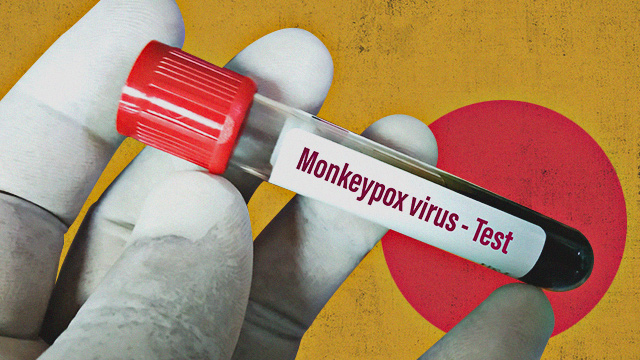
(SPOT.ph) After health agencies in Europe and North America raised the alarm about yet another viral disease—monkeypox—back in May, the first case in the Philippines has just been detected. This is according to Department of Health Undersecretary Beverly Ho during the press briefing of Press Secretary Trixie Cruz-Angeles on Friday, July 29.
According to the local health agency, patient zero is a 31-year-old who traveled from a country where monkeypox is not endemic. There are 10 close contacts, three of which are from the same household as the patient.
Also read:
10 Online Medical-Consultation Services You Can Use From Home
10 Prepaid Health Cards You Can Avail for Less Than P5,000 A Year
What Is Monkeypox
Monkeypox is a viral zoonosis, meaning the virus can be transmitted to humans from animals. The United States Centers for Disease Control and Prevention said that it is a "rare disease," and the World Health Organization explained that it is caused by an "enveloped double-stranded DNA virus that belongs to the Orthopoxvirus genus of the Poxviridae family." Another infectious disease caused by a virus that belongs to the Orthopoxvirus genus of the Poxviridae family is smallpox, specifically caused by either virus variant Variola major or Variola minor. This is also why there are similar symptoms between patients with smallpox and monkeypox, although the latter is clinically less severe. Despite the name, monkeypox is not similar to chickenpox, caused by the varicella-zoster virus from the family of herpesvirus and not poxvirus.
Monkeypox was discovered in 1958 when a pox-like disease occurred in colonies of monkeys kept for research. However, its source remains unknown (and no, they're technically not from the aforementioned monkeys). African rodents and non-human primates, according to the U.S. Centers for Disease Control and Prevention (CDC), may harbor the virus and infect people.
The first human monkeypox cases were recorded in 1970 in 11 African countries: Benin, Cameroon, the Central African Republic, the Democratic Republic of the Congo, Gabon, Cote d’Ivoire, Liberia, Nigeria, the Republic of the Congo, Sierra Leone, and South Sudan. Several outbreaks were reported after that, including one in 1996 in the Democratic Republic of Congo.
In Nigeria, cases have continued to be reported since 2017. In 2003, the first monkeypox outbreak outside Africa was reported in the United States after pet prairie dogs were housed with Gambian pouched rats imported from Ghana. Monkeypox has also been reported among travelers from Nigeria to Israel in 2018, then to the United Kingdom from 2018 to 2022, to Singapore in 2019, and to the U.S. in 2021.
How Can You Get Monkeypox
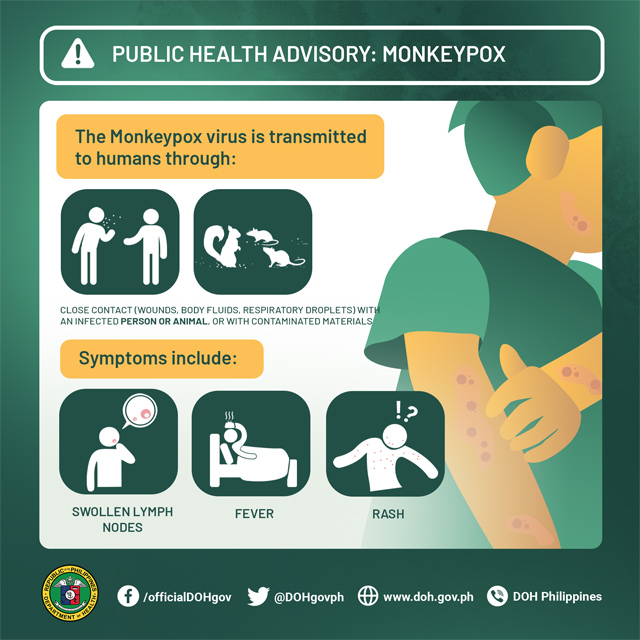
Animal-to-human transmission, which is highly possible for a viral zoonosis like monkeypox, occurs from direct contact with blood, bodily fluids, or cutaneous or mucosal lesions of infected animals. You can get this by eating inadequately cooked meat and other animal products of infected animals. There is also indirect or low-level exposure among people living near forested areas where infected animals thrive.
Human-to-human transmission of monkeypox, according to CDC, can happen through:
- direct contact with the infectious rash, scabs, or body fluids
- respiratory secretions during prolonged, face-to-face contact, or during intimate physical contact, such as kissing, cuddling, or sex
- touching items (such as clothing or linens) that previously touched the infectious rash or body fluids
The transmission also occurs through the placenta from an infected mother to the fetus or via close contact during and after birth. "While close physical contact is a well-known risk factor for transmission, it is unclear at this time if monkeypox can be transmitted specifically through sexual transmission routes," according to a report by the World Health Organization.
Johns Hopkins Public Health also said that: "Simply put, monkeypox spreads by close physical contact and anyone can get it. Close physical contact could include sex, but it really does not have to—and that's why monkeypox is not [a sexually transmitted disease]. Monkeypox is also not a 'gay disease,' as some have called it online. Let's push back on stigma before it takes hold. Because anyone can be exposed, everyone must be vigilant. Know what to look out for, and know that treatments are available."
What Are the Symptoms of Monkeypox
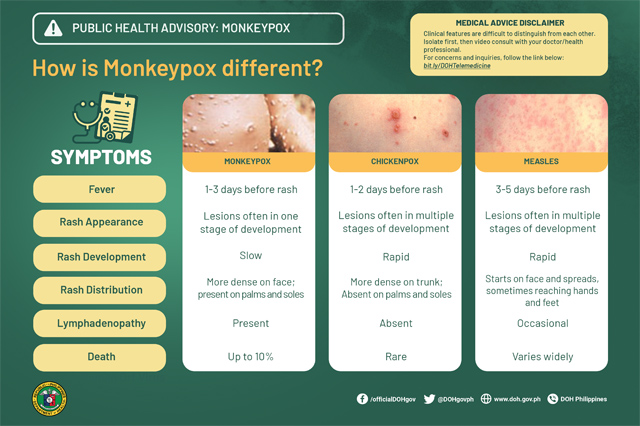
According to WHO, the incubation period of monkeypox is usually from six to 13 days but can range from five to 21 days. The infection can be divided into two periods, namely the invasion period and skin eruptions.
Symptoms of monkeypox during the invasion period:
- fever
- intense headache
- lymphadenopathy (swelling of the lymph nodes)
- back pain
- myalgia (muscle aches)
- intense asthenia (lack of energy)
Symptoms of monkeypox during skin eruption:
- the appearance of rashes within one to three days of fever
- rash that is more concentrated on the face and extremities (palms of the hands and soles of the feet)
- also affected are oral mucous membranes, genitalia, and conjunctivae, and cornea
- rash evolves sequentially from macules (lesions with a flat base) to papules (slightly raised firm lesions), vesicles (lesions filled with clear fluid), pustules (lesions filled with yellowish fluid), and crusts that dry up and fall off
WHO said that monkeypox is a "self-limited disease" with symptoms lasting from two to four weeks.
What Is the Cure for Monkeypox
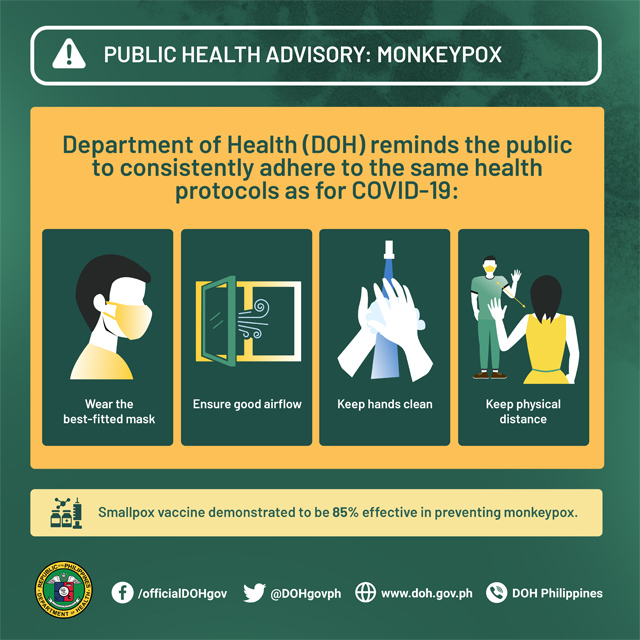
Like COVID-19, there is no specific treatment for containing the monkeypox virus. Outbreaks can only be controlled by various measures. There's also no vaccination yet specifically for monkeypox, but prior vaccination against smallpox showed about 85% effectiveness in preventing monkeypox. The U.S. CDC also said that the anti-viral drug cidofovir and vaccinia immune globulin could be used to control a monkeypox outbreak.
On July 25, the Department of Health officer-in-charge Maria Rosario Vergeire said that the U.S. Food and Drug Administration authorized a smallpox vaccine against monkeypox. The local agency is currently coordinating with WHO to secure smallpox vaccine supplies.
“What we’re doing now for COVID-19 preventive measures also applies to monkeypox,” she explained on Monday.