
Today in Random: Why Is There a Question Mark in Space?
Scientists have a guess.
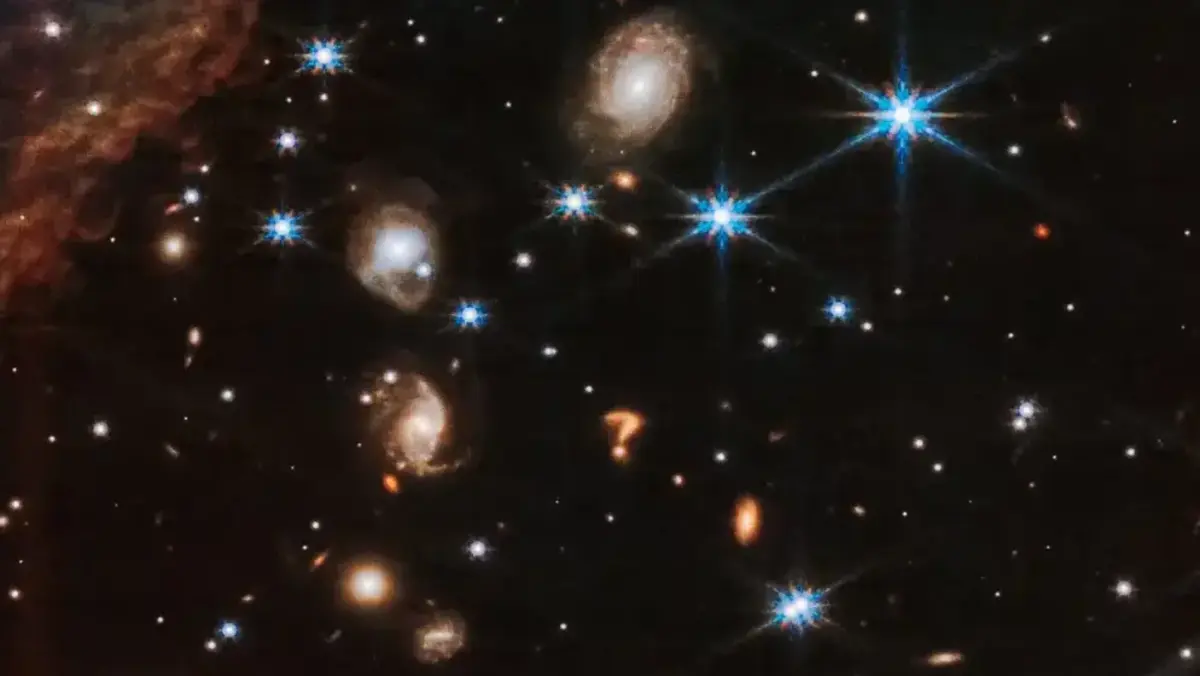
(SPOT.ph) On July 26, NASA spotted a giant question mark in deep space using its James Webb Space Telescope, making headlines that week. This question mark resulted in several questions of its own: Is the universe asking us something? Is it aliens trying to communicate with us? It turns out it’s neither of the two.
Several scientists have since come forward to explain that the question mark is likely a single galaxy with an unconventional shape or a bunch of galaxies merging together as observed from the telescope’s perspective.
"The two distinct features could easily be merging galaxies in the background, with the upper part of the question mark being part of a larger galaxy getting tidally disrupted," Physics assistant professor Matt Caplan told Space.com. "Given the color of some of the other background galaxies, this doesn't seem like the worst explanation. Despite how chaotic mergers are, double-lobed objects with curvy tails extending away from them are very typical."
There we have it: It’s very likely space objects lining up perfectly to feed our human wonder (PS: You can find the question mark at the lower center of the picture).
It wasn't astronomer David Helfand's first time to see a punctuation mark in space, either. He told National Geographic: “It's very cute. It's a question mark... but you can find the colons and semicolons, and any other punctuation mark, because you have 10,000 little smudges of light in each image taken every half hour."
Also read: Heads Up: Two Supermoons Will Light Up the Sky in August
What is the NASA picture about?
Let’s put the question mark aside and talk about what's found in the bigger picture.
The James Webb Space Telescope managed to capture two young stars called Herbig-Haro 46/47 on July 26.
“To find them, trace the bright pink and red diffraction spikes until you hit the center: The stars are within the orange-white splotch. They are buried deeply in a disk of gas and dust that feeds their growth as they continue to gain mass," NASA published on its website.
“The most striking details are the two-sided lobes that fan out from the actively forming central stars, represented in fiery orange. Much of this material was shot out from those stars as they repeatedly ingest and eject the gas and dust that immediately surround them over thousands of years.”
NASA's James Webb Space Telescope has been offering mind-blowing views of the cosmos since it began science operations in the summer of 2022.
Also read: 10 Places for Stargazing Near and Around Manila