
The SPOT.ph Guide to Desks
Looking to buy a new desk? We lay it down for you.

(SPOT.ph) We’ve shown you everything you need to know about office chairs. Now, let’s talk desks. Office desks can do much more than just provide surface area to hold your workplace essentials. They can also be a space for reading, writing (as in with a pen and paper—yes, people still do that), drawing (particularly for creatives and designers), and for students, studying. Your desk of choice must also be a perfect companion to your office chair—the harmony between the two will make every work-from-home day all the more productive and significantly less exhausting. So it’s important when you're looking to buy to get one that suits your needs, your available space, and of course, your budget.
Also read: The SPOT.ph Guide to Coffee
Everything you need to know about desks
A Brief History of Office Desks
According to Britannica, the first “desks” were probably designed for ecclesiastical use—what you’d now call a lectern for reading religious material. And while you probably don’t consider your own personal desk an altar for anyone’s blood-turned-wine, we’d argue that for many of us, it is a sacred space.
Many of the desk styles we know today were introduced in the 18th Century—Louis XV, for example, owned an early model of the rolltop-type desk while the kneehole desk was developed in England early in the same century. By 1899, Belgian architect and interior designer Henry van de Velde had created an art noveau-style desk, which, while definitely antiquated in design, is not far off in function and build from some of the office desks you might see today.
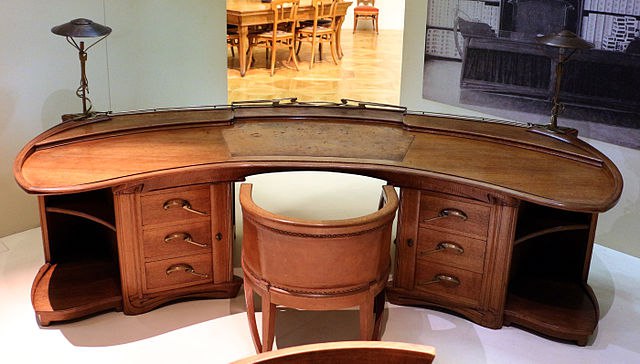
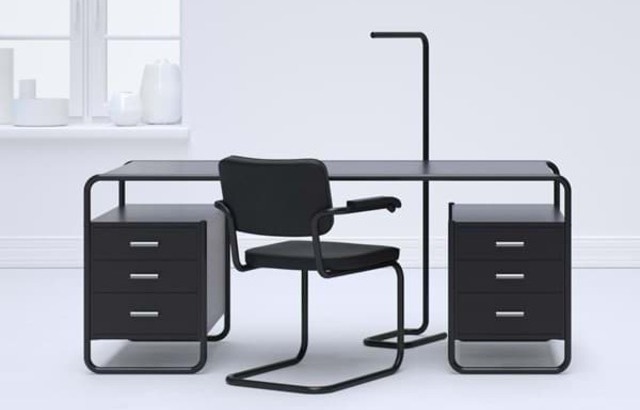
Not long after the industrial revolution, the 20th Century brought about the popularity of the Taylorism movement in professional settings. The movement focused on maximum efficiency, which meant tightly packed office spaces with basic desks and chairs that provided minimal comfort or function. It wasn’t until the 1930s—as companies migrated to larger office spaces in skyscrapers and typewriters, telephones, and paper files became mainstays in modern offices—when comfort and practicality became more of a concern. This lead to the launch of designs like Marcel Breuer’s famous tubular-steel desk, a Bauhaus take on the functional work desk.
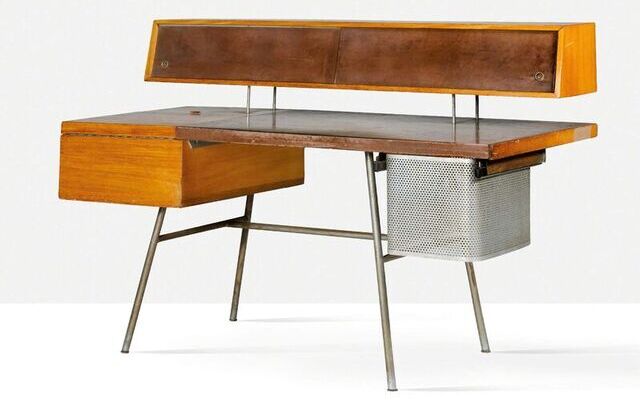
But a true early pioneer of the office desk as we know it today was George Nelson, a designer at Herman Miller—yes, the same company that pioneered modern office chairs. Nelson’s landmark Home Office Desk was launched in the mid-1940s and is still considered a classic today. With a compact build and generous tabletop space along with drawers and shelving for storage, Nelson’s design is considered the first-ever modern workstation.
Things to Look For in a Desk
Now that you know a little about the historical journey that brought you the tables you work on today, let’s talk specs and features. Below, we run through all the factors you need to consider when buying a brand-new desk.
Size
Choosing the right-size desk will depend mostly on the size of your room and the number of things you need to keep on top of the table. If you’re a no-nonsense laptop-only kind of worker—with the occasional strewn-about items in the mix—you’ll probably be safe with a fairly compact desk. Keep in mind, however, that it may be beneficial for you to have open space left to allow your arms some breathing room and keep your things from getting knocked over as you move about.
But if you’re, say, a designer with two large monitors, a printer, stacks of paper, and tons of art materials, you’ll want to invest in a larger desk. Just make sure it fits seamlessly in your room—make the effort to measure the available space in your home office and bring the tape measure with you to the store. If you’re shopping online, most retailers provide size dimensions for their desks, so you should be able to match those up with your space.
Shape
A majority of the desks you’ll see in any professional setting are rectangular and in most cases, we’d recommend sticking to that basic shape. Not only is it stylishly simple and spatially economical, but it’s also the easiest to fit into most rooms, and can be moved from room to room or to different areas of your home office with ease. With a rectangular table, what you’ll really need to consider is its length and width—a desk that’s longer than it is wide for example may not be ideal for narrower rooms while a desk that’s wider than it is long can make it difficult for you to reach for items farther away from you on the table.
Depending on your home office’s size and layout, you can also opt for corner desks—a decent option if you need more tabletop space, but don’t have very wide walls. Just keep in mind they’re typically not as versatile as your standard rectangular table, i.e. you will always need to be putting them in the corner of the room. But hey, they are kind of fancy looking so if you have the space and don’t need the versatility, why not?
As for round desks, we’d mostly steer clear as they don’t quite provide as much functional tabletop space as a rectangular desk. Unless you’re opting for a multifunctional table (e.g. one you can also use for eating dinner if you live in a small condo) or just have a really specific aesthetic, round desks will rarely be the practical option.
Storage Space
There are plenty desks on the market that are as simple as a flat piece of wood on four legs. And to be clear, there’s nothing wrong with that, especially if you only really need a laptop and a few other things to get sh*t done. But if you’re someone who keeps a lot of files on the desk, has art materials stored away for occasional use, or just needs more storage space at home to minimize clutter, you may want to opt for a desk that provides drawers and shelves.
You’ll have to walk a fine line here, though—while more and more storage space can be a plus, it can also mean a bulkier, heavier desk as well as a heftier price tag to match. If you ask us, a row of drawers on one or both sides of the desk can be more than enough. Shelves a great option, too, especially if you like to keep decor on display, but we’d avoid choosing a table that’s too tall because of added storage space. And in case you don’t want to go for a desk with built-in storage, you can always opt to buy standalone drawers to fit underneath or install shelves up top.
Height
It’s imperative that the height of your desk be harmonious with the height of your chair. Most modern office chairs provide adjustable height controls, so if you’ll be fine if your chair has that option. In case it doesn’t, take the time to sit on your chair and figure out what height would be most ideal for you, depending on your usual sitting position, your work habits, and your body—those who sit cross-legged, for example, may need more room underneath while those with longer torsos may need extra height on the table.
Adjustable standing desks are also an option as they can be customized for any height, chair, or position, but be ready to shell out a lot if you have one on your wish list.
Quality and Material
High-quality, well-constructed wood is always a safe best and would look great with almost any interior style—at least for your tabletop, that is. You can be a little more flexible with the table legs, which are sometimes metal. You’ll want to invest in a desk that can stand the test of time as well as the wear and tear that comes with constant use. All-metal desks can be pretty sturdy, too, but keep in mind that not only can they be pretty heavy, but they can also absorb heat, so try not to go for metal if you work close to a window.
As for plastic desks, we’d say only choose them if you’re buying a temporary desk while saving up for your dream desk, or if you’re looking for ultra-compact tables that you’ll stow away outside of work hours.
Also read: The SPOT.ph Guide to Speakers
Where to Buy Desks and How Much to Shell Out
Flint Desk (P4,800) from Mandaue Foam
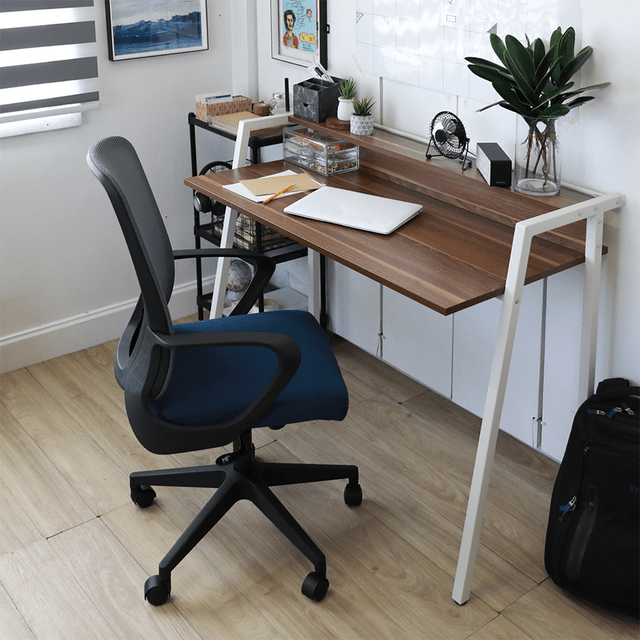
Keep your workstation simple with this desk from Mandaue Foam. Perfect for small spaces, it provides more than enough room for your laptop, writing materials, or art tools along with a small shelf up top for other essentials or decor. Plus, you’ll get lots of space underneath in case you ever want to store some drawers there.
Available online; see a list of Mandaue Foam stores.
Elair Office Desk (P12,950) from Our Home
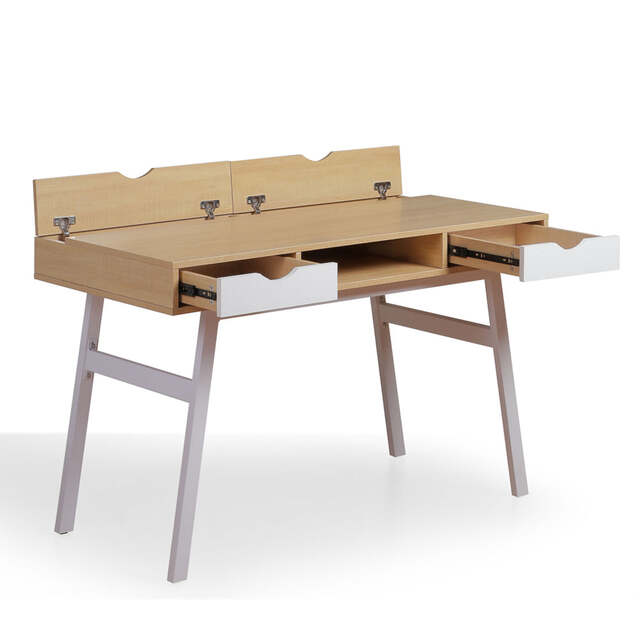
For minimalist or Scandinavian-style homes, this Elair Office Desk from Our Home would be a great pick. With no shelves or frills up top, you get maximum tabletop space from the desk along with two drawers and even a cubby in the middle. You’ll also find hidden storage compartments for small essentials on the end of the table farthest away from you.
Available online; see a list of Our Home stores.
LAGKAPTEN (P13,620) from IKEA
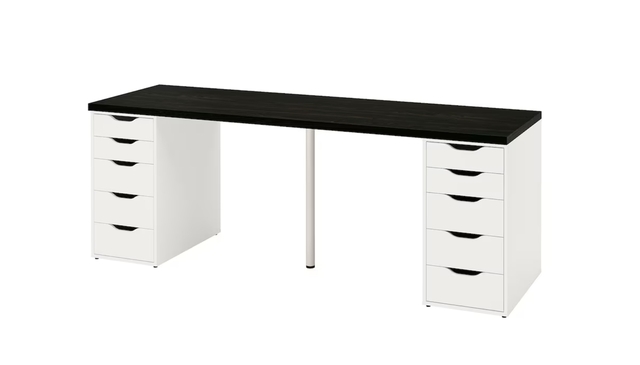
If you need as much storage space and surface area as possible, check out this IKEA desk. You get a spacious desk with 200 centimeters of length to hold all your office essentials and more as well as two stacks of IKEA’s Alex drawers built into either side. You’ll never run out of space. It’s available in a variety of colorways that mix shades of black and white with chic wooden accents.
Available online and at IKEA Philippines at the SM Mall of Asia Complex, Pasay City.
Executive Dual Motor Standing Desk (P26,990) from Stance
For the ultra-techy, we’d say a standing desk is well worth the investment—so long as you get the most out of its features. Standing desks are simply desks that are tall enough to use while standing, allowing you to incorporate more movement into your day and avoid being slumped over for eight hours straight. Some people even opt to put walking pads under their standing desks so they can get their steps in while working.
Our pick? This standing desk from Stance, which is easily adjustable with buttons on the front—that means you can even bring it down to the height of a regular desk. Plus, it has built-in USB charging ports.
Available online.