

Fascinated With Flying? Plane Spotting Might Just Be Your New Hobby
Find out how you can become a plane spotter.

(SPOT.ph) Growing up within the vicinity of the country's international airport and headquarters of the Philippine Air Force, it doesn't come as a surprise that I have always had this fascination for flight and airplanes. Fast forward to now, this fascination led me to actually land a job in the aviation industry as well as become an AvGeek (aviation enthusiast) and a planespotter (an AvGeek who loves taking photos of planes). It is also a privilege to be able to take snaps of different airplanes, especially since I work in the area where they take off, land, and park.
In other countries, plane spotting or aircraft spotting has long been regarded as a hobby comparable to that of photography itself. But here in the Philippines, it has yet to attract more people.
Also read:
Which Is More Dangerous When Flying: Takeoff or Landing?
The Dangers of Removing Your Airplane Seat Belt While the Sign Is Still On
What Is Plane Spotting
Plane spotting refers to the hobby of watching planes, taking photos or videos of them, and recording their movements. Plane spotters (or simply "spotters") would usually "stake out" near an airport and spend long periods just waiting for planes to arrive and leave. Some plane spotters are motivated by the sheer joy of watching aircraft take off and land, while others go as far as recording details and tracking airliner fleets.
Records show that the word "plane spotter" was first coined during World War II when civilians were encouraged to observe aircraft for public safety. There was even a publication named The Aeroplane Spotter to help spotters in identifying different aircraft types.
Where to Go Plane Spotting
I have been to airports abroad with designated observation decks and areas for plane spotters. But after the tragic 9-11 in New York City, other airports opted to just have these facilities accessible by airline passengers for safety and security reasons. Plane spotter-friendly airports abroad sometimes have raised mounds just outside their perimeter fences for photographers.
Plane spotting in the Philippines might be a bit tricky, but a local community called the Philippine PlaneSpotters Group on Facebook often shares tips and tricks with fellow AvGeeks, especially the best places to plane spot around the archipelago. This online community has aviation professionals (pilots, cabin crew, ground crew, mechanics, airport and Air Force personnel) and hobbyists as its members. Their Facebook group also serves as a gallery of aircraft and aviation-related photos taken around the country, complete with details and stories worth noting and reading.
Also read:
Scared of Flying? Here's Why Turbulence Is Not Always a Big Deal
It's Not a Bus: Here's Why the Back Seats of a Plane Are Best
Plane Spotting: More Than a Hobby
While most plane spotters treat the activity as just a hobby, some are actually earning from the photos that they take. It is common for airlines and airports to license photographs taken by plane spotters to be used for their marketing collaterals.
Websites such as JetPhotos.net and Airliners.net serve as databases of aviation photographs, screened and curated by human webmasters. Aviation companies can then use the contact information posted by spotters in their respective galleries should they wish to use their photos commercially.
A number of aviation-related incidents also used photos taken by plane spotters to aid their investigation. When Air France Flight 4590 crashed on July 25, 2000, for example, photos taken by plane spotters played a vital role in determining the cause of the only Concorde accident in its 27 years of operations.
Legal Issues Related to Plane Spotting
Though plane spotting is just a recreational activity, there are cases when hobbyists are accused of serious offenses in different countries.
In 2001, 13 British and Dutch aviation enthusiasts were arrested at the Kalamata International Airport in Greece for alleged spying and related charges. The group spent six weeks in jail and was later released on bail. Except for one, the plane spotters were declared innocent a year later when an appeal court overturned their convictions. Plane spotting was previously unheard of in Greece, but a local judge advised that they had only been pursuing their hobby as plane spotters.
In the Philippines, there have been reported incidents where plane spotters were brought to the Philippine National Police Aviation Security Group for questioning even if they are far from the perimeter fences of the Ninoy Aquino International Airport in Pasay City.
Back in 2012, MGen. Jose Angel A. Honrado, General Manager of the Manila International Airport Authority, clarified that "there is no existing airport security regulation which prohibits plane spotters from taking pictures of airplanes from outside the NAIA perimeter fence. These plane spotters are not considered threats to airport security for as long as they keep their activities outside the restricted airside area."
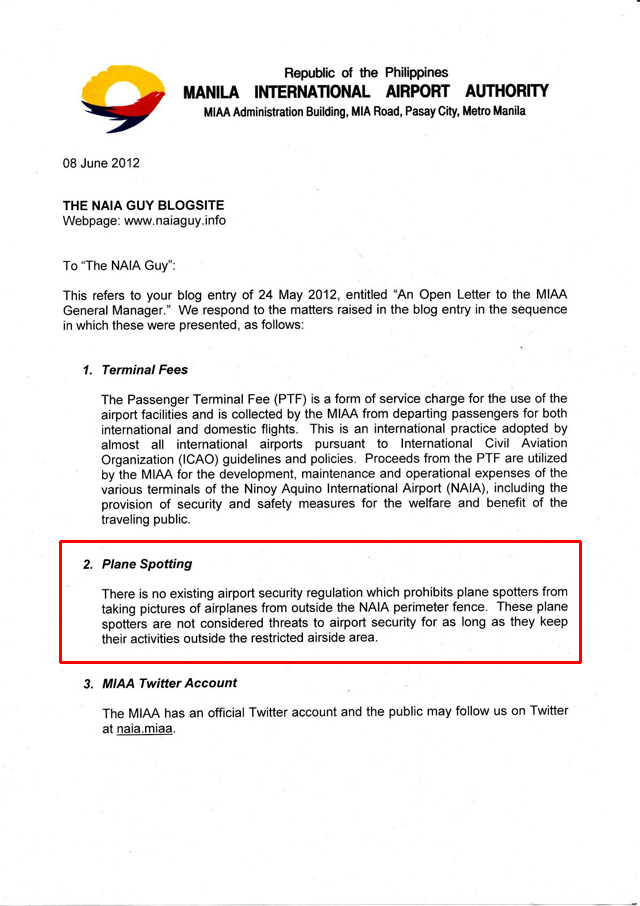
This memorandum released by his office comes after an open letter circulated online by Twitter user The NAIA Guy, who raised an issue about reported arrests of several plane spotters along Multinational Avenue in Parañaque City.
Plane spotting in the Philippines may not be a popular hobby yet, but considering the return of post-pandemic travel, it might just be soon.
Robert "Bob" Reyes is an AvGeek (aviation enthusiast), planespotter (an AvGeek who loves taking photos of planes), and technologist (who represents the global non-profit Mozilla in the Philippines). He spent more than two decades of his life as an aviation support professional for a conglomerate and CTO of an aviation college.