

A 'Planet Parade' Is Visible in the Night Sky This January
Here's how to spot those planets.
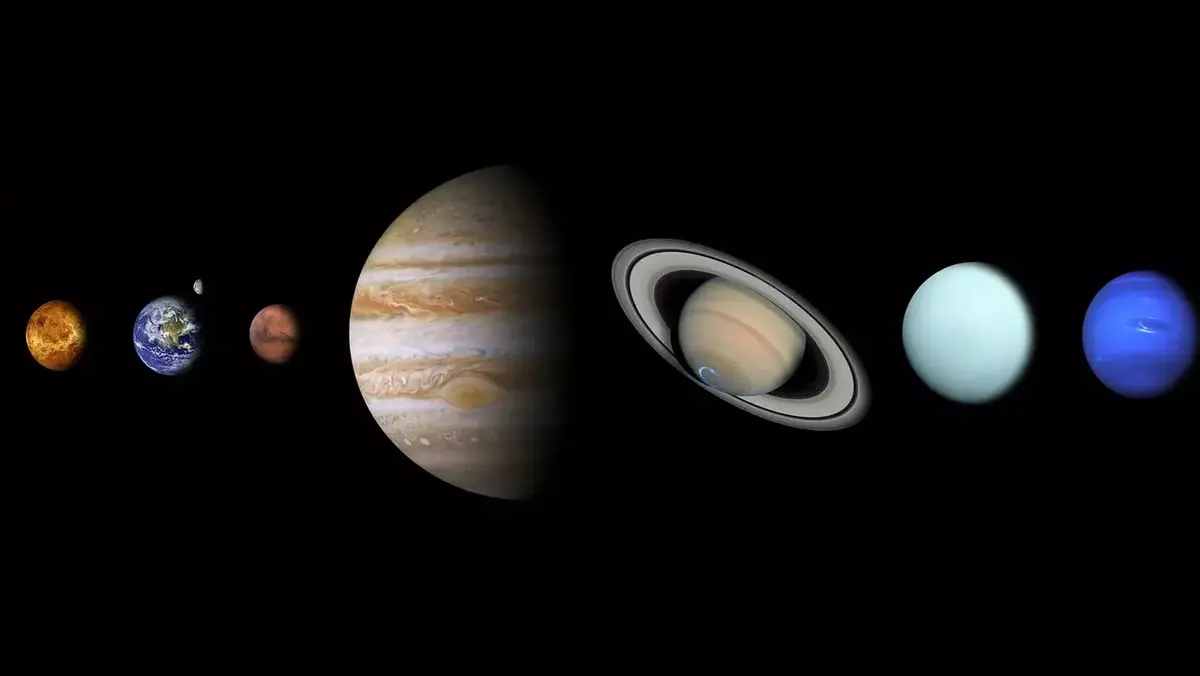
(SPOT.ph) It’s not every day we get to see stars in the metro, but to see planets? Six of them at that? That’s exactly what’s happening this January with a celestial phenomenon called planetary alignment or planetary parade.
Filipinos have the chance to witness six planets—Venus, Mars, Jupiter, Saturn, Uranus, and Neptune—aligning in the night sky. According to the Philippine Atmospheric, Geophysical and Astronomical Services Administration’s (PAGASA) latest astronomical diary, Venus, Mars, Jupiter, and Saturn will be “readily visible” to the naked eye, but a small telescope or pair of high-powered binoculars will be necessary to view Neptune and Uranus.

For those without equipment, you can head to the DOST PAGASA Planetarium in Quezon City, which reopened last September. The entrance fee is only P25 per head, but visits are strictly on a request or reservation basis. To book, send a request email to astronomy@pagasa.dost.gov.ph with your preferred date, time, and number of attendees, and then wait for the email confirmation before proceeding with the visit.
International reports, including one from the BBC, claim this planetary alignment will continue to be observable until mid or end of February, but we’ll have to wait for PAGASA’s next update to confirm if it's the same on our side of the world.
Also read: Inside the Newly Reopened DOST PAGASA Planetarium
What’s the science behind a planet parade?
“Planetary alignment known as syzygy, is a roughly straight-line configuration of three or more celestial bodies in a gravitational system and a Conjunction is an astronomical phenomenon that occurs whenever two planetary bodies are close to each other in the night sky, as seen from Earth,” PAGASA said.
It's not rare for planetary alignments to happen, but it’s rare to see as many as six planets at the same time. Although these planets look like they are in a straight line, PAGASA said this does not mean they are physically close to one another—it’s just how they appear to us when viewed from Earth. In reality, they are spread out across vast distances in the cosmos.
“This kind of configuration of celestial objects has been observed through time and it never or will ever cause natural disasters and imminent hazards,” PAGASA said.
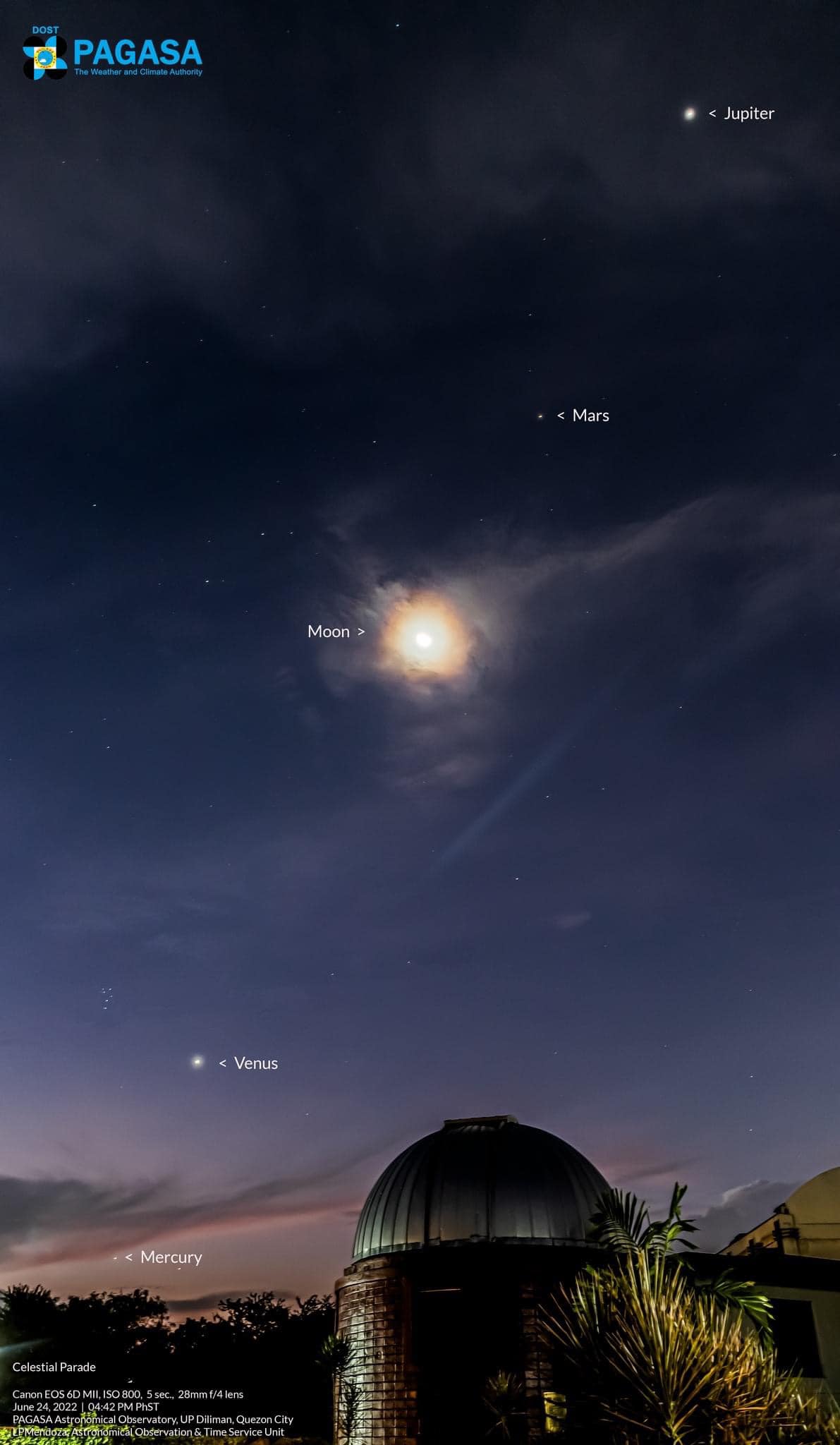
The last planetary alignment PAGASA noted was in April 2022, but that one featured only five planets—Mercury, Venus, Mars, Jupiter, and Saturn. Here’s a picture taken from the PAGASA Astronomical Observatory:
Take advantage of this planetary parade before it disappears! After all, it’s not often you get to see the universe showing off like this. For the best view, head to locations with minimal light pollution—and that might mean going outside of Metro Manila. Might we suggest somewhere in Antipolo?
Also read: 10 Campsites In and Around Antipolo for Stargazing