

This Provocative Exhibit in Iloilo Sparks a Dialogue on "Aesthetic Cuisine"
Kaon na Ta runs until August 20.
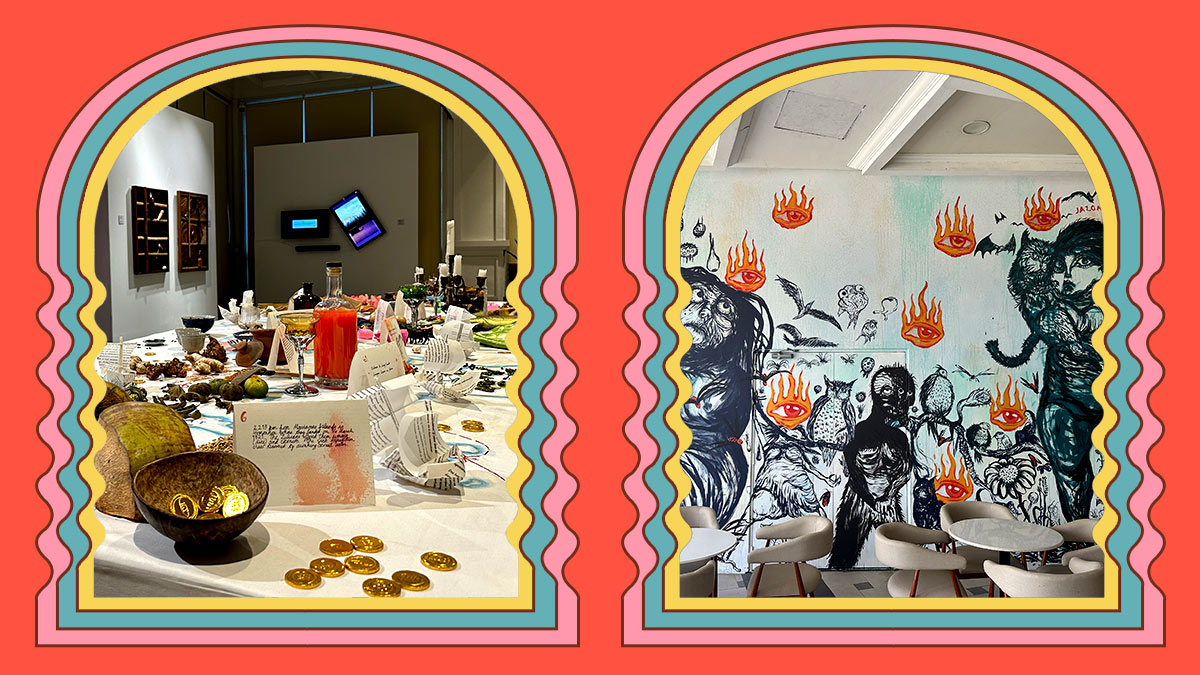
(SPOT.ph) "Kaon na ta" is a common greeting in Western Visayas. Though it translates to, "Let us eat," it says so much more than that. "Kaon na ta" is an invitation to partake and exchange. Within it is an opening, a bond, and a possibility for growth and engagement.
And Iloilo Museum of Contemporary Art (ILOMOCA)’s latest installation Kaon na Ta: A Melding of Visual Flavors puts the spotlight on this tradition. The exhibit, which runs until August 20, brings together 42 artists from Metropolitan Manila and Western Visayas "to focus on the idea of an 'aesthetic cuisine;' where food is used as a metaphor for cultural consumption, community and identity, and originality and invention. The mixture of different tastes fuse as one, to produce something fresh in the hopes of generating a dialogue on creativity." It is curated by Marika Constantino, Rock Drilon, and Manuel Ocampo.
Also read:
10 Exciting Things to Do in Iloilo
The SPOT.ph Guide to Iloilo City
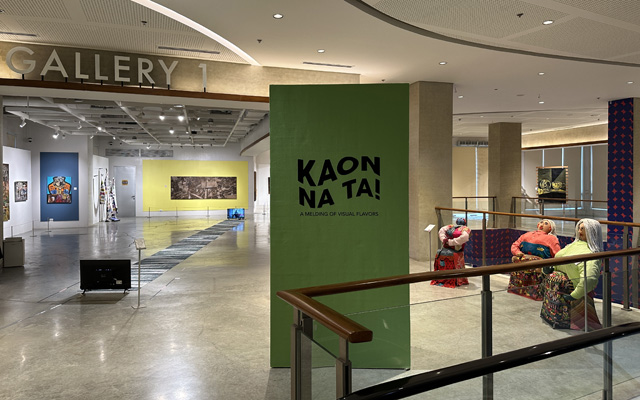
Ideas of Exchange at ILOMOCA
The exhibition is housed in different locations in Iloilo, including the Iloilo Museum of Contemporary Art (ILOMOCA) and Brandy Museum at the Casa Emperador Building; Richmonde Hotel; and murals at Festive Walk Parade.
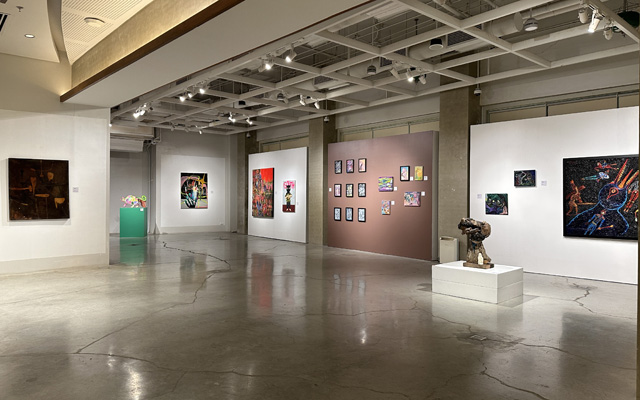
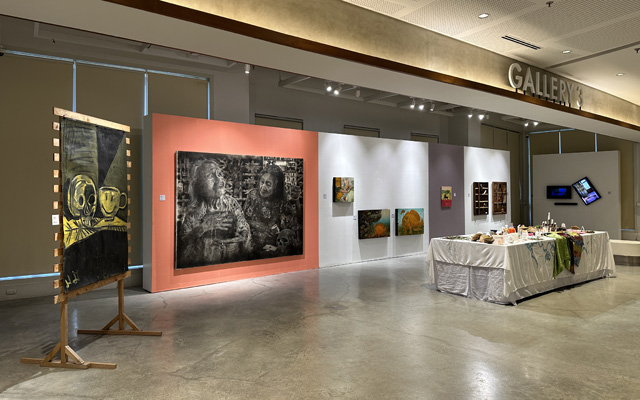
ILOMOCA is the first museum in Western Visayas dedicated to modern and contemporary art opened in 2018. Since then, it became a venue for exchange and engagement, not just for Western Visayas artists, but for Filipinos and the global art world. Kaon na Ta is an expansive exhibition, anchored on works contemplating the idea of exchange and challenging expected forms found inside the regional museum.
Religiosity and Traditions
One of the key pieces in the exhibition is Manny Montelibano’s "Mater Dolorosa" (2023) which belongs to his temperatura series, installed in the museum lobby. Montelibano, a contemporary artist from Bacolod, explored the people’s cultural relationship with the figure of Mater Dolorosa, the sorrowful mother. His temperatura series use thermal cameras, capturing the body heat of the people captured in the video.
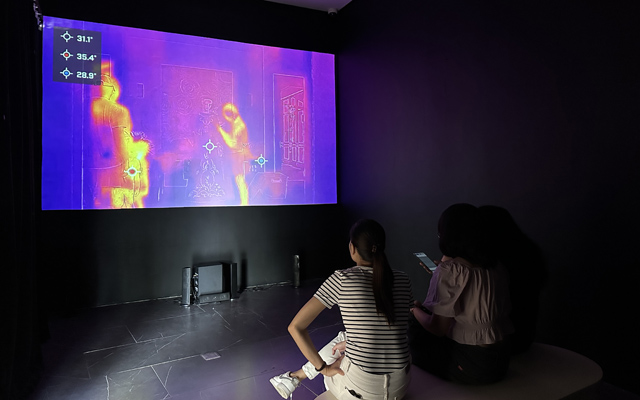
For "Mater Dolorosa," he captured the believers and followers of Mater Dolorosa as they bathe, dress, and prepare her for a religious ceremony. The provocation in the video is the absence of heat and body temperature in the sculpture, as the movement and act of the believers captured on the camera, in contrast, demonstrate heat and life. The absence and presence of heat–and in turn, life, gives a reflective component to the video piece.
Together with the visual representation is a sound recording of The Sorrowful Mysteries from the Holy Rosary, recited in Hiligaynon. The installation invites critique and contemplation of the religious practice as it relates to Filipino culture, but responses vary, with the audience making the sign of the cross and praying–almost an automatic response to a long-standing social performance.
Technological Interventions
In contrast with traditions are QR codes, which are quickly becoming common in a digitalized environment. Museums and galleries often use QR codes to lead the audience toward additional information on the displayed artworks. Kaon na Ta utilized the QR code with Idan Cruz’s "Sa Pagitan at Paglimot at Paggunita" (2021), a recording of his five-minute and 20-second poetry performance.

Cruz does not claim to be a poet or a writer, instead, he presents his reflections and ruminations during the long lockdown. His fervent and frustrated emotions as he spent the lockdown in Cebu, away from his son, flow through the recording. The ubiquitous nature of QR codes in a digitalized environment risks the audience ignoring the work. Nonetheless, the form lends itself well to taking a few minutes quietly listening on the phone, perhaps with a headset, feeling and remembering the isolation and longing during the lockdown.
Consuming Colonialism
A key piece in the exhibition is Lena Cobangbang’s visually inviting work "Pigafetta Picnic" (2023). The mixed media installation included various objects which alluded to the colonial past, particularly of the Visayas islands.
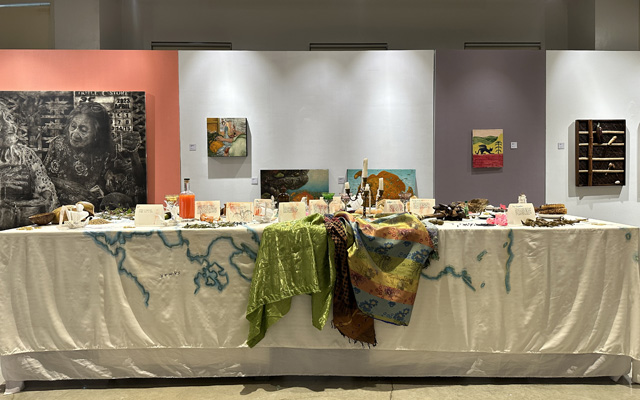
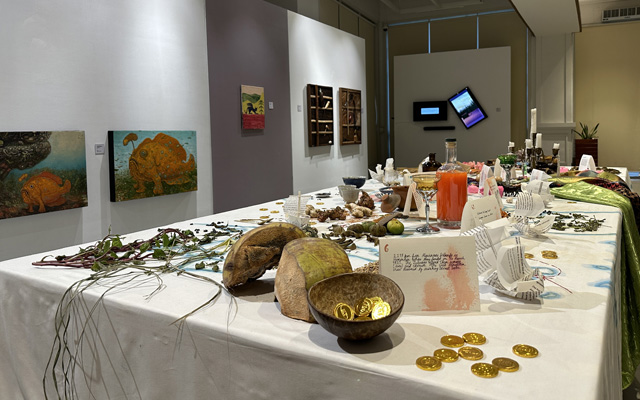
Antonio Pigafetta was a Venetian scholar who accompanied Ferdinand Magellan’s expedition. Pigafetta’s manuscript and illustrations are early records of Philippine culture and languages at the time of contact with colonizers.
Cobangbang’s work resonated powerfully, through a table covered with a white tablecloth, a roughly drawn and embroidered map, handwritten notes, and various objects representing the interests of colonialism—gold chocolate coins, beads, jewelry, rich cloths, fruits, vegetables, rice, spices, and toy ships. The vibrant installation is eye-catching, but beyond that invites a rethinking of the colonial experience on the table.
Intersections of Culture
Near Cobangbang’s work is Marvin Dalisay’s large lampara (lamp) soot wall-bound work "Basi Palang" (2023). "Basi palang" is a Hiligaynon phrase that roughly translates to "baka sakali" or taking a chance.
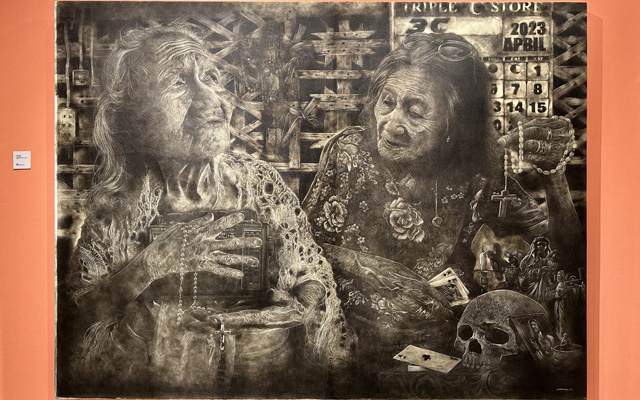
Religious practices continued long after formal colonization and are intimately tied to local culture. The two elderly women portrayed hold objects reminiscent of religion such as rosaries and a bible. Near them are statuettes or santo, a Christ image, candles, and a skull. Behind them is a calendar, a rough image of a crucifix, and sawali walls of a bahay kubo. The elderly woman on the right wears a pair of glasses on her hair, a number of rings, and playing cards.
The combination of images looks into things we believe in, with a resonance toward chance and unpredictability. The results of a gamble, the accuracy of religious teaching, and life after death are things that cannot be predicted and are ultimately uncertain.
Collaborations in Practice
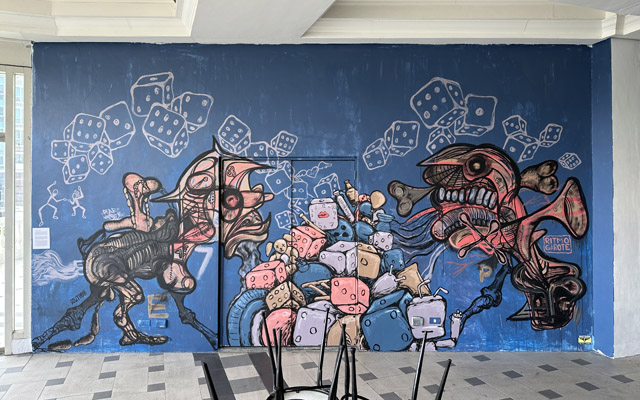
Though the ILOMOCA exhibition provides a collaborative framework in the various pieces in the exhibition, the concept of Kaon na Ta was best expressed in the collaborative and mostly spontaneously expressed murals at the Festive Walk Parade. The idea was for two artists—from Manila and Western Visayas to immerse in each other’s style and converse with the community around them.
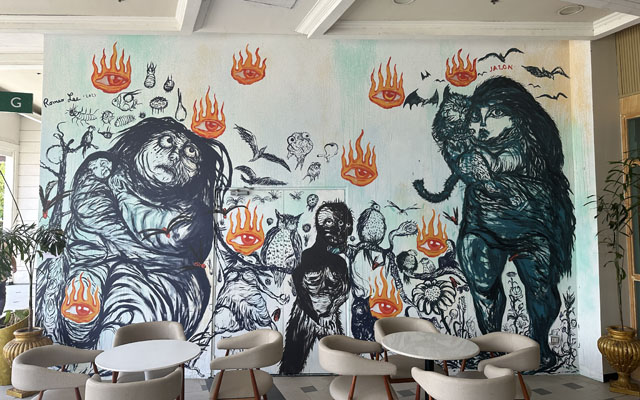
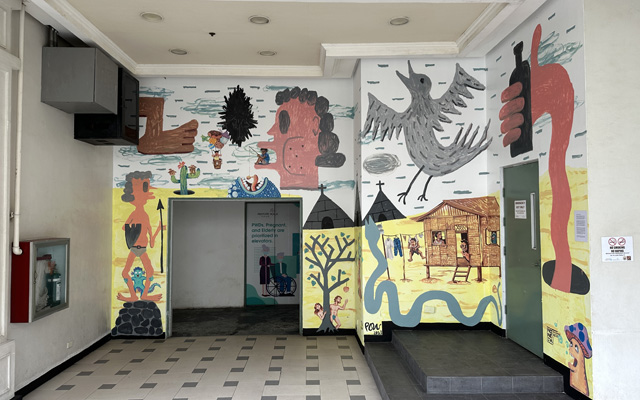
Romeo Lee and Jason Rufino’s mystical imagery disrupt the polished and commercial space of the business district. The fiery eyes and surreal creatures challenge the cushioned seats and the image of comfort in an otherwise plain space. Pow Martinez and Janine Tolores, in contrast with Lee and Rufino’s dark palette, leaned toward child-like and playful images. The lighthearted presentation subverts the uncomfortable questions of religious and social structures of Philippine society.
Challenging Commercial Spaces
Arvin Nogueras and Da Da continue the playful approach with graffiti-style imagery and playful dice, again interrupting the formality and coldness of a business district.
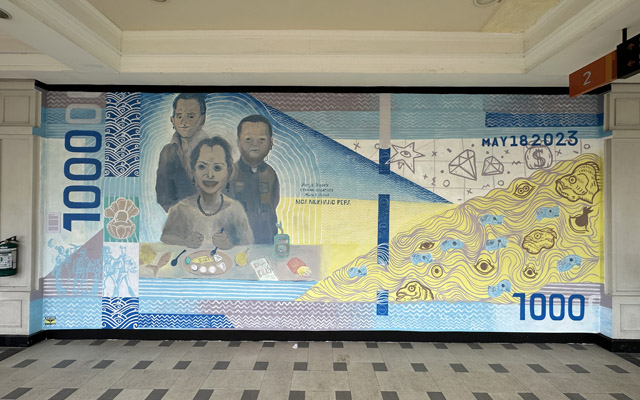
Yet, the most provocative mural, ironically placed within the commercial space is Marija Vicente and Eyecan Creative’s "Dinaan sa Pera." The piece is the only titled mural for the group, playing on the design of the P1,000 bill. Quite provocative, particularly with the text "Mga Mukhang Pera," it is a necessary activation of the business space, with a sharp critique of the late capitalist condition of the country.
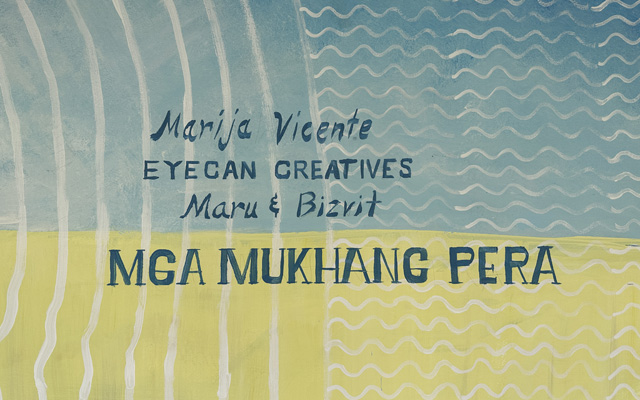
Murals, particularly in a graffiti style, were always meant to disrupt spaces. ILOMOCA’s inclusion of such a challenging style amidst a business environment is a refreshing approach for an institution meant to stimulate modern and contemporary art, particularly in the regions.
Confrontations of Space
Wrapping up the exhibition are Poklong Anading and MM Yu’s video projection across the Casa Emperador Building during the exhibition launch. The ornate building which houses ILOMOCA and the Brandy Museum became another site of disruption. Anading’s "counteracts" and Yu’s "untitled landscape" flesh out the imperfections and roughness of everyday life. Their interference with a wealthy and moneyed space forces a confrontation with social, cultural, and political struggles often felt by the majority of Filipinos. "Kaon na Ta," and at the core—ILOMOCA, though housed in a business and entrepreneurial environment, manages to push the boundaries and challenge the norms they are situated in.
Kaon na Ta runs until August 20 at the Iloilo Museum of Contemporary Art, Casa de Emperador, Iloilo Business Park, Mandurriao, Iloilo City. Featured artists include Bryan Liao, Janine Tolores, Eyecan Creatives, Jason Rufino, PJ Cabanalan, Marvin Dalisay, Jeanroll Ejar, Noel Elicana, Orland Espinosa, Tyron Dave Espinosa, Kinno Florentino, Kat Malazarte, Barry Matthew Namo, Roselle Perez, Da Da, Nunelucio Alvarado, Kristoffer Ardeña, Charlie Co, Manny Montelibano, Neil Pasilan from Western Visayas and Poklong Anading, Argie Bandoy, Valeria Cavestany, Lena Cobangbang, Mike Crisostomo, Jigger Cruz, Idan Cruz, Maria Cruz, Patrick Cruz, Tracie Anglo Dizon, Arvin Flores, Robert Langenegger, Romeo Lee, Pow Martinez, Arvin Nogueras, Jayson Oliveria, Carlo Ricafort, Geremy Samala, Gerardo Tan, Marija Vicente, MM Yu, Jeona Zoleta from Metro Manila.