

These Defaced Magazine Covers Explain the Conflicts in Gaza and West PH Sea—Sort Of
The bursts of tinsel look like Christmas, but they're farthest from that.
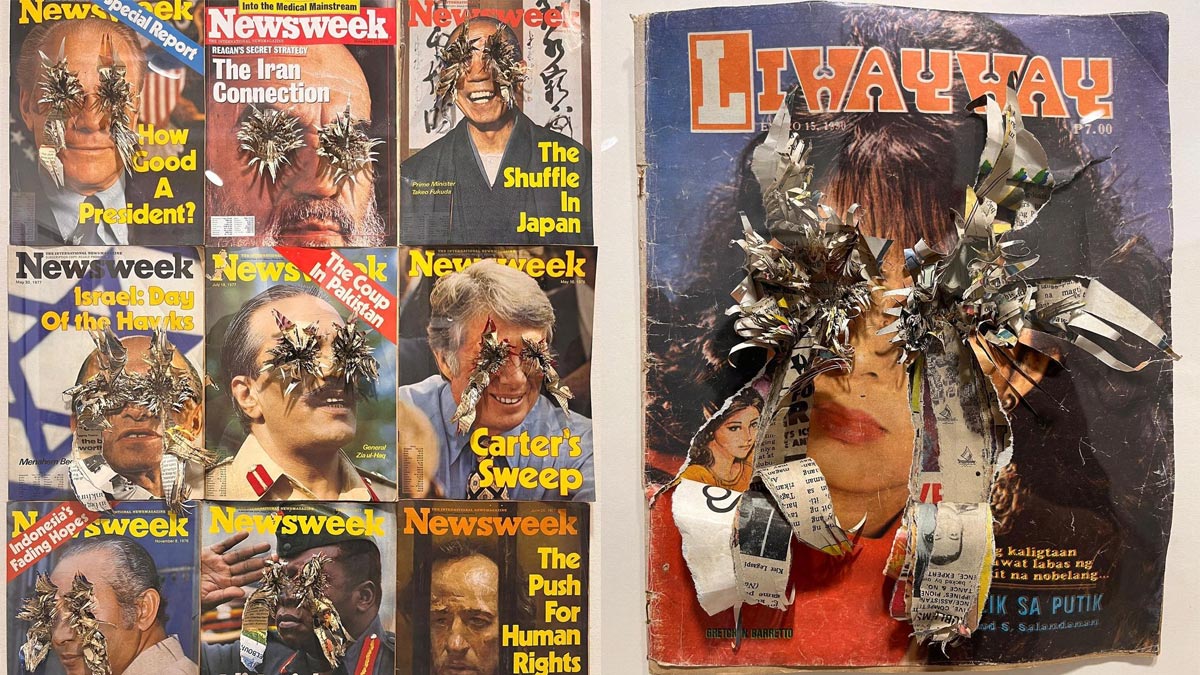
(SPOT.ph) There’s something very timely about the new exhibit at West Gallery by the Colombian artist and frequent Philippine visitor Pablo Bermudez. And not only because its two biggest works are mixed media-paper collages of covers of TIME and Newsweek.
In one work mostly zeroed in on Middle East conflicts, the oldest TIME used is a September 1972 edition about the Munich massacre, in which Palestinian militants raided the Munich Olympic Village, killed two members of the Israeli team, and hostaged several others, who were likewise later all killed during the disastrous rescue by West Germany. And then there’s a January 1980 edition with Ayatollah Khomeini, who just led the successful Iranian revolution, as TIME’S 1979 Man of the Year. Other editions have U.S. President Jimmy Carter and Shah of Iran Reza Pahlavi, who, of course, were the losers in the Iranian milestone.
The covers are timely if instructional especially for those who can hardly comprehend, much less care about, the conflict in Gaza and the Middle East.
Gaza is ruled by Hamas, an Islamist group committed to the destruction of Israel; it is designated as a terrorist group by the U.S., U.K., Europe, and many other countries. Like Palestinian militants raiding the Munich Olympic Village, Hamas militants attacked Israeli kibbutzes and other areas last October 7, killing 1,400 and holding 240 hostages. Israeli defense forces have since retaliated by sweeping through Gaza to destroy Hamas, resulting in thousands killed, wounded, and displaced.
According to security experts, Hamas could not have made the October 7 attack without Iran’s support. And Iran could not have provided Hamas with sophisticated war equipment to launch its attacks without U.S. President Joseph Biden’s clumsy yet disastrous decision two years ago to ease sanctions on Iran—which has since enabled it to profit from its oil exports and promptly send billions to support Hamas and other militant groups so that they could fight proxy wars against Israel, the U.S., and Iran’s Sunni Muslim rivals.
Biden is perceived as a bumbling Democratic president, much like Carter, who lost his re-election bid in 1979 to Republican Ronald Reagan, largely for reportedly mishandling the Iranian crisis. (Of course, Carter, who has somehow redeemed his record post-presidency by becoming a Nobel Peace laureate and, at 99, the world’s oldest statesman, was most recently in the news for leading the funeral service for his wife, former first lady Rosalyn Carter, who passed away on November 19.)
History’s Winners and Losers
The TIME covers are included in the biggest work in Bermudez’s exhibit (49.6 x 39 inches), "Grain as a Weapon," which is the title of the cover story of the magazine’s January 21, 1980 issue. The viewer is initially confused since most of the covers are of key protagonists in wars and conflicts until s/he reads the descriptive title of the 1980 cover story, "Who wins, who loses."
Ergo, the TIME covers show history’s winners and losers.
The next biggest work (at 43.3 x 35.8 inches) is "The Push for Human Rights," which shows Newsweek magazine covers of authoritarian rulers such as General Zia ul-Haq of Pakistan, Idi Amin of Uganda, and President Suharto of Indonesia, and human rights figures like the Nobel literature laureate Alexander Solzhenitsyn.
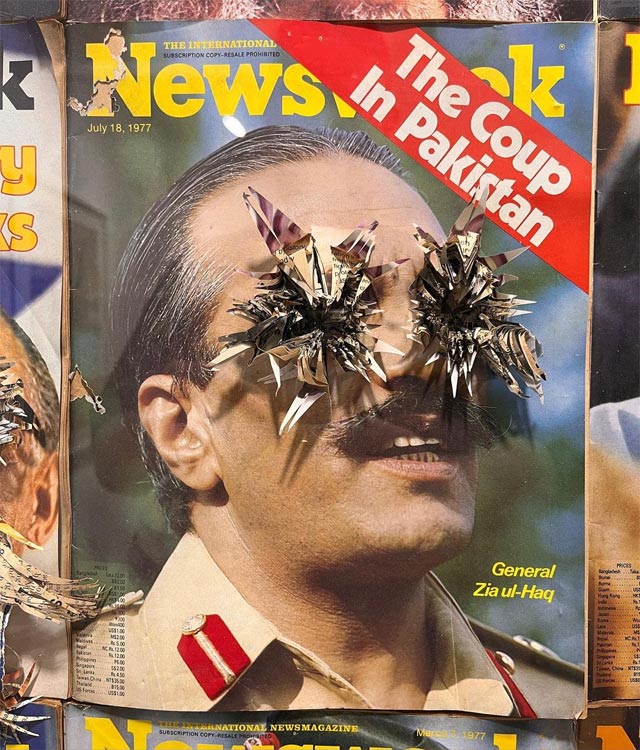
Newsweek covers in the 1970s and early 1980s are used in the smaller work, "The Scramble for Power" (27.5 x 24.4 inches); they show the faces of leading players in power transitions in East Asia, especially of Hua Guofeng, the Chinese leader who succeeded Mao Tse-tung and Chou En-lai, but who was, around the time of the Newsweek editions, being gradually eased out of power by Deng Xiao-ping. He once held all of the reins of power—the party, military, and government—much like today’s Xi Jinping, the bully of the West Philippine Sea and much of Asia.
In all the faces of these power players, their eyes are obscured by tendrils of paper collages that resulted from Bermudez’s experimentation with distorting and cutting magazine pages using a scalpel blade.
In past exhibits, Bermudez used the scalpel technique, if we could call it that, on images from fashion and advertisement magazines showcasing glossy models’ faces. The scalpel technique stresses the fleeting nature of beauty captured in mass-culture images.
In contrast, in Nothing New Under the Sun, Bermudez uses the covers of past editions of TIME and Newsweek showing key geopolitical figures of their time to show the ebb and flow of history, the rise and decline of potentates and pretenders, as well as prove what the French writer Jean-Baptiste Alphonse Karr wrote in 1849, “plus ça change, plus c'est la même chose” – the more things change, the more they stay the same.
Artist-Traveler
Bermudez is an artist-traveler. Though originally from Pereira, Colombia, he has lived in Barcelona, Spain, and Como, Italy, and now makes frequent trips to the Philippines.
Bermudez emphasizes the vital role of traveling in gaining a deeper understanding of history. His many trips to the country have enhanced his understanding of the complexities of Spanish colonialism and former European colonies in Southeast Asia. His Philippine exposure has contributed to his artistic development.
His mixed-media works focus on how media images represent the world and history, often with lenses that distort and deceive.
The deliberate bursting of the magazines aims to challenge the conventional method of perceiving printed pages. Through this act of "opening them up," viewers are offered a collective viewpoint, altering the original message and fostering new interpretations via deconstruction and reconstruction.
Through his innovative use of three-dimensional collages, Bermudez disrupts our inclination to conform to the advertising images we encounter daily, or in this case, to be cowed and swayed by the depictions of power and authority as shown by pompous covers of leading international news mags.
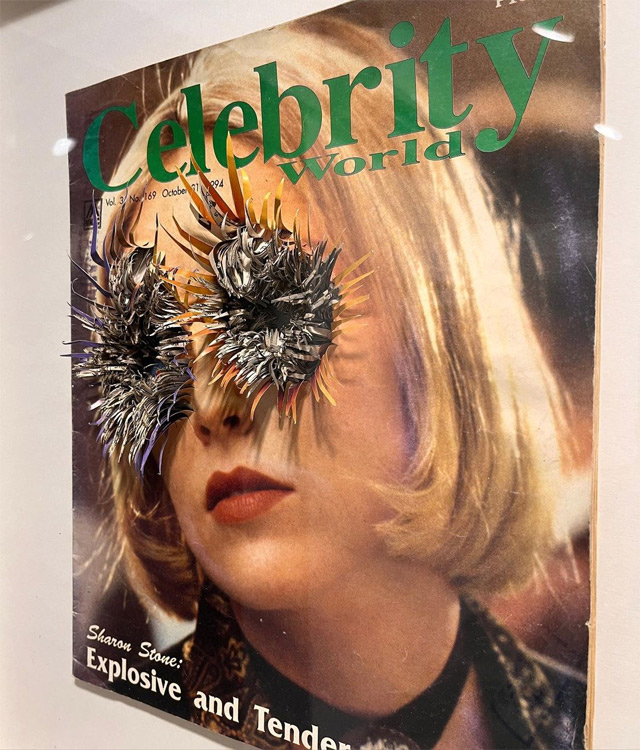
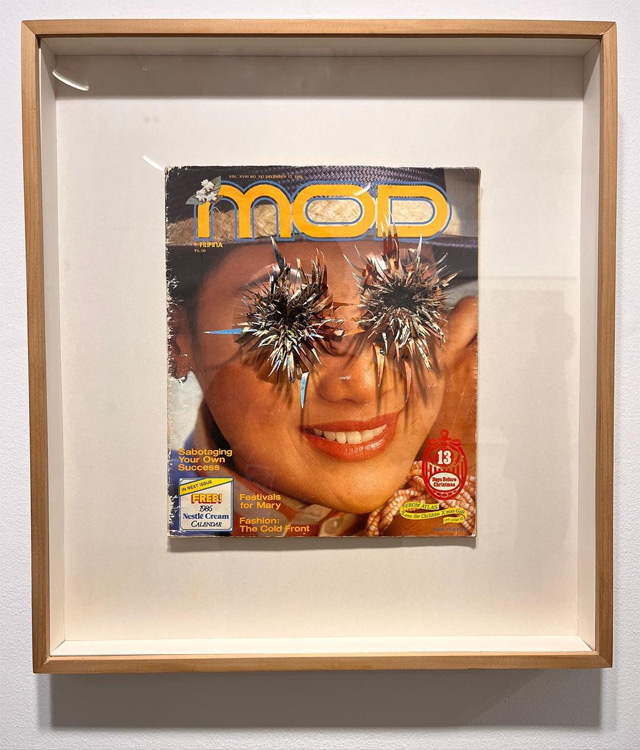
By subverting media images of capitalism and commerce and of power and authority, Bermudez prompts critical reflection on our penchant for such, enabling us to uncover the concealed messages in advertising and propaganda.
Through his meticulous manipulation and carving of images using a scalpel, Bermudez unveils a realm where the truths we peremptorily, if not unconsciously, accept can be questioned.
He disrupts our understanding of reality by employing three-dimensional collages, challenging our inclination for conformity through the visual media we encounter routinely.
Iconoclasm
In a globally interconnected world influenced by passive exposure to propaganda, Bermudez's manipulation of advertising and news-media visuals prompts introspection about our vulnerability to mass-media conditioning. This challenges us to decipher the concealed messages—how do we uncover the truth hidden under layers of mind-control and propaganda?
Through his manipulation of images, meticulously carving with a scalpel, Bermudez reveals an illuminated realm—a space encouraging us to question the realities we embrace as truths.
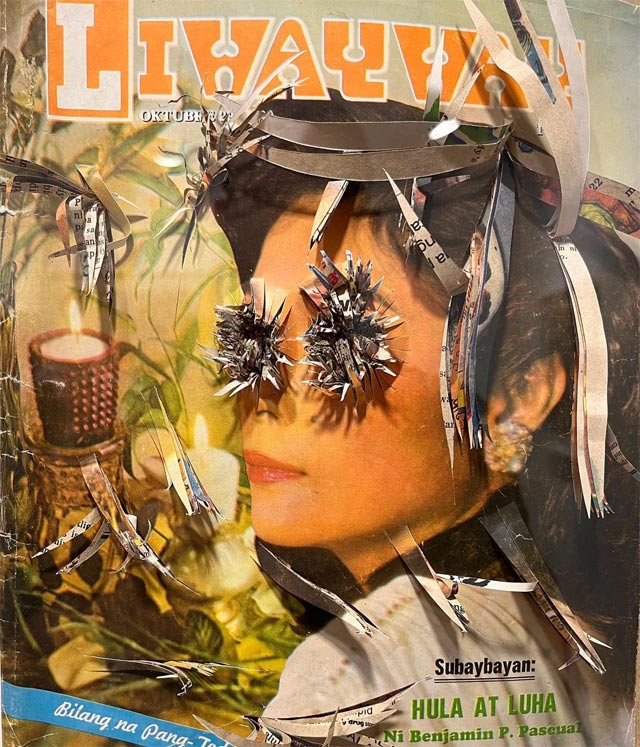
In a way, his art embodies the iconoclastic tradition of art—a practice that disrupts and manipulates mass-media images without entirely obliterating them. He exposes the idolatry fostered by the mass media without completely toppling down the idols.
Photos by Instagram/artspotting_mnl
Nothing New Under the Sun by Pablo Bermudez runs until December 29 at West Gallery, 48 West Avenue, Quezon City.
Also read: 10 Art Exhibits to See in Metro Manila This December