

EXHIBIT REVIEW: Rethinking Migrant Labor through Karakoa Warriors
It runs until January 31 at Galleria Duemila.
(SPOT.ph) What does it mean to be a warrior in the contemporary present? What do we face, and how do we face it? Such thoughts entered my mind as I looked at Mervy Pueblo’s Karakoa Journeys: From Past to Present, which is on display as a double-solo with Noell EL Farol’s Cosmographia at Galleria Duemila. The gallery space in Pasay City is tucked away in the backroads, within walking distance from the EDSA stop of LRT1, which happens to be the Taft stop of MRT. The garden and gallery provide respite from the concrete of the city. To date, it is considered the longest-running commercial gallery in the country.
Re-exhibiting Karakoa Journeys
Pueblo’s Karakoa Journeys is a play on multiple layers. The current installation in Galleria Duemila is a re-exhibition of her Nakanojo Biennale 2023 exhibition, where she also stayed as an artist-resident. Through the residency and the Philippine embassy, she sought to contact and converse with OFWs and Filipinos currently in residence in Nakanojo.
In our conversation, I asked how she veers away from exploitative lenses, often a possible burden in engaging Filipino workers abroad. Pueblo responded that she remained open in her intentions and only revealed what the participants wanted to tell. Though ethics is a delicate matter when using personal narratives in research and art, honest dialogue and sincere connections prove necessary in developing the art project.
Use of Discarded Materials
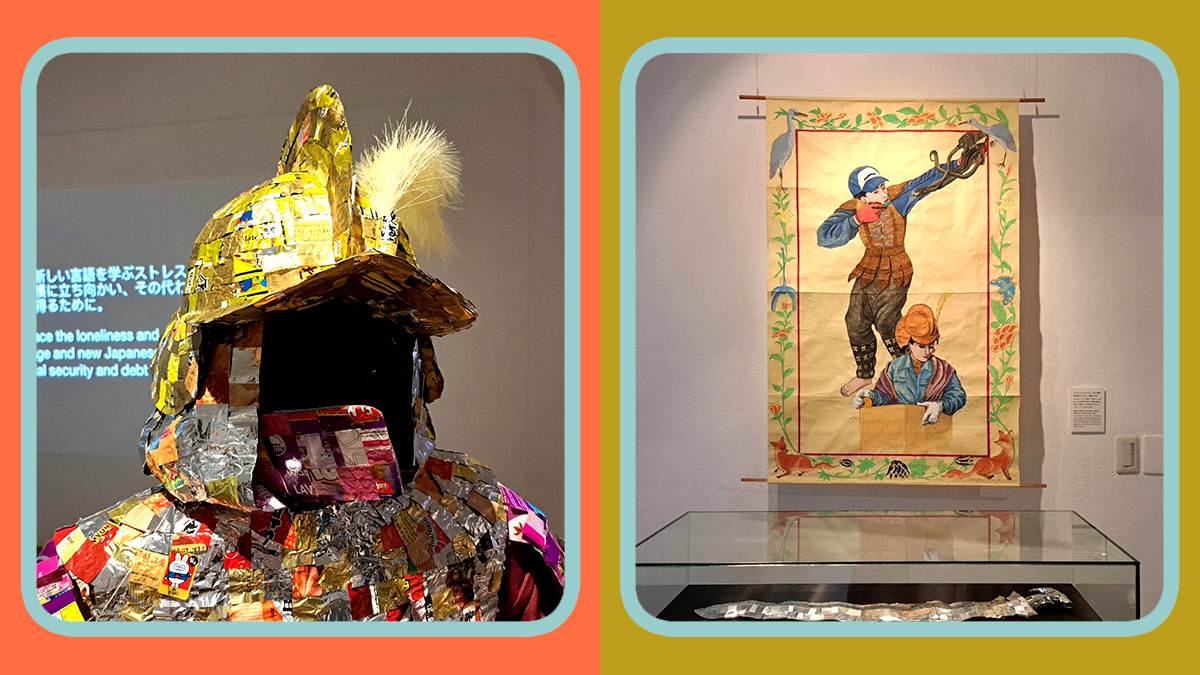
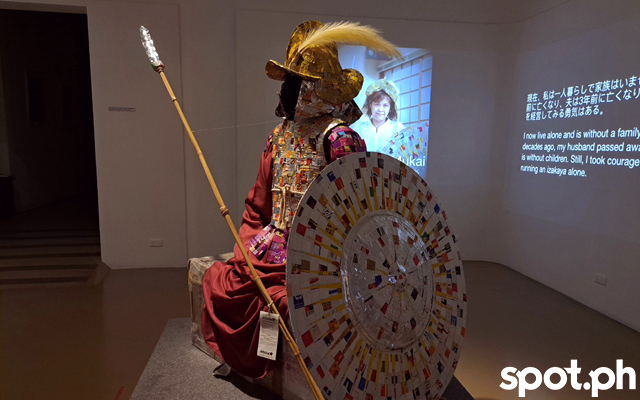
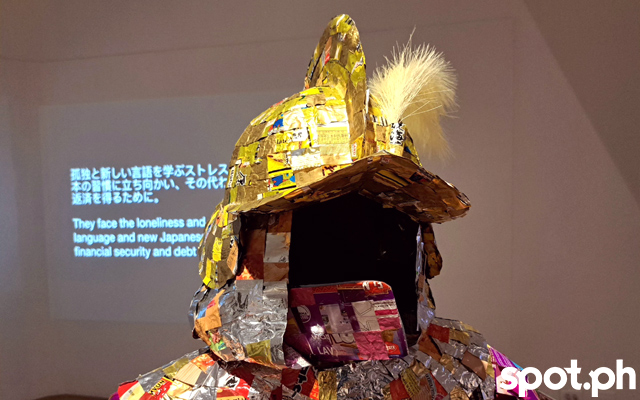
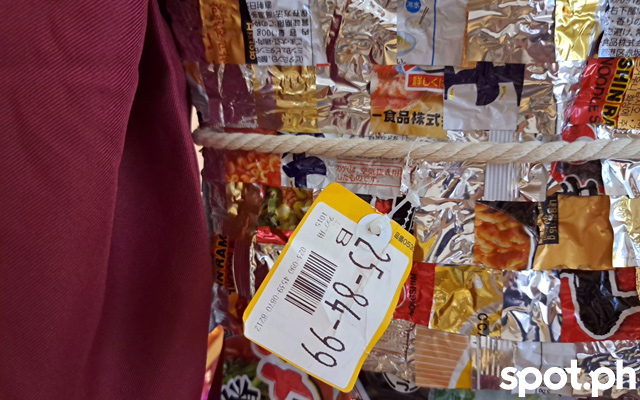
Central to the exhibition is the armor made from packaging materials and other travel paraphernalia found in Pueblo’s journey in Japan. Karakoa are large warships in the pre-colonial and colonial eras. It was used for trade and cargo, but it was also used to fight and get resources from nearby territories. Seafaring was a common practice in the pre-colonial Philippines. Pueblo reimagines the present-day OFWs as Karakoa warriors and pre-colonial and colonial-era Filipinos searching for better resources outside their homes. To engage with the site of her residency and the subject of her research, she used discarded objects, packaging materials, and objects found on the streets of Nakanojo—creating ties with the found and lived environment.
OFW as Karakoa Warrior
OFW life, as in the life of a Karakoa warrior, is not easy. They have to leave their homes, search for resources, and live away from their loved ones—taking care of families who are not their own. Popular culture often frames OFWs through the lenses of awa or pity, rather than the strength and dignity in which they uphold for themselves.
The armor, installed in the gallery, is layered with a two-channel video of the OFWs wearing them as they narrate their personal stories of the experiences. Similar to the Karakoa warriors of the past, present-day OFWs are encouraged by our society and government to look for labor and income outside the country. Much of the earnings and the money that circulates in the economy are from the money sent back home by the OFWs.
Renewed Boxer Codex
Another layer of the exhibition is a reinterpretation of an illustrated page of the Boxer Codex. The Boxer Codex is a 16th-century Spanish manuscript, translated into Spanish from Portuguese, with illustrations including observations of pre-colonial and local inhabitants of pre-colonial Philippines.
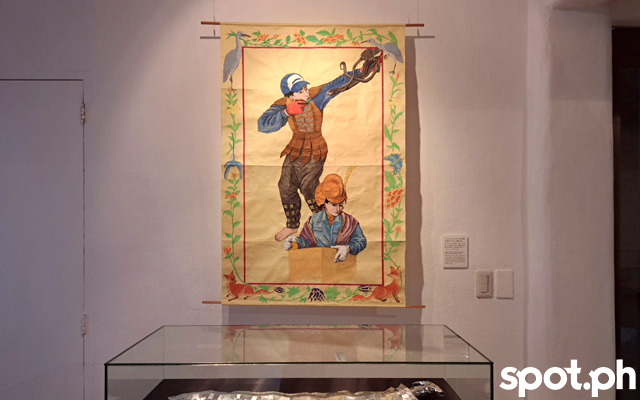
Pueblo’s "Neue Codex: Filipino Warriors in Nakanojo, Japan" shows two blue-collar workers–a man fixing cables, appearing in the form of holding a bow and arrow, and a woman packing a box, quite similar to a balikbayan box. Their appearance and clothing appear to be a mix of Filipino, Japanese, and even remnants of Spanish colonizers. It was painted on the familiar Manila paper, with folds, and hung like East Asian paintings or calligraphy. The play on meaning gives a thoughtful reflection on the forms presented—pre-colonial objects, current conditions, and colonial subjugations.
Traditional Weapons and New Materials
Interesting objects in the exhibition are the recreation of traditional weapons with mixed media, ultimately covered with packaging materials found in Nakanojo. Pueblo named them "Resilience," "Courage," "Strength," and "Oblation."
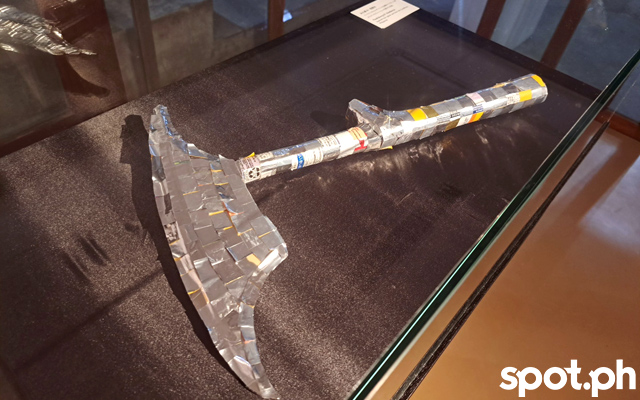
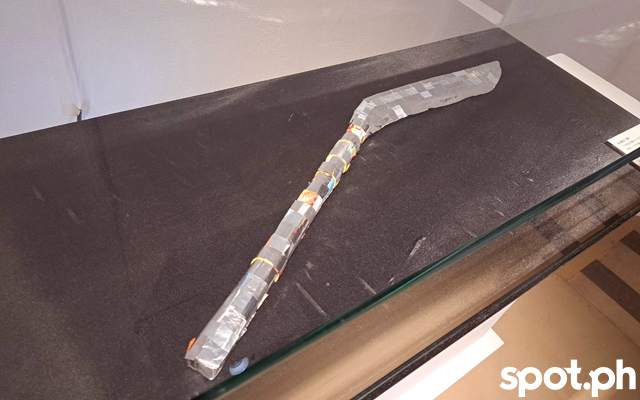
Such values are looked into, not just for OFWs but also for Filipinos. Though conceptually admired, there are tensions in such values, including resilience—as Filipinos were often taught and demanded to be resilient to their environment and situation challenges. But resilience often comes with a price–of accepting the truly terrible conditions Filipinos are forced into. For Filipino OFWs, resilience could mean their survival, accepting the unjust conditions they had to accept, and leaving the country for better access to resources.
Rethinking the Cosmos
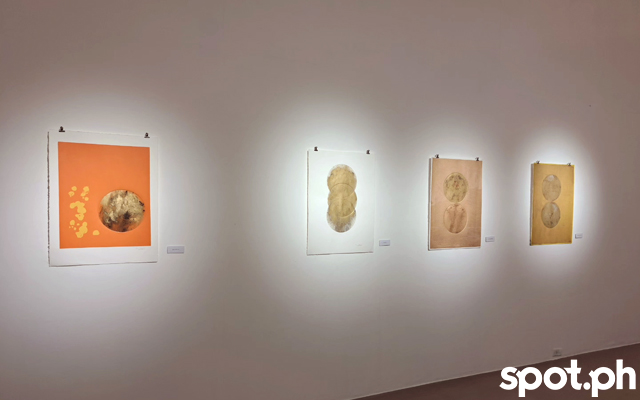
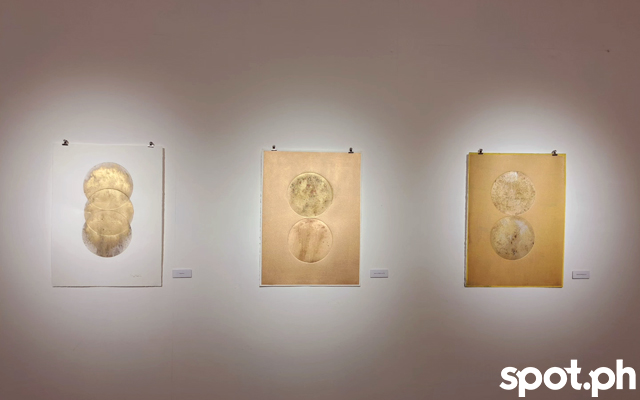
Parallel to Pueblo’s solo exhibition is Noell EL Farol’s Cosmographia, an extension of his participation in the Nakanojo Biennale alongside Pueblo. In Nakanojo, Farol examined the commercialized aspects of objects such as anting-anting. For the Galleria Duemila exhibition, he featured his experimentation on prints. His title, Cosmographia, was taken from Sebastian Munster’s book of the same title from the 16th century, featuring notable woodcuts of maps. It had 24 editions in 100 years and was considered one of the most popular books.
Experimenting with Materials
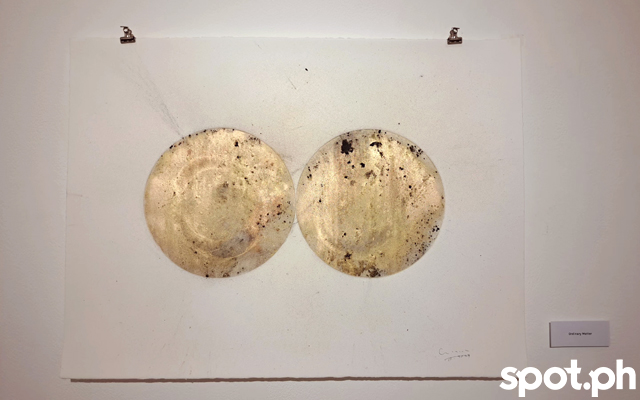
Farol takes Munster’s interpretation of geography and explores the trajectory of the cosmos with his experimentation of materials. Hannah Jo Uy quoted Farol in the catalog, "Taking dust as a medium in art constitutes a problem and a concern. And the medium itself is a question or problem to be explored. I would like to strip away the essentials of painting and printmaking and relate to some timeless understanding that the nature of the media can offer." Such a philosophical take on material and concepts was evident in the beautiful print pieces for Cosmographia.
Materials as Starting Point
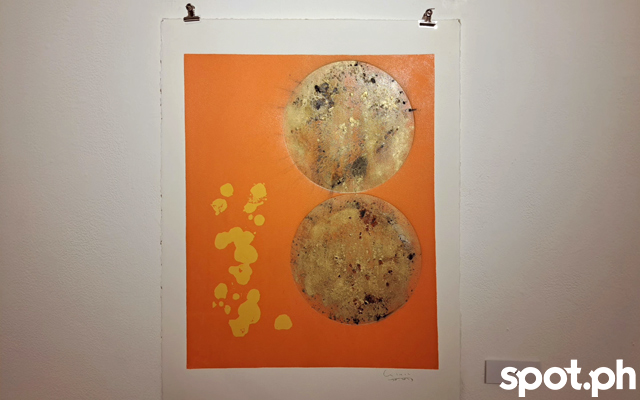
Both Pueblo and Farol anchor their artistic practice in materials. Pueblo, during the artist talk, shared her childhood growing up in Tondo and valuing a box of crayons. This translated to her conscious choice of materials, even later in her practice. For Karakoa Journeys, this translated to using found objects, remnants of travel paraphernalia, and discarded packaging materials as key materials in producing the armor. For Farol, it was the unused and leftover powder pigments that invited a renewed experimentation, resulting in the objects in Cosmographia.
Passing on the Knowledge
The two artists are also professors at the Philippine Women’s University’s School of Fine Arts and Design. When asked about their practice as educators, they shared how they prompt students to experiment. Pueblo does not dictate what materials her students should use. Rather, she invites them to experiment and mentors them depending on the interests and subjectivities of her students. Farol, on the other hand, takes a more technical side, teaching students the dynamics of print and how they can work with the materials and experiment later on.
Sincerity in Practice
Going back to Pueblo and Farol’s participation in Nakanojo Biennale, finding ties that bind to a foreign land, as well as to migrant laborers and their roles as migrant artists, is not a straightforward path. There are plenty of nuances that can be explored, but it may be fraught with risks of misrepresentation and possibilities of exploitation. For Pueblo, in particular, the sincerity of her engagement resonated with the trust given and expressed by wearing the armor and sharing complicated stories of migrant laborers, particularly in Nakanojo.
Rethinking the Lived Experience
Re-exhibiting the Karakoa Journeys at Galleria Duemila removed it from its original context, taking it away from the OFWs as Karakoa warriors. But at the same time, it brings it home, hoping to translate and communicate the stories to the local audience, most of whom have family or friends who are or have experienced migrant work. It opens the possibilities in contemplating the historicity of migrant work–of leaving home to find resources and better situations. The exhibition goes beyond the popular cultural representation of awa and api, looking more into the complex and complicated feelings, contexts, and lived experiences.
Karakoa Journey: From Past to Present runs until January 31 at Galleria Duemila, 210 Loring Street, Pasay.
Also read:
Art Evokes Excesses in Philippine Culture and Politics
Beauty and Ugly: Complexities in Philippine Art