

This PGH Doctor’s Funny Memories as Intern Just Won Him a National Book Award
It all started with journaling on Friendster.
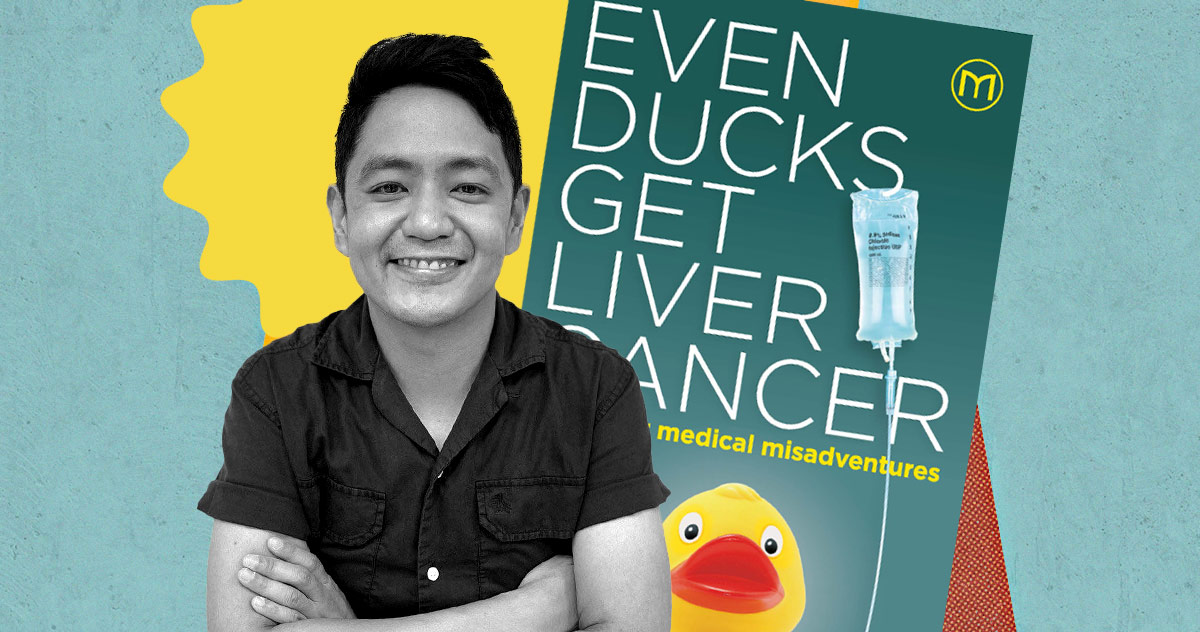
(SPOT.ph) Medical narratives, in whatever form, are almost always fascinating. You have stories of hope, where nothing short of a medical miracle happens at the most opportune time. You have tales of inspiration, where friends and family come together to support a loved one. You have a hero’s journey or someone saving the day, whether a medical professional or an unlikely character at the hospital. For Dr. Wilfredo Liangco, author of Even Ducks Get Liver Cancer and Other Medical Misadventures, medical narratives can also serve as love letters.
"I wanted to think of this project as a love letter to friends and family who were involved in my medical training, a love letter to my patients, and to the entire PGH internal medicine experience as well," he tells SPOT.ph.
Even Ducks Get Liver Cancer and Other Medical Misadventures, released by Milflores Publishing in January 2023, consists of 49 essays with a distinct comic tone. The "misadventures," in this case, follow his years of training as a medical intern and oncology fellow at the Philippine General Hospital (PGH).
From Friendster to a National Book Award-Winning Creative Nonfiction
Liangco completed his medical degree from the University of the Philippines - Manila in 2006, the same year he started journaling. He journaled on Friendster, then Blogspot.
"I didn’t plan on writing about my experiences in the hospital—the conceit was, there was more to me than being a medical trainee. I was wrong; that was all there was to me at that time. Luckily, life in the hospital was not always about great tragedies or the triumph of the human spirit, which I felt were difficult topics to write about."
Liangco went through the Internal Medicine Residency Program, then the Medical Oncology Fellowship at PGH. With patients coming in from all over the country, likely with some of the most complicated cases, a medical residency at a state-funded institution was no easy task. Being a full-time oncologist also gets one as busy as the profession sounds. Still, Liangco finds the time to write.
"Writing gives me time to reflect on the events of the day, on how I dealt with situations, on my own feelings. Days in the clinics can be crazy and busy that I hardly get the time to reflect on things as they happen. It also gives me a different perspective. As soon as I start writing about a harrowing event I end up realizing that it is not so harrowing at all. That it is, all things considered, funny, ridiculous, or even inconsequential."
At the height of the pandemic, more patients and doctors started writing essays about their own experiences inside the country’s medical institutions, their bouts with COVID-19 and its physical and emotional complications. It was a time of isolation and all that was left to do for most was put pen to paper and somehow make sense of the world. That was what Liangco did.
"I finally decided to come up with a creative non-fiction book, and these blog entries became the source document that enabled me to construct something honest and coherent," Liangco recalls about how his Friendster blog entries turned into a 49-essay collection. With the encouragement of mentors, including Dr. Marjorie M. Evasco, De La Salle University’s Professor Emeritus of Literature; Jessica Zafra, and other writer friends like Elvie Razon-Gonzalez and Ronald Baytan, the good doctor was able to complete the project. Even Ducks Get Liver Cancer later bagged the Pablo Tan Prize for Best Book of Non-Fiction Prose in English, which was announced by the National Book Development Board in early December.
Finding Humor in the Drama
"When I was writing the book I sometimes imagined that I was writing a full season of a sitcom—the stories would mostly be with a comedic undertone, but there would be a few stories with human drama here and there. It might sound like a stretch but I also imagined that I was putting together a pop or alternative album, something that the listener would hopefully enjoy without skipping a song," Liangco says about his creative process.
But he clarifies that he tried to avoid writing with the intention of being funny.
"I don’t want the humor to sound forced or contrived. I sometimes put in a few deliberate jokes here and there, and these required a lot more attention during the editing and re-writing process. Before turning it in I read the manuscript so many times just to see if I got the humor right or the jokes landed and were not inappropriate—took a lot of time but that was the part I enjoyed the most."
The title of the book comes from an inside joke shared among his colleagues: liver cancer and other liver diseases were so common in a small town in China that even ducks got them, at least according to a textbook. It's a grim disease, these oncologists know for sure, but the joke is something to think about when the cases of cancer around them just keep getting worse by the day.
"Primarily I want the readers to just enjoy reading it, for them to not get bored, for them to have fun from start to finish. It warms my heart when readers tell me that they learned something from it, or that they were able to identify with some of the stories. One of my patients said that when her mother developed leg swelling, and gurgling sounds started to come out of her throat she knew that death was imminent, because she had read it in one of the stories in the book."
While it does have information on medical situations, Even Ducks Get Liver Cancer isn’t big on medical jargon. On the rare occasion a big clinical word appears on the text, Liangco provides enough context so that a layperson would get the gist without having to look for footnotes and appendices.
Doctors Are Writers, Too
Why are there many doctors who are writers, too? "I think that just like everyone else, in whatever profession or stature in life, doctors have the need to express and share their own experiences, and be heard, whether this expression is in the form of music, poetry, or children’s literature," says Liangco. "It’s wonderful whenever we are able to create avenues for these stories."
In 2020, De La Salle University held a CNF (Creative Non-Fiction) Writers' Workshop for Doctors, which Liangco participated in as one of the selected writer-doctors. It is part of the Bienvenido N. Santos Creative Writing Center's efforts to "boost collaborations and critical/creative exchanges between scientists and artists; to train medical practitioners in the art of life-writing; and to help immortalize the stories and contributions of our front-liners to this nation especially during these precarious times." The Philippine Society for Literature and Narrative Medicine was later created and spearheaded by Dr. Joey Tabula, one of the doctor-writers who served as a panelist in the workshop.
"DLSU’s pathography workshop has been greatly instrumental in the discovery and cultivation of new literary voices among medical professionals,” says Liangco. “I am excited for the new writing projects that will definitely emerge from its workshop fellows."
For future writer-doctors, Liangco recommends developing the habit of writing regularly.
"The work doesn’t always have to be good, because not everything should be written with the goal of publishing anyway. My belief is that the more you write the more that elusive inspiration will actually come. As for humor writing, I think one shouldn’t be afraid to be corny or awkward or cheesy. There’s really a lot of trial and error in the tone and structure of a humorous piece. Eventually one of these jokes will land."
If you think medical narratives are always just about blood and drama a la Grey’s Anatomy, think again. Even Ducks Get Liver Cancer and Other Medical Misadventures have those too, yes, but this book is also a dose of carefully crafted comic relief.
Even Ducks Get Liver Cancer and Other Medical Misadventures (Milflores Publishing, 2023) is available on Shopee and Lazada for P584.
Also read:
10 Binge-Worthy Medical TV Shows to Stream Now
10 Medical K-Dramas to Put on Your Watch List