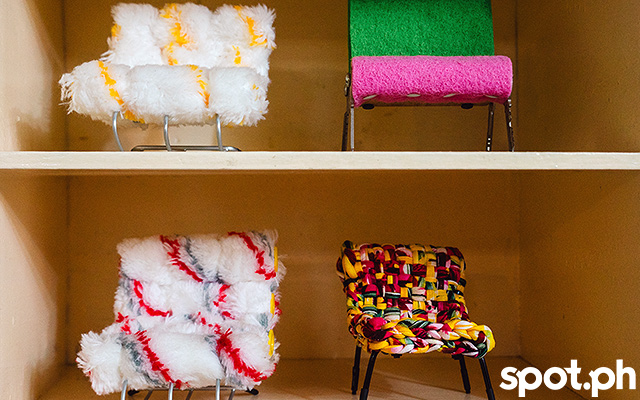
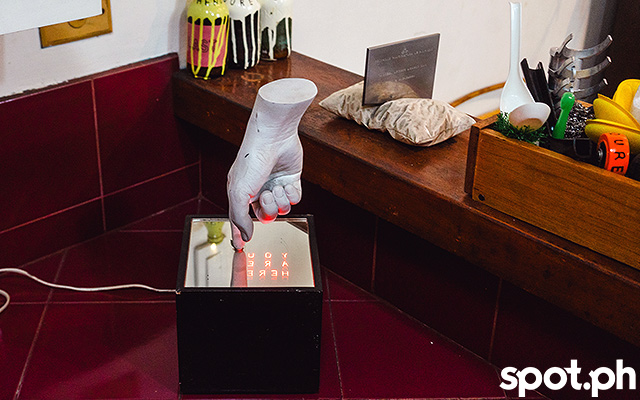
(SPOT.ph) Tucked in the restaurant-filled neighborhood that is Kapitolyo, Pasig, Juan Alcazaren’s four-storey house is almost empty of furniture except for chairs and a dining table. But you wouldn't call the place bare. The piano his two kids are playing on, its fallboard shut, occupies a corner. Several life-sized but minimalist sculptures, miniature models, and wall-bound artworks dot the space. Ordinary objects have taken a new form and function but their original material remains recognizable. For example, a plastic container for cookies that is now a lamp in his kitchen. This concept of conversion, whether literal or spiritual, manifests itself in different phases of Alcazaren’s personal and professional life.
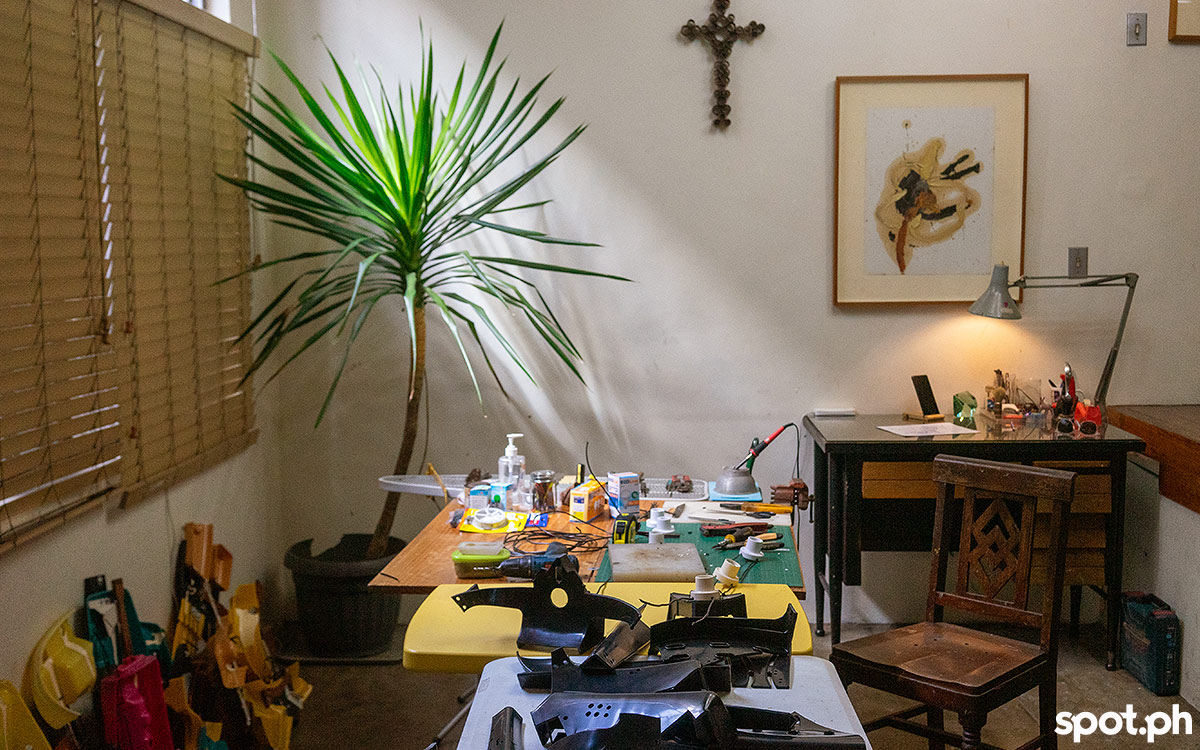
"This was my studio since the late '90s when I was single," Alcazaren tells SPOT.ph. "It’s just recently [that] we moved into a cleaner space. This is the first time anyone has seen this as a studio again. We’ve been actually living here for 15 or more years."
PHOTO BY Christine Chung
How Juan Alcazaren Takes His Time in Life, in Art
The 63-year-old Alcazaren, "Johnny" to his friends, speaks calmly but with certainty. Throughout the interview, he takes his time offering answers. Come to think of it, he's really not the type to hurry. He admits he spent many years at the University of the Philippines Diliman as a student, an athlete, and a teacher.
Article continues after this ad.
ADVERTISEMENT - CONTINUE READING BELOW
He finished Landscape Architecture and practiced it for a while, but it was the prodding of his brother—urban planner and architect Paulo Alcazaren—that led him to study foundation courses in Sculpture at the UP College of Fine Arts. Sculpture, after all, is a complementary feature of landscaping. He attended welding and construction classes under the esteemed sculptor and National Artist for Visual Arts Napoleon Abueva and consequently learned by practice.
"Just to see him, inspiring na, larger than life 'yung tao," he recalls of Abueva who used to maintain a shop behind the Jorge B. Vargas Museum. "His materials, nakatambak do'n, then you can use his welding machines."
PHOTO: Christine Chung
Post a Comment
In 1995, it was Alcazaren's turn to teach a course about materials to a new generation of artists. This includes the likes of Geraldine Javier, Mariano Ching, Alvin Villaruel, and Katya Guerrero, in the same college. In between, the then new teacher played tennis and even competed in the University Athletic Association of the Philippines (UAAP). "The tennis court near [the College of] Engineering, parang 'yun [ang] second home ko."
Alcazaren was also at one time a filmmaker, much like his brother Miguel and more recently his nephew Whammy Alcazaren. In 1996, his four-minute film Vexations—which was two years in the making—won second prize at the Gawad CCP for Video. The film features 3,000 hand drawings that were crudely shot frame by frame using a security camera.
PHOTO BY Christine Chung
Article continues after this video.
ADVERTISEMENT
watch now
PHOTO BY Christine Chung
PHOTO BY Christine Chung
"The title came from a musical by Erik Satie, a French composer," the artist tells us. "There's a set of notes, 'yung instruction niya is to play it over and over for 24 hours, so when they try to do that nagpapalitan 'yung pianist just playing over and over." His close friend and fellow visual artist Bernardo Pacquing laid down Satie's notes by playing them on his violin. "He wasn’t very good, so it was more vexing," Alcazaren quips.
Ten years later, the film took another form in the music video for "Fallen," which was sung by Alcazaren's wife, Drip vocalist Beng Calma-Alcazaren. "[Vexation] resonated with me as an animator because it's very tedious and repetitive and naging metaphor na rin for life, which is tedious and repetitive.”
Article continues after this ad.
ADVERTISEMENT - CONTINUE READING BELOW
Immersed and interested in numerous other things, it was only in 1992 that he fully committed to pursuing a career in the visual arts—this was after his first solo presentation of his thesis Anthropophilia at the Cultural Center of the Philippines. The show featured a series of arthropods or insect-looking sculptures and wallbound works. From then on, he continued exhibiting in different group shows, some curated by then CCP museum director Roberto Chabet, widely considered the Father of Conceptual Art in the Philippines.
PHOTO: Christine Chung
Post a Comment
Understanding the Supernatural Through Creating Art
For Alcazaren, art-making is an act of "emptying of oneself, a conversion of things from having one meaning to having infinite and unfathomable meanings."
His preference for object-making over drawing may be traced back to his high school days at Don Bosco Technical College in Mandaluyong, where he learned about woodworking, metalwork, and electronics. Drawing by hand was something he only had to deal with in architecture.
PHOTO BY Christine Chung
PHOTO BY Christine Chung
Article continues after this ad.
ADVERTISEMENT - CONTINUE READING BELOW
"I avoid drawing now. I have learned that I don’t draw that well," he says. "It’s easier for me to work straight with the material and see what comes out of it. And I draw for technical reasons, to figure out how to do the electricals or the constructions. I don’t make studies of sculpture. I draw after may form na." He mentions that he was influenced by the Fluxus art movement that advocated for spontaneity and an interdisciplinary approach to art.
Of late, the subject of death seem to be a preoccupation in his work, connecting one show to the next. "I guess it’s part of the age. I married very late. I have very young children at this age, so you can’t avoid thinking of death, suddenly dropping dead, then being dead. Then my focus has become more on the eternal, afterlife," he explains.
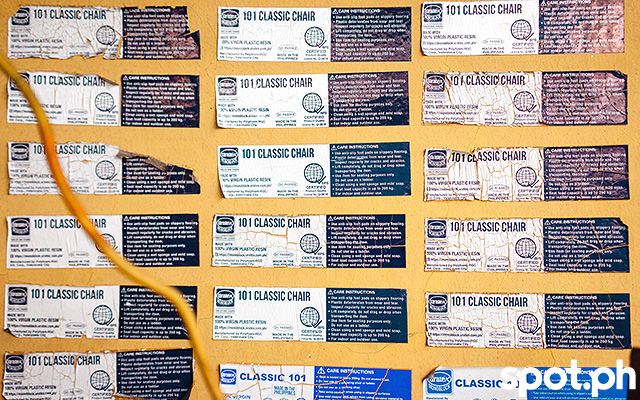
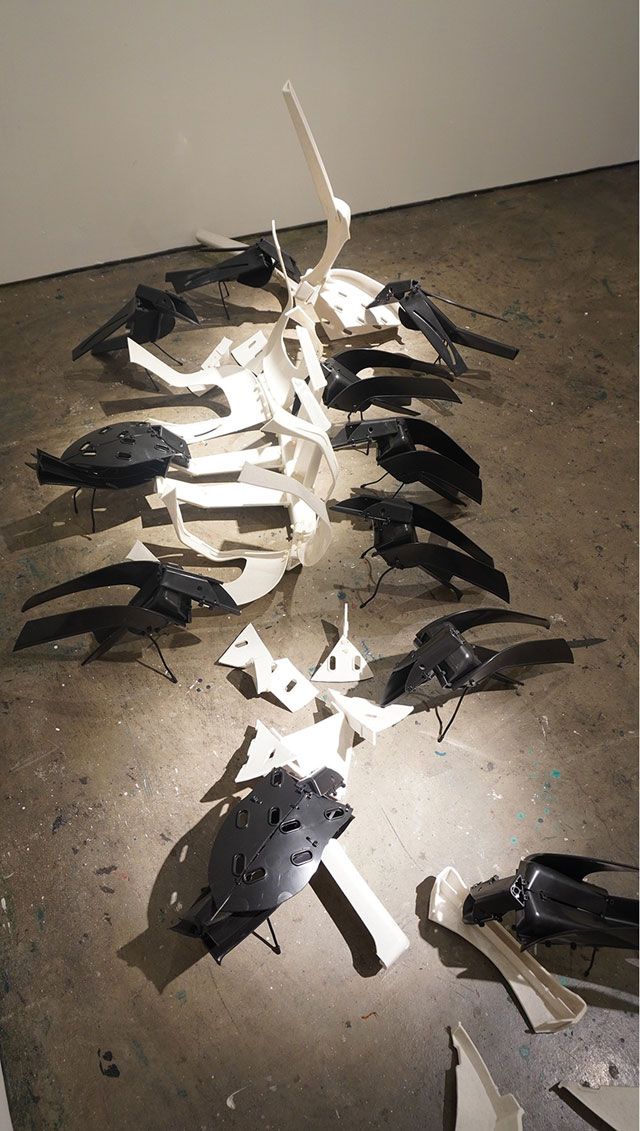
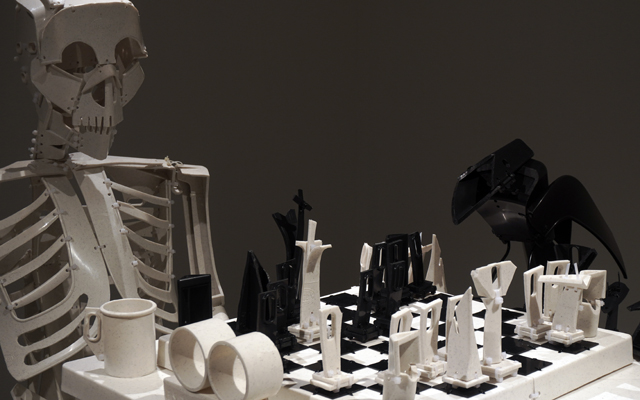
This connectedness is present in his exhibitions Three Piece Suite (2022) and Touch Move (2023) which was held at Artinformal Gallery, where he used monobloc chairs to assemble figures of crows reminiscent of the ones he usually spots from his workshop, and then there were skeletons. Both exhibitions touched on the idea of play in relation to man’s destiny, as represented by the presence of board games in the works.
"Derived to the Bone" in Three Piece Suite (2022) at Artinformal Gallery
PHOTO Courtesy of Artinformal Gallery
Touch Move (2023) at Artinformal Gallery
PHOTO Courtesy of Artinformal
"Each material has its own behavior," says Alcazaren. "Some you can alter, some it really works only a certain way. Like 'yung steel, you can do pretty much anything, you can bend it, and then you can beat it. Pero plastic may limitation." Each material poses a different challenge. "How I start is I gather all materials within view and just see what happens."
He explains his process further. "I imagine an object to want to be something else, and I give it that chance to be something else. Like with the monoblocs—everybody has come in contact with a monobloc chair, no matter how high or low. So parang feeling ko gusto niyang maging something else."
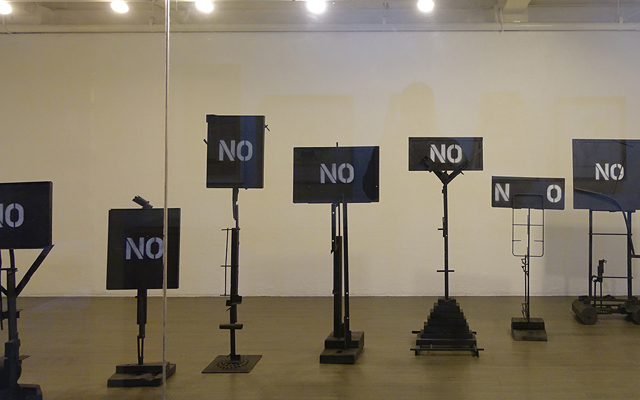
Other related solo presentations like NO (2016, West Gallery) and The Last Things (2017, Finale Art File Gallery) ruminate about the future, the former asking existential questions with a definite "no" answer to everything ("'Yung inspiration ko do'n 'yung daughter ko at that time, two years old. First word out of her mouth is 'no'".), while the latter contemplates endings and finalities. In these exhibitions, his personal experiences speak to universal realities.
NO (2016) at West Gallery
PHOTO Courtesy of West Gallery
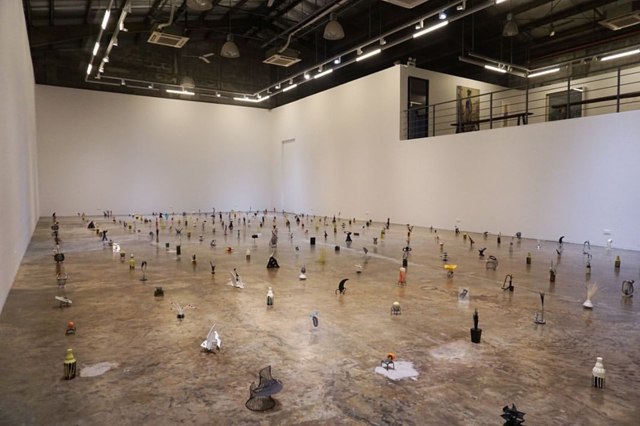
Monuments to The Next to Nothing (2022) at Finale Art File
PHOTO Courtesy of Finale Art File
In Monuments to The Next to Nothing (2022), Alcazaren not only descales our perceived notion of what a monument is but also inverses one’s experience of viewing art: looking down instead of looking up. The miniature monuments of over 300 pieces were lined up on the floor of Finale Art File's main gallery. "The space itself is already monumental, and when you go in, depending on your attitude or disposition, either you see yourself as a giant, looking down on the art. Or you imagine the space is really a monument and you are that tiny.
"As a private joke, my point was to make people look down at the ground. You cannot look at the work if you’re not looking down… I got people on their knees."
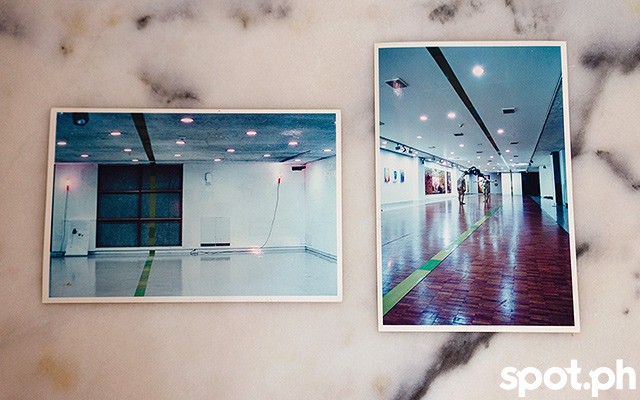
(L) The line intersected with the work of his co-awardee Pacquing, who uncladded a wall at the CCP Gallery; (R) "Lounge Act: Teetotalitarian Envy" for the 2000 Thirteen Artists Award
PHOTO BY Christine Chung
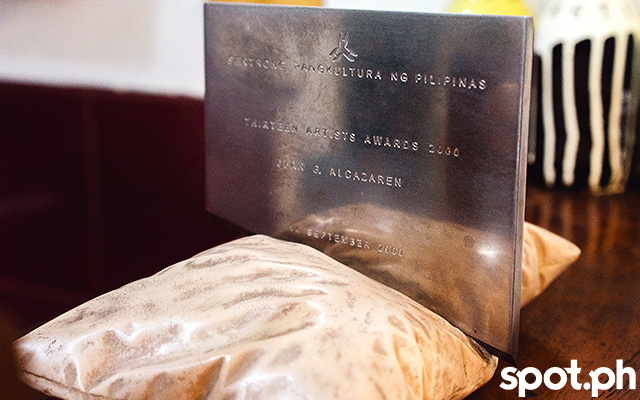
2000 Thirteen Artists Awards trophy by 1988 TAA recipient Dan Raralio
PHOTO BY Christine Chung
As a landscape architect, Alcazaren did not find it difficult to have a grasp of the space and play around it. He develops large-scale works in limited spaces and vice versa. This is evident in the commissioned work "Lounge Act: Teetotalitarian Envy," which he presented as a recipient of the 2000 Thirteen Artists Award. He installed a vinyl strip he painted green that ran throughout the cubic structure of the gallery space, a sort of intervention in the space.
In the third edition of ALT Philippines, Alcazaren is producing a light and text work on an approximately 10-foot by 30-foot wall that spells out "NOW."
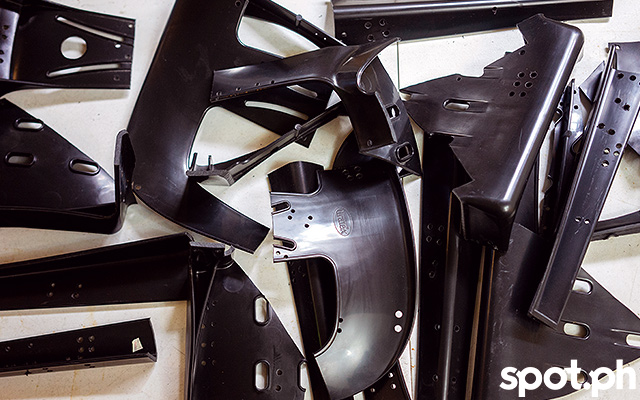
"NOW," for ALT Philippines 2024, work will be made from black monobloc chairs.
PHOTO BY Christine Chung
"I only started using those [text works] recently. Hindi ako text artist talaga tulad ni Lui [Alcazaren]," referring to his nephew known for his text-based art. "At saka may malaking chance maging corny. I guess that's the challenge." For this particular work, he will be using light and monobloc chairs to form the letters of the text.
In 2011, he made a similar work that spelled "SORRY" in his solo exhibit Save Me From What I Want to Save, also at Finale. When asked if he’s apologetic for anything, he remarks, "Before, my answer was to say sorry for all the bad art I’ve been producing. Pero personal din 'yun." The word in itself and its meaning as understood by everybody gives it gravitas. "It’s a universal word that appeals to everybody."
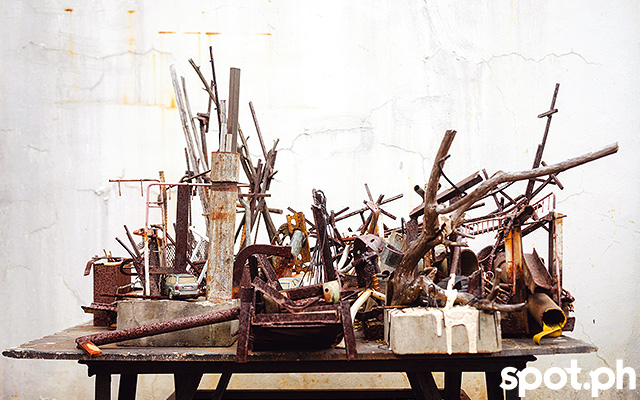
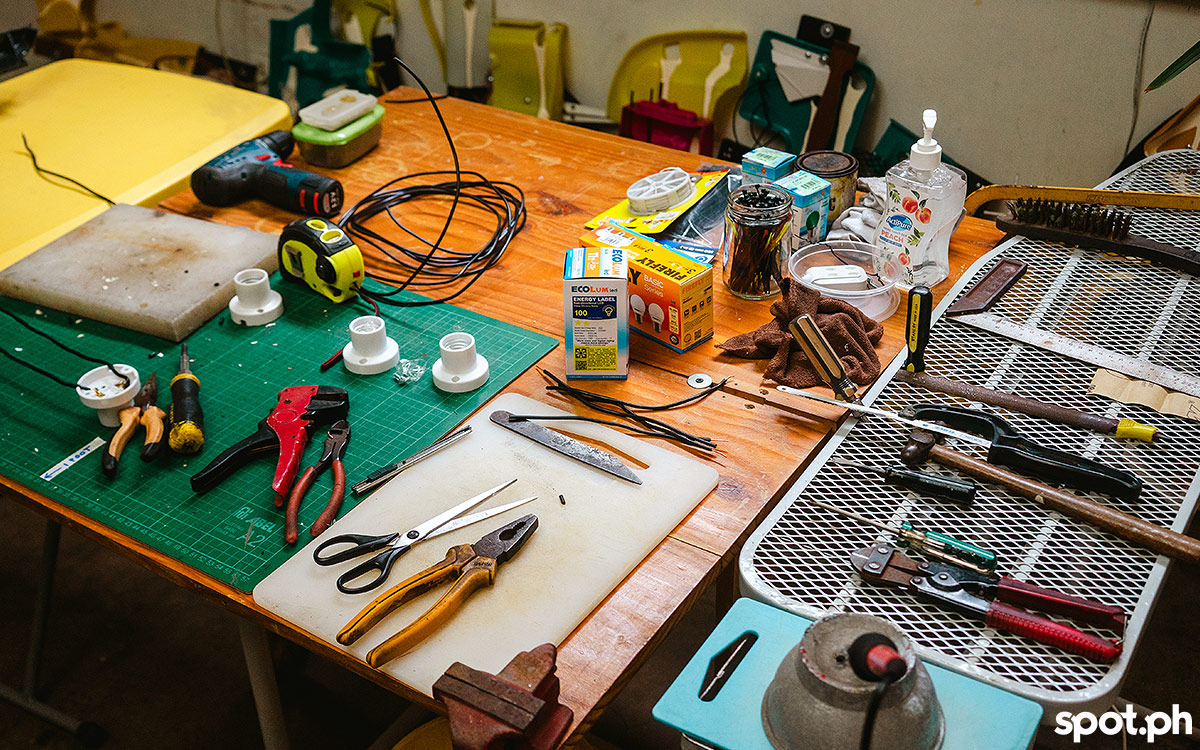
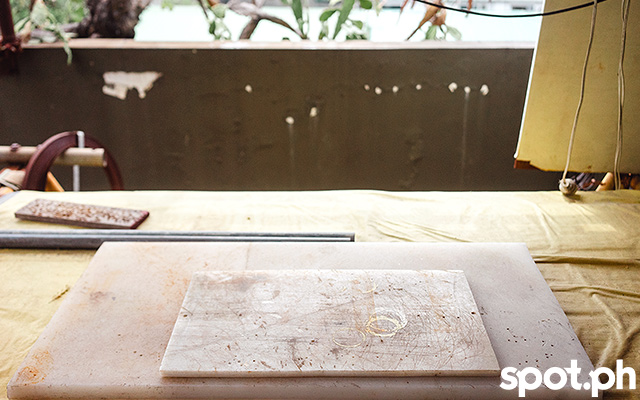
At home, Alcazaren spends most of his time in an open-air rooftop area with a small shed. Here, he stores his decades-old tools and equipment—for welding, bending, and assembling materials. Their rusty surface indicates the years of usage and their service to Alcazaren. Without meaning to, the artist have converted them as well: from mere tools they've become constant companions, his veteran workmates.
ALT Philippines 2024 is from February 21 to 25 at SMX Hall A, Mall of Asia Complex, Pasay City.
We use cookies to ensure you get the best experience on Spot.ph. By continued use, you agree to our privacy policy and accept our use of such cookies. Find out more here.


Comments