
Grace Is A Perceptive Retelling of The Lipa Apparition
Because of the material, the play tends to tell rather than show.
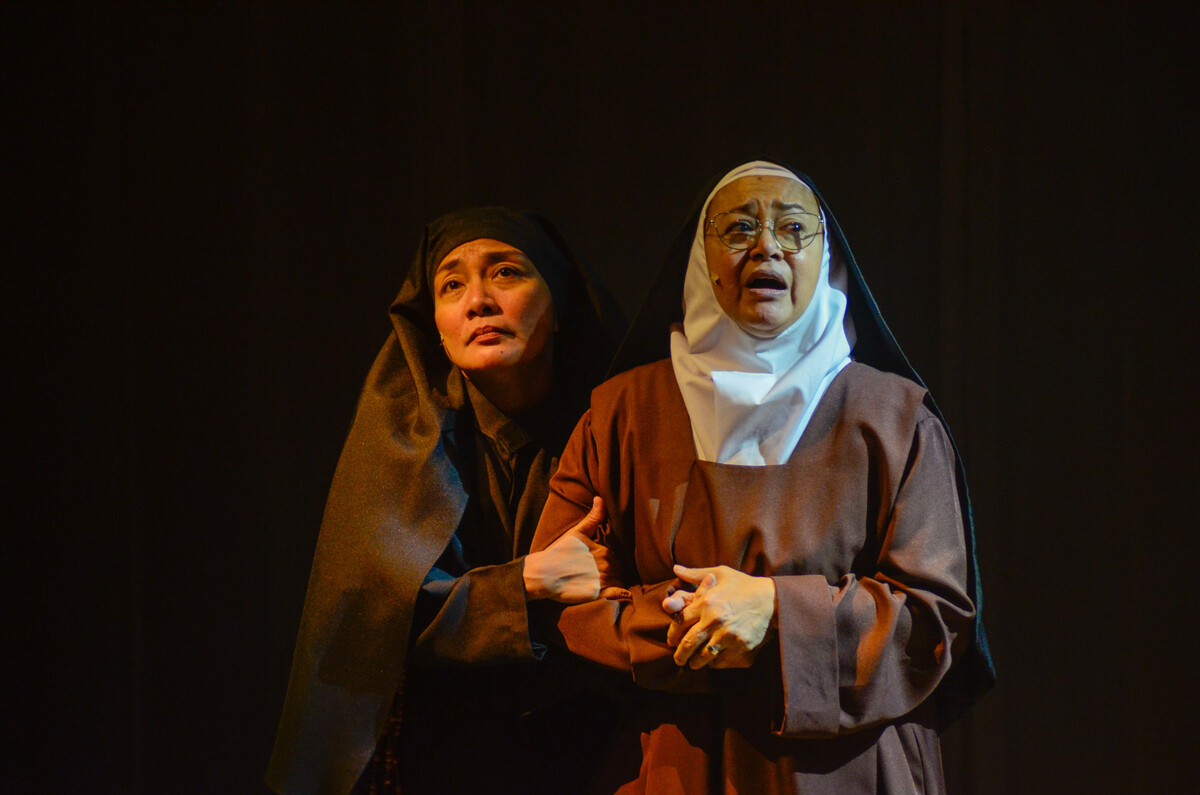
(SPOT.ph) Dramatist Floy Quintos’ demise due to heart attack last April shocked media and the performing arts world, but with his last original play, Grace, friends and admirers may take comfort in the apparent fact that he made his exit amid an ambience of spirituality and grace, however contentious.
Contentious because Grace dramatizes the events surrounding the alleged apparition of the Virgin Mary to the postulant Sister Teresita Castillo in the Carmelite convent of Lipa, Batangas in 1948, and the subsequent canonical inquiry that ruled the incident to be bereft of supernatural basis. High church leaders ordered the key nun-players banished, and even the statue carved in the supposed likeness of the Marian apparition, burned and destroyed.
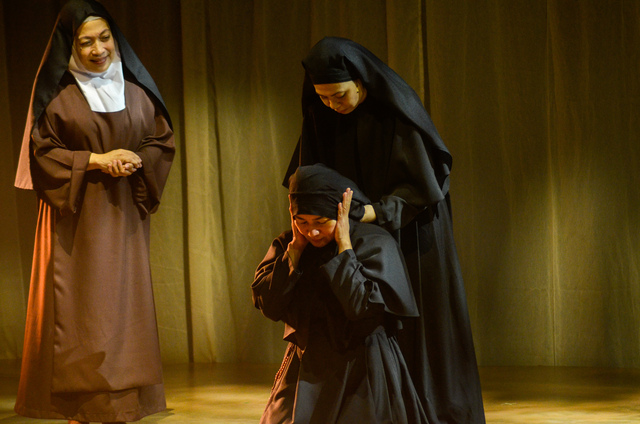
In the new century, the incident has again hit the headlines when Lipa Archbishop Ramon Arguelles reopened the inquiry into the incident and declared it in 2015 to be authentic, only to be overruled the following year by the Holy See’s Congregation for the Doctrine of the Faith. As a result of the Vatican veto, Arguelles resigned.
Also read: Bye, Floy Quintos: Theater Friends Recall His Love Languages
Even before this, Cebu Archbishop Emeritus Ricardo Cardinal Vidal had said that one of the messages of the Lipa Virgin prophesied the “invasion” by China of the Philippines. Vidal had been Lipa archbishop before his transfer to Cebu.
More recently, the Holy See has released a hand-written memo supposedly signed by the pre-Vatican II doctrinal watchdog head Cardinal Alfredo Ottaviani in 1954; it supposedly showed Pope Pius XII’s approval of the 1951 decree.
Time to revisit, not to reopen Lipa case
The release only this May by the Holy See’s Dicastery for the Doctrine of the Faith (DDF) of new guidelines governing canonical inquiries into alleged supernatural occurrences seems to have provided a more welcoming regard for such phenomena as Lipa’s.
“The Church has stated that the faithful are never forced to believe in this phenomenon,” said Cardinal Victor Fernández, DDF head. “The Church, as a matter of fact, leaves the faithful free to devote their attention to this phenomenon or not.” In any case, everything that the Christian needs to be saved has already been revealed in the Bible and the sacred tradition of the Church, explained Fernandez. “It (revelation) contains everything we need for our Christian life.”
Grace therefore should be viewed in the context of what Caloocan Bishop Pablo David, president of the Catholic Bishops Conference of the Philippines, said in the aftermath of the Vatican reaffirming the ruling against Lipa: that it’s time “to revisit” the incident, not to “reopen” it but to explore it anew.
Grace should afford that revisit, that re-exploration. To be sure, devotion to the Mary Mediatrix, the alleged title of Lipa Virgin, has not been stopped by the 1951 decree. It has continued to flourish even with the Vatican suppression.
Rising from the massacre
Quintos’ pen had always been “historicist” and in Grace, he adumbrates the historical and cultural determinants of the Lipa incident and places it in the context of the postwar effort of Batangas to rise from the ruins of war.
As it turns out, when Lipa Bishop Alfredo Versoza invited the Carmelites to set up a monastery in Lipa, he was trying to expunge the tragic memory of what happened there during the war.
The Lipa seminary had been taken over by the Japanese at the start of the occupation, and in the waning days of the war, fearful that the Lipa menfolk would rise against them in aid of the returning US forces, the Japanese herded the locals there and on Feb. 27, 1945, bayoneted them. The Japanese subsequently burned down the building along with the bodies. Later, American bombardment levelled Lipa.
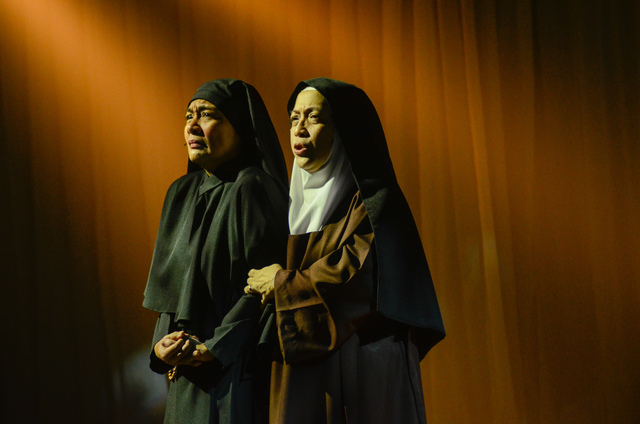
When the Carmelites arrived in Lipa in 1946, they were shocked to see that the stark traces of the devastation of the previous year were still evident.
In referring to the Lipa carnage in 1945, Quintos may be laying the groundwork for the apparition—or even its production, if the canonical inquiry that basically declared it a hoax is to be believed—and how it may have been a means of firmly erasing from collective memory the terrible holocaust of war.
Is Quintos also suggesting that the claim of Castillo (played by Stella Cañete-Mendoza) that she was attacked by the devil a reliving of the trauma of the massacre?
As the first ever Filipina Carmelite, Mother Cecilia de Jesus (performed with solid spirit by Shamaine Centenera-Buencamino) saw the war’s havoc in Lipa before the convent was constructed. Was the rain of rose petals a form of enchantment to relieve Mother Cecilia of the trauma of the carnage?
Mediatrix of All Grace
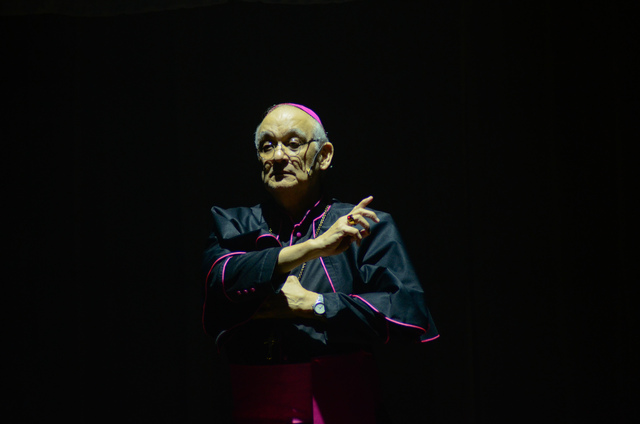
It is also perceptive of Quintos to focus on the chief theological issue that may have boggled the apostolic nuncio, Archbishop Egidio Vagnozzi, and the holy inquisition of Philippine prelates led by Bishop (later Cardinal) Rufino Santos that investigated the incident: Castillo’s claim that the apparition introduced herself as the "Mediatrix of All Grace" and not “of All Graces.”
The alleged title had not figured in the debates about the apparition until it was noted by the Dominican Fr. Gerard Francisco Timoner, who in 2014 was named by Pope Francis to the International Theological Commission.
According to Timoner, now head of the Dominicans worldwide, the title “seems unprecedented and invites a closer theological scrutiny (because) if the message truly came from the Blessed Mother and Sr. Teresing heard her accurately, then it appears that the Blessed Mother was correcting, if not refining the title Mediatrix of All Graces which was previously accorded to her.”
In the play, Vagnozzi (played with ecclesiastical elan by Leo Rialp) questions the title and argues that it detracts from Jesus Christ as the source of all graces and appears to elevate Mary to the godhead itself.
An ashtray-throwing incident
Quintos likewise updates the Lipa story by including the seer’s “devil’s advocate,” the Spanish Dominican friar Fr. Angel de Blas, the psychologist who interrogated Castillo.

In the play, Vagnozzi commissions Father De Blas (played with unction by Nelsito Gomez) because he’s a man of both faith and science. But likewise appealing to the friar’s European background, Vagnozzi is shown to be harboring racial superiority over Catholics of the so-called New World, especially over “the little nuns of Lipa”.
When she was alive, Castillo had claimed Father De Blas had demanded she sign a statement confessing to the “hoax”. When she refused, Father De Blas reportedly threw an ashtray at her.
The emergence of Father De Blas’s journals said to have been kept at the archives of the Dominicans in Rome has revealed that the friar-scientist had been merely testing Castillo’s reflexes when he threw the ashtray at her. In his journals, he declares that Castillo was “normal, “that her trances were not caused by hysteria, and that she was indeed a “visionary.”
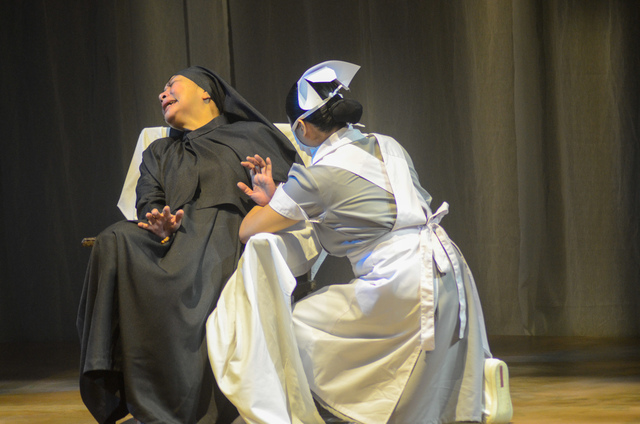
In the play, De Blas disagrees with Vagnozzi’s thesis that the Lipa incident was a “diabolical intervention.”
Father De Blas wrote in his journals:
“While the devil will seek to entangle himself in everything and will seek his gain all the time, I do not believe him to be capable of devising a scheme that will counter his own goals.”
De Blas adds that the Lipa incident had led to conversion and spiritual renewal, surely the devil would not have engineered those.
A careerist cardinal
In the play, Vagnozzi’s local agent to set up the canonical denial by Philippine bishops of the alleged apparition is Rufino Santos (played with crusading fervor by Dennis Marasigan). Then as now, Santos (1908-1973), the first Philippine prince of the Church, has always been an ambivalent figure—seen as an effective administrator but also a remote and dry pastor.
Having studied in Rome, his involvement in the Lipa incident may have been a chance to burnish his pontifical credentials the better to improve his prospects at higher ecclesiastical office, just as some prelates today try to catch the Vatican’s eye and outdo one another in the profession of orthodoxy by demeaning the Lipa incident, ridiculing the devotion to it by simple folks, and even having the image of the Lipa Mediatrix exorcised.
In Grace, Quintos does not challenge the reputation of Rufino Santos as an ecclesiastical careerist.
Discursive drama
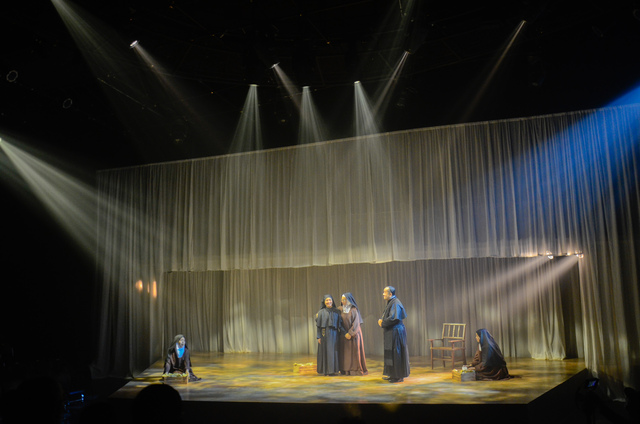
Ultimately, Grace holds our attention not because of the alleged apparition and rain of rose petals (hardly dramatized in this severely minimalist production by director Dexter Santos), but because of the ecclesiastical backroom goings-on seeking to dismiss the alleged apparition and demean the faith and devotion of small people.
Because of the expository demands of the material, Grace tends to be more discourse than drama. It tells rather than shows.
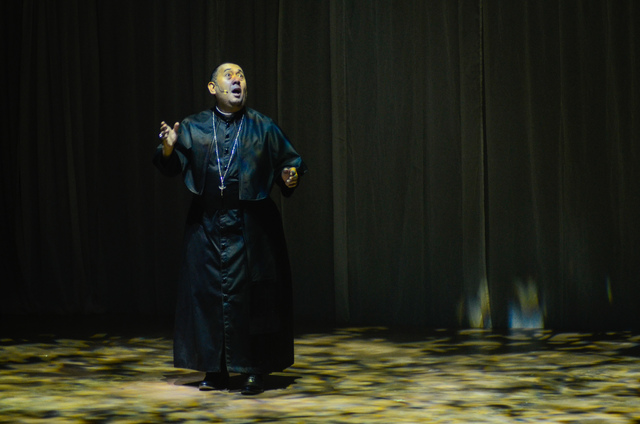
But since the discourses are delivered by a first-rate acting ensemble, the discursiveness is somehow alleviated. Mention should be made of Jojo Cayabyab as the unfortunate Lipa Bishop Alfredo Versoza; Frances Makil-Ignacio, who plays the fictional Sister Agatha with riotous relish; and Raphne Catorce who provides similar comic alleviation with his “Carmel boy” Guillermo, a convent volunteer.
Judgment
Catholic mystical theology employs four criteria to recognize a supernatural occurrence: the message must align with Christian teachings; the seer must be sincere, credible, coherent, and without self-interest; there must be acts of healing or physical signs of a supernatural presence; and the incident should result in long-term religious conversions.
But even when the Church recognizes an apparition to be supernatural, individual Catholics are not obligated to believe in it. As Cardinal Fenandez has said, everything that Catholics need to be redeemed have already been revealed.
And revelation is in the guardianship of the Church. This explains why despite the heavy-handed and perhaps unfair treatment by the Church of the Lipa incident and its players, believers and devotees still need the guidance of the Church.
The late French theologian and Lourdes apparition scholar Fr. Rene Laurentin has said it is up to every person to judge whether an incident is supernatural or not. But ultimately it is the Church, the people of God as guided by the Magisterium or teaching authority of the bishops, that will decide.
As Father Laurentin said, "Let each person judge for (himself) and let the Church judge for all of us."
Grace runs every Saturday and Sunday, with matinee and evening performances, up to June 16 at the Power Mac Center Spotlight Blackbox Theater, Ayala Circuit Mall, Makati City. Tickets are available at Ticket2Me.net at P1500 to P2000.