

Urban Designer Rings Alarm on "Rotting From the Inside" Escolta Building
Adaptive reuse could be a creative solution.

(SPOT.ph) Calle Escolta is a place of many firsts. It was, after all, the center of finance and commerce in Manila in the 1930s. The half-a-kilometer-long street was lined with shops that sold imported luxury goods, while nearby roads housed multi-storey buildings for offices, banks, and other financial institutions.
It was also there here that Insular Life (a.k.a. Insular Life Assurance Company), the first Filipino-owned life insurance company, set up its headquarters—specifically between Plaza Moraga (along Calle Rosario, now Quintin Paredes Street) and Plaza Cervantes. It is currently an abandoned nine-decade-old structure surrounded by galvanized iron sheets in an effort to keep intruders away.
Urban designer and landscape architect Paulo Alcazaren, who is part of the Heritage Conservation Society's (HCS) Board of Advisers, speculated on the possibility of losing the old Insular Life building. "Now it apparently is rotting from the inside, and its days appear numbered. [...] Most likely, it will be replaced by a skyscraper. The lot beside it is already vacant," he said in a post on January 7. The speculation is not without basis, considering what happened to nearby structures like the Capitol Theater, which was demolished in 2020 by real estate developers.
"I do not recall what stood there, but Plaza Cervantes was the Ayala Avenue of old Manila. All the banks had their headquarters there. We cannot stop the loss of this building, but the HSBC, El Hogar, and old FNCB building are still there. The Chinabank building, FNCB, and HSBC buildings have been adaptively reused, which is wonderful. The Uy Chaco Building is also, thankfully still there. Without these, Binondo would lose all its distinctiveness and devolve into a homogeneous mass of non-descript skyscrapers with no cultural specificity or history. We should at least save all these and ditto with the two plazas - Cervantes and Moraga (both of which are essentially parking spaces). Surely, we can find better ways of using these spaces by partially pedestrianizing the two and improving the urban design of the district," Alcazaren continued.
History of the Insular Life Building in Escolta
The seven-storey Insular Life Building was designed by Filipino architect Andres Luna de San Pedro, son of Juan Luna. De San Pedro was also behind the design of the First United Building, the Regina Building, and the Philippine National Bank Building—all in the area. It was among the tallest buildings in Manila at the time, serving as a beacon of progress and prosperity.


The building's architecture was a statement of elegance and stability, designed to inspire confidence in the clients who walked through its doors. Its imposing façade and neoclassical design elements were a common sight in the period's financial institutions, reflecting the economic optimism of the era.
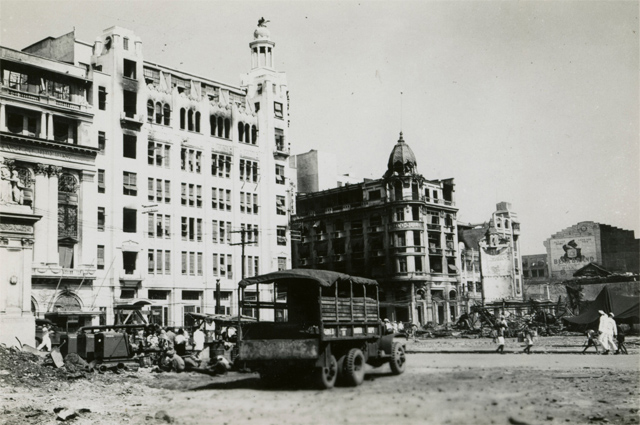

In 1963, Insular Life transferred its office to a new building designed by Cesar H. Concio at the corner of Ayala Avenue and Paseo de Roxas in Makati. The old building was renovated multiple times, including the removal of the corner tower as well as the identifying feature of an eagle at the highest point of the facade. (The eagle can now be found at Insular Life's headquarters in Alabang, where it moved to in the '90s.)
What's Next for the Old Insular Life Building
With Escolta's buildings getting demolished one after the other, the fate of the old Insular Life Building is under imminent threat, all in the name of urban development. Not to mention the structure's natural wear, seeing that there are no signs of the building's preservation and restoration.

Preservationists and heritage advocates have long called for the building's conservation, recognizing its architectural significance and its role in the city's collective memory. Efforts to restore Escolta to its former glory have been ongoing, with the Old Insular Life Building often cited as one of the key pieces in this historical puzzle, including the two plazas of Cervantes and Moraga (now both parking spaces).
One resolution is adaptive reuse. This has been successful in preserving other buildings in Escolta, including the First United Building (a.k.a. Perez-Samanillo Building), which houses design offices, a community museum, a coffee shop, a resto-bar, and a go-to bazaar at the old downtown.
In a chat with Alcazaren, he said: "Adaptive reuse would be the ideal way to conserve this landmark. The creative solution would be to tie up with the owner of the adjoining lot—now empty. They could merge the two lots and dovetail a taller building into the old Insular Life structure. I would bring back the original Andres Luna de San Pedro facade and towers, but the insides could be gutted and adaptively reused. A green or garden roof could be added if structural reinforcement can be added to the central core. This type of [retrofitting] has been accomplished in other world cities like Singapore and Hong Kong."
Gio Abcede, president of HCS, added: "[Adaptive reuse] highlights how existing historic spaces can still be flexible to the new needs of the community, making a good case for its preservation rather than demolition."
If the walls could talk, the structures in downtown Manila have a lot to say. They give us a sense of our past and some perspective about our future. They boast designs indicative of our culture. And, most of all, they give us a chance to think about what "development" really means.
Also read:
The Story of Berg’s: How a Pre-War Shopping Mecca Keeps Its Spirit Alive in Today’s Escolta
These Vintage Photos of Binondo, Escolta, and Divisoria Will Remind You of Manila's Glory Days