

10 Brutalist Buildings in Makati You Can See in a Day
Make sure to drop by when you're in the business district.
(SPOT.ph) Brutalist architecture is everywhere in Manila. You may not know it but you're already looking at an example of one, especially if you're in Makati's Central Business District where there is a particularly high concentration of brutalist structures. The easy telltale characteristics: it's big and blocky, not interested in being pretty, and the bare building material is the star. It's often described as cold and dark but it no doubt has it own allure. For why else will the three guys behind the six-year old Instagram account, Brutalist Pilipinas, Karl Castro, Mel Patrick Kasingsing, and Eldry Infante devote a considerable amount of their time promoting this style of architecture? Through the social media platform, the guys—a book designer, editor/creative director, and an architect-designer-illustrator, respectively—tell their followers of brutalist structure sightings on the city's streets, in media, advertising and pop culture.
Brutalist Pilipinas serves as a visual database that fosters appreciation for brutalist architecture, but it has also transcended the online space to become a force that hopes to effect change in heritage conversation efforts. Sure the buildings may remind us of a dark period in the country's history, but there's no question they must be preserved if only to honor the architects, the Filipino talent, that made them. This is an advocacy Kasingsing and company share with their thousands of followers (32.1K now to be exact), a number of whom they've met in photo walks they organized, and more recently, during their exhibition titled Brutalism as Heritage: Leandro Locsin and the Makati Central Business District, at Convenience Coffeehouse nestled in the The Atrium of Makati, itself a building that embody brutalist characteristics (show runs until May 11).
SPOT.ph sat down with Brutalist Pilipinas recently to talk, whatelse, brutalism and to ask them to name 10 must-not-miss brutalist buildings in Makati.
Also read: This Secluded New Hub in Makati is Home to a Growing Community of Creative Spaces
What is brutalism?
Brutalism is a style of architecture that favors function and minimalist construction. It showcases bare building materials and structural elements that may be raw but nonetheless offer memorable visual impact. It can be grand—think Philippine International Convention Center, a Leandro Locsin ouvre—but far from ornate; prioritizes function over decorative design. The style reached the height of its popularity in the 1950s and 1960s. Think of steel and concrete fusing together to create massive blocks you simply can't miss as you walk past. Think Cultural Center of the Philippines, another Locsin.
No two buildings in a city are ever alike—unless they're deliberately constructed that way—but many structures in Makati share certain design elements that make the city an interesting landscape that showcases the evolution of architecture in the country, as well as the evolution in the styles of Filipino architects.
Many more examples of brutalist buildings exist across the Philippines, but as we said there are plenty peppered all over Makati. This was likely brought about by the shift of the economic center from Manila to Makati after the war, explains Castro. Makati too had very early on a master plan in zoning; and just as the structures were beginning to rise in the district, the prevailing sensibility was modernism and brutalism.
Also read: The Brutalist Architectural Gems to Check Out in Metro Manila
These brutalist buildings in Makati deserve a visit
Ramon Cojuangco Building
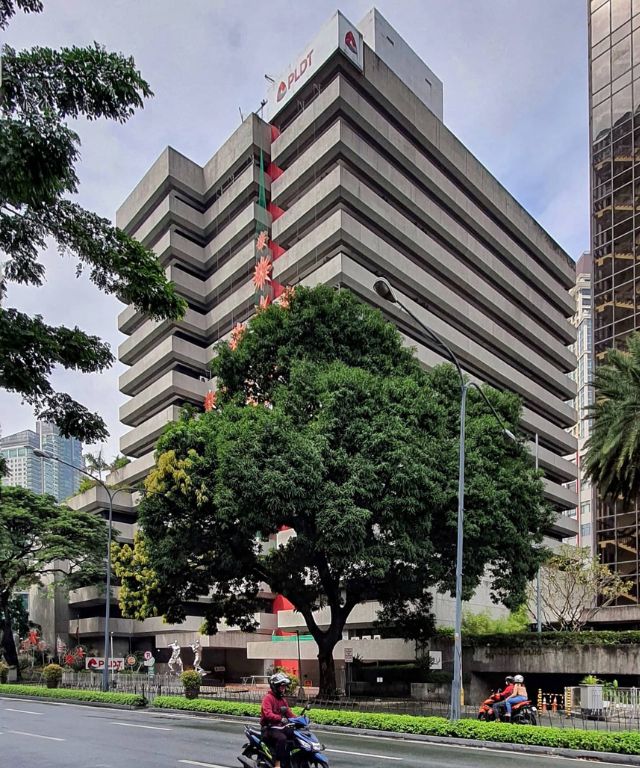
Architect: Leandro Locsin
Year of completion: 1982
The RCB is very special to the Brutalist Pilpinas team, as they fought for its presumed important cultural property (ICP) status when PLDT requested the removal of the aforementioned status back in 2022. The National Commission for Culture and the Arts considers the property an ICP as it is the work of a National Artist, Leandro Locsin, which means it should enjoy protection from exportation, modification, or demolition.
The Ramon Cojuangco Building is at Makati Avenue cor. Dela Rosa Street, Legazpi Village, Makati City.
Sarmiento Building
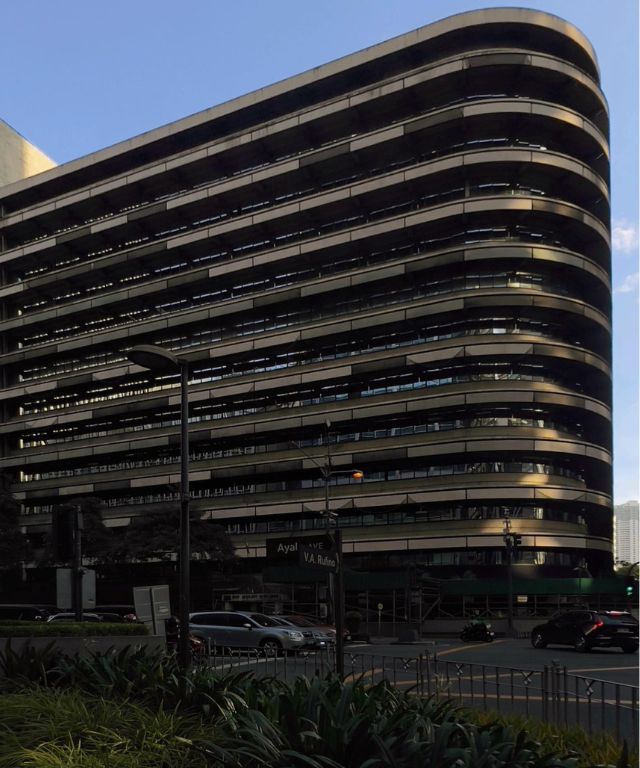
Architects: Leandro Locsin
Year of completion: 1965
The Sarmiento Building is the oldest structure on this list, and is an earlier work of Leandro Locsin. It's also more modernist than brutalist, but when seen vis a vis Locsin's later works in the neighborhood, it becomes a touchstone to his evolution, an example of his work before he rode the brutalist wave. The appearance of curves is rare in this list, with the Sarmiento Building being one of the two to possess that softer architectural feature. It lends a gentler touch to the chunk of a building, which houses a seemingly infinite number of windows on each floor, no doubt occupied by an employee looking to get things done.
The Sarmiento Building is at Ayala Avenue cor. Rufino Street, Makati City.
Makati Stock Exchange
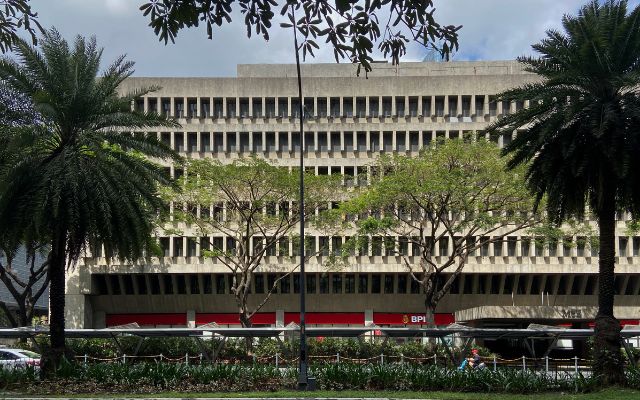
Architect: Leandro Locsin
Year of completion: 1971
The Makati Stock Exchange already fascinated Kasingsing even before he knew it was a brutalist structure. "I didn't know what I was looking at but I found it interesting," he says. When he finally got the chance to visit the building and take pictures, he was even more impressed, largely by the "sheer boldness of its form, the way it imposes itself on the viewer." Brutalism may have its roots in Scandinavia and the U.K. but this building, says Kasingsing , shows how a foreign style can be adapted to the local setting, incorporating tropical touches like the rhythmic bris soleil in the facade—which don't only give the interior extra shade but also give the Stock Exchange itself more character.
The Makati Stock Exchange is at Ayala Avenue, Makati City.
Leandro V. Locsin Building
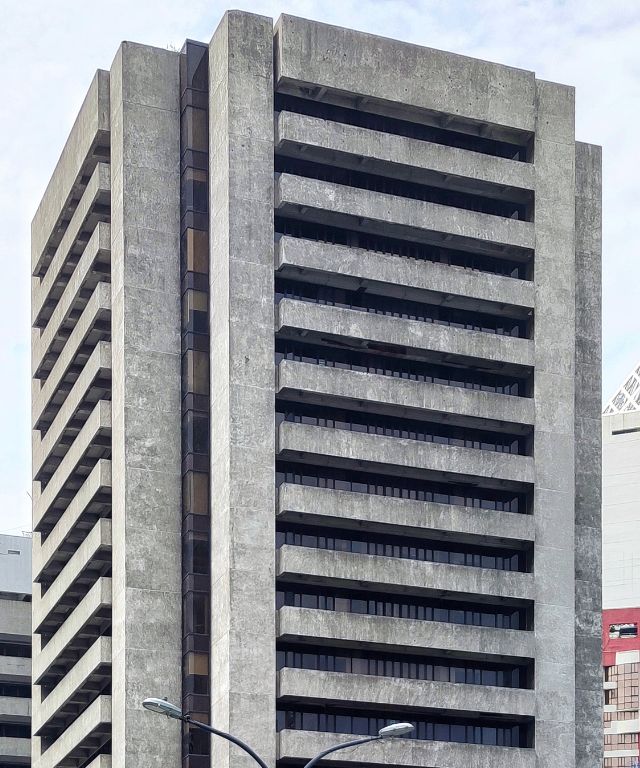
Architect: Leandro Locsin
Year of completion: 1985
The L.V. Building is what you get when you cut the corners off a square cake—madness, really, but those gaps let the glass shine through, and we imagine looking at the district from the building’s corner on a high floor is nothing short of grand. Named after the architect who built it, the Locsin Building was likely designed with the Ramon Cojuangco Building in mind. Locsin "made the connection with the RCB, nagkaron ng certain rhythm," says Infante. "Parang magkapatid sila na building." They were constructed three years apart. Unlike its sibling, the Locsin building has no corner columns—the first of its kind in the country—and housed the architect's office when he was still practicing.
The Leandro V. Locsin Building is at Ayala Corner Makati Avenue, Makati City.
Philippine National Bank Building
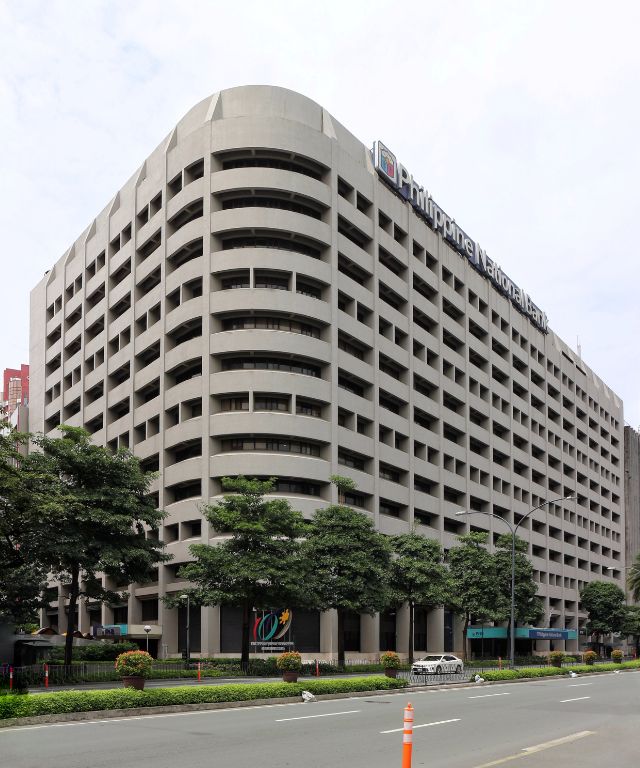
Architect: Carlos Arguelles
Year of completion: 1980
The 12-storey building is prime spot for businesses and enterprises as it is planted in the intersection of Ayala Avenue and Legazpi Street, two of Makati's busiest thoroughfares. It bears the Philippine National Bank logo now but it once carried the Allied Bank insignia. Curved at the corner, this building also has a softer edge, except columns cut every row on every floor, unlike the Sarmiento Building that seems to run seamlessly.
The Philippine National Bank Building is at Ayala Avenue, Makati City.
Also read: Inside a Brutalist Structure: Rediscovering Leandro Locsin's PICC
The Peninsula Manila
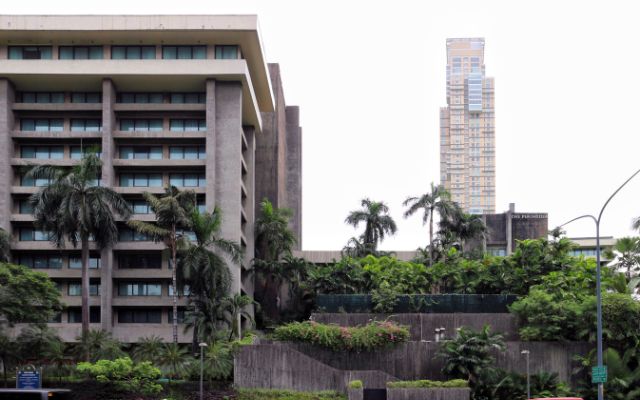
Architect: Gabriel Formoso
Year of completion: 1976
One of Makati's true icons, it was built around the time hotels were rising in Manila to accommodate foreign dignitaries and conventions, when the metropolis was priming itself up as an international playground. The Peninsula Manila welcomed its first guests on September 14, 1976, ahead of that year's International Monetary Fund conference in the Philippines. When it was renovated in 1994, it adapted neo-classical flourishes into its brutalist structure—that lobby! that fountain!—perhaps to hew closer to how its sister hotels looked in other parts of the world.
The Peninsula Manila is at Ayala Avenue, Makati City.
St. Andrew the Apostle Parish
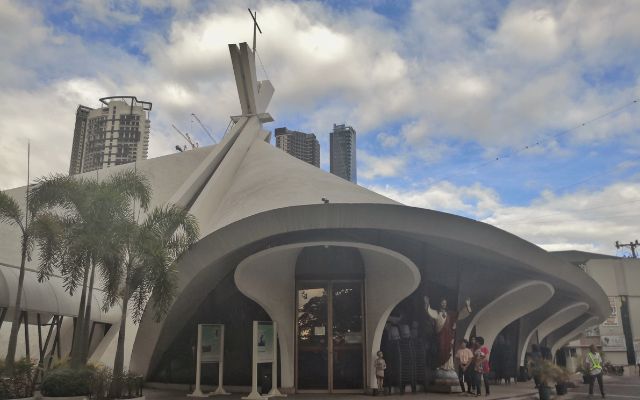
Architect: Leandro Locsin
Year of completion: 1968
Castro counts the St. Andrew the Apostle Parish in Bel-air as an important landmark when it comes to tracing Locsin's evolution, being one of his earlier sculptural buildings. It might remind people of the Parish of the Holy Sacrifice in the University of the Philippines-Diliman, which Locsin designed in the 50s. The details that make this Makati church unique? The butterfly-shaped floor plan, the hanging cross, and the giant chandelier over the altar.
The St. Andrew the Apostle Parish is at Bel-Air Village, Makati City.
Legazpi Tower 100
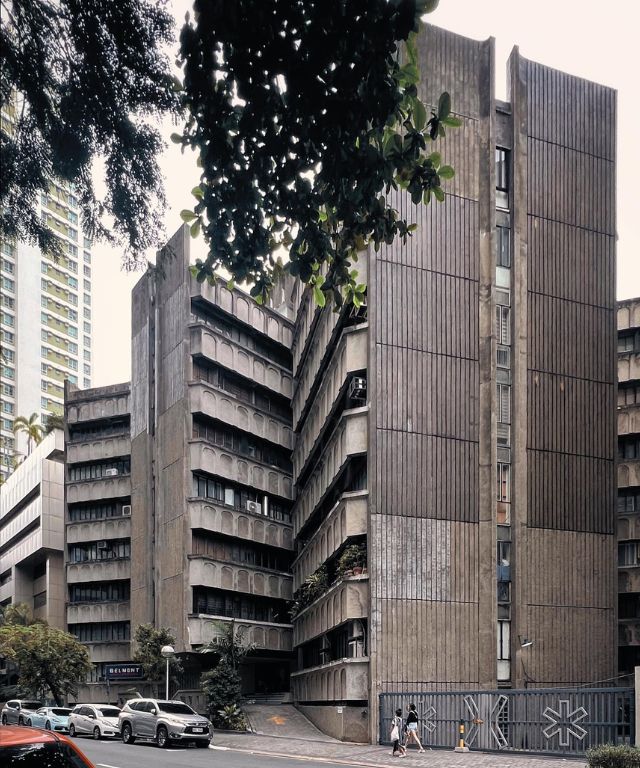
Architect: Antonio Mercado
Year of completion: 1973
The asterisk-shaped building is hard to miss, and while it looks grand as is, we implore you to seek a bird's-eye view on Google, too. The Legazpi Tower 100 is the only residential building on this list, so while you can look at it safely from a distance, do keep in mind it's technically a private space, which means there might be a chance you won't be allowed to enter. It's one of those buildings whose front and back you can see unimpeded. The facade is very textural and the entire structure just very photogenic, says Kasingsing.
The Legazpi Tower 100 is at Legazpi Street, Legazpi Village, Makati City.
Dominion Building
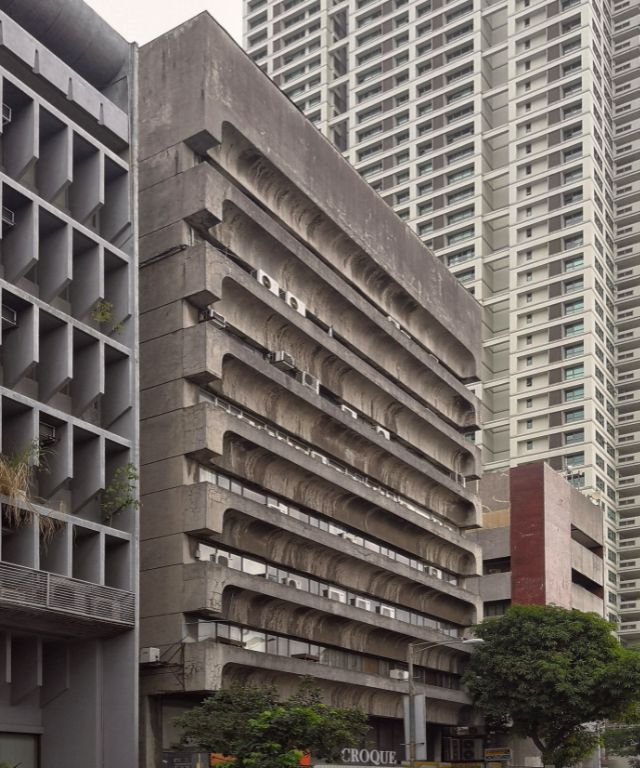
Architect: Arcenas Payumo Dee Andrews Architects (APDA)
Year of completion: 1980
Like the Makati Stock Exchange that exists as a major character along Arnaiz, the Dominion Building on the same avenue is also a character worth a visit and a snap or two. What's most striking about it is the facade formed by stacks of handlebar-shaped slabs. It used to host the office of the group from where it takes its name. It's also one of those buildings where you can take pictures of its front and back without obstruction.
The Dominion Building may be less imposing compared to its contemporaries on the list, but it has a commanding presence all the same. If we were to compare to a much smaller, everyday object, it’s like several long staples wires piled high—surely the beginnings of some architectural sense in kids.
The Dominion Building is at Antonio Arnaiz Avenue, Legazpi Village, Makati City.
ODC International Plaza Building
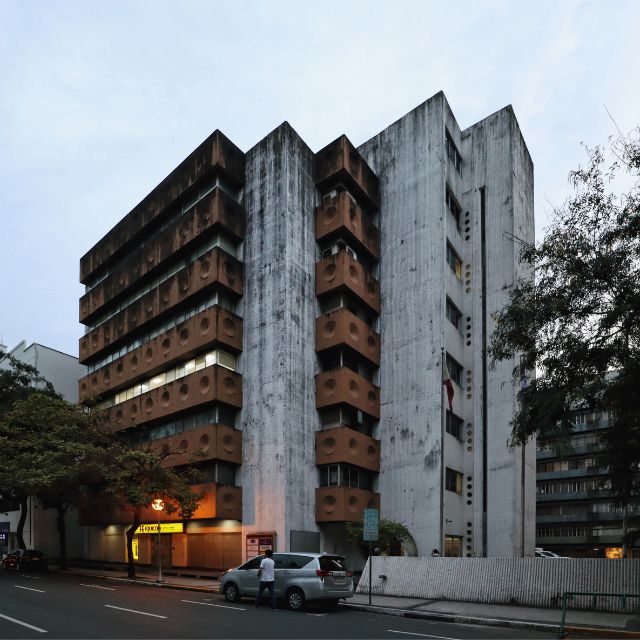
Architect: Antonio Heredia
Year of completion: No data
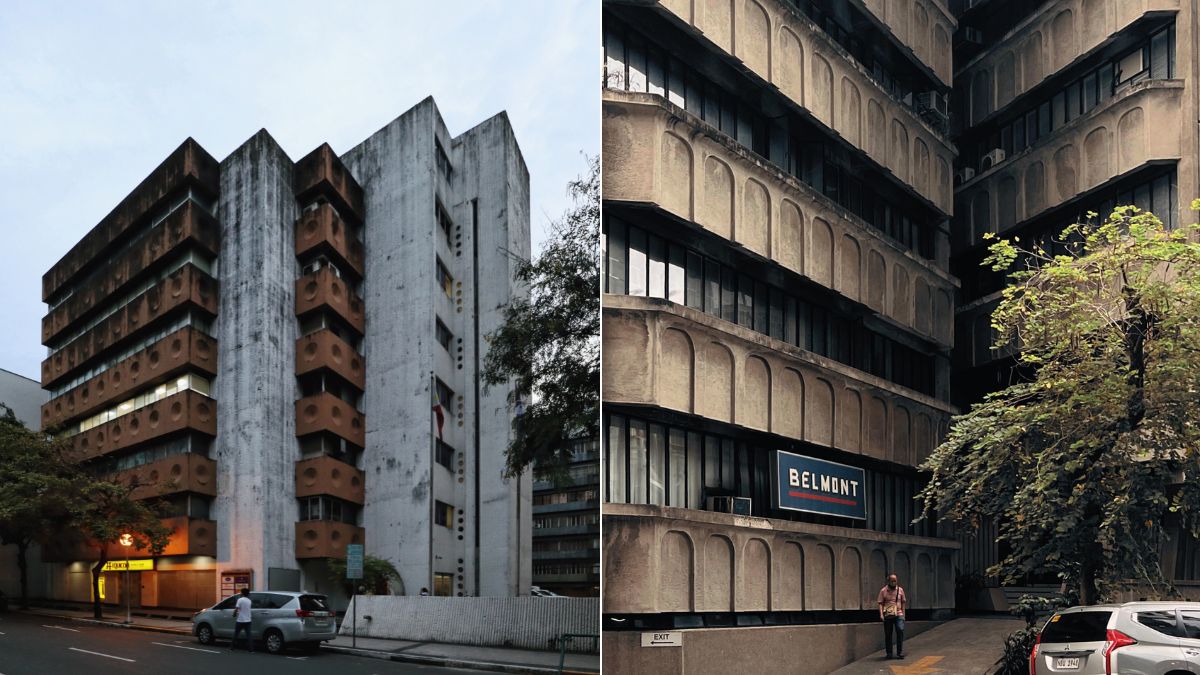
Not going to lie, very little is known about this building, even the guys from Brutalist Pilipinas have not been fortunate to stumble upon more information. We do know that the ODC International Plaza Building was designed by architect Antonio Heredia and sits on Salcedo Street in Legazpi Village. Perhaps what sets it apart from the other buildings on this list is the striking touch of a brick hue present in the structure's facade. It also has concave circles carved into each red block and circular holes running down the building’s side which create contrast against the sharp lines and dominance of squares. Should you want to drop by for a visit, it's located in front of the Office of the Solicitor General. This Gen Z magnet, says Kasingsing, has always given him Metabolist-Tokyo vibes.
The ODC International Plaza Building is at Salcedo Street, Legazpi Village, Makati City.
The Atrium of Makati
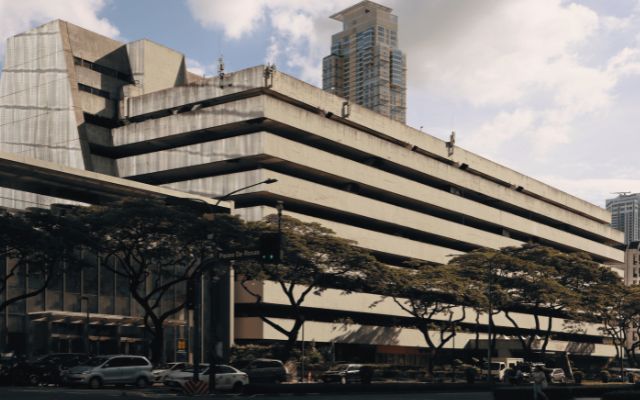
Architect: Jose Maria Zaragoza
Year of completion: 1983
While The Atrium of Makati's facade is a little painted, "the function is revealed in the form which is very brutalist," says Infante about this low-rise building that looks a lot like a horizontal chart. Step inside and you'll find yourself in the middle of rectangles stacked upon one another, all connected by escalators and topped by arched winows. It's like stepping into one of those 80s movies set in Makati's concrete offices. It's also where Convenience Coffeehouse is located, and where Brutalist Pilipinas' latest exhibition is held. Be sure to visit unitl May 11!
The Atrium of Makati is at Makati Avenue, Urdaneta Village, Makati City.
Also read: This Church Is a Marker of Poblacion's Centuries-Old Heritage