
Here's Why Ramadan Falls on Different Dates Every Year
Maybe next time you can anticipate when the next holiday falls.

(SPOT.ph) Ramadan—a sacred month marked with fasting, prayer, and introspection for Muslims—happens for one month each year, and for the mostly Christian population in the Philippines, its start and end are marked with regular holidays. Unlike other regular holidays though, the highly-anticipated Islamic holy days aren't fixed on the calendar and may be a surprise announcement each time for non-Muslims.
Muslims follow the Islamic lunar calendar, that's why the actual activities—and the holiday declarations of the government—differ annually, according to university researcher Kamaruddin Bin Alawi Mohammad of the Institute of Islamic Studies , University of the Philippines-Diliman.
"Governed siya ng lunar phases... doon bine-base ang pagbibilang ng araw ng activities and celebrations ng Muslim communities," he told SPOT.ph in an interview.
For 2023, April 21 is declared a regular holiday to observe Eid al-Fitr, or a festivity that marks the end of Ramadan. In 2022, May 3 was the declared Eid al-Fitr holiday. In 2021, it fell on May 13.
Take note though that the exact date of Eid al-Fitr in the Philippines will still depend on moon sightings in several parts of Mindanao on April 20, according to the Islamic Advisory Council of the Bangsamoro Autonomous Region in Muslim Mindanao (BARMM).
Also read:
EXPLAINER: What is Ramadan and Why Does it Require Muslims to Fast?
10 Interesting Ramadan Facts to Learn Right Now
What You Need to Know about Ramadan
Ramadan is the ninth month in the Islamic calendar and is one of its most sacred months. During this time, Muslims undergo strict fasting from food, drink, sexual activities, and any basic human desire between dawn and dusk so they can increase worship-related activities.
Muslims also believe that the first verses of the Qu'ran was first revealed to the Prophet Muhammad—Allah's messenger—during the Ramadan.
Fasting (or "sawm" in Arabic) is just one of the Five Pillars of Islam, which also includes Shahada (Declaration of Faith), Salah (Prayer), Zakat (Almsgiving), and Hajj (Pilgrimage).
How to Determine the Start and End of Ramadan
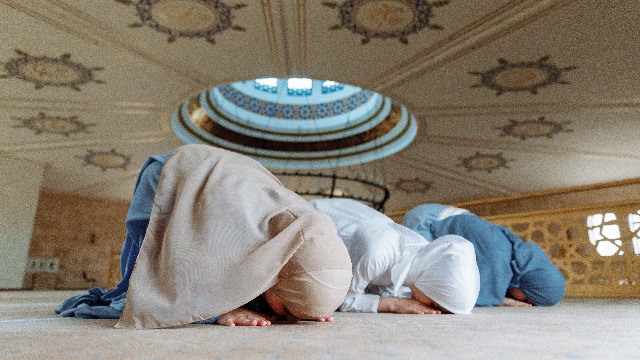
Muslims turn to the moon for guidance as the Islamic calendar uses the lunar cycle—based on the monthly phases of the moon—which is shorter by 10 to 11 days compared to the Gregorian calendar, a solar calendar that we use around the world.
Muslims follow the Hijri calendar—also with 12 months—which starts with Prophet Muhammad's hijra (migration) to Medina from Mecca to escape persecution, said Mohammad.
Ramadan begins and ends with the appearance of the crescent moon, a symbol we also see atop mosques. For Eid al-Fitr, moon-sighters look for the Shawwal moon, which marks the 10th month of the Islamic calendar.
It's based on the Sahih Muslim Hadith Number 2378 as narrated by Abu Hurairah: "Whenever you sight the new moon (as of the month of Ramadan), observe fast. And when you sight it (the new moon of Shawwal), break it. If the sky is cloudy for you, then observe fast for 30 days."
"Kapag maayos ang weather, ibig sabihin hindi malabo kalangitan o cloudy, hindi dark, hindi uulan, hindi umaambon—basically makikita talaga ang buwan kasi clear ang kalangitan," said Mohammad.
"'Pag di nakita ang moon, ang gagawin, the next day which is [April] 21, supposedly ine-expect natin talaga ang Eid, fasting pa rin kami. Tuloy ang fasting, gagawing 30 days."
Once you understand this, it's easier to estimate when the Islamic holiday will fall the following year.
In 2017, Eid fell on June 25. In 2018, June 15. In 2019, June 5.
In 2020, it fell on May 24. May 13 in 2021, and May 2 in 2022.
This year, 2023, it may fall on April 21. See the pattern yet?
"In three years (2017, 2018, and 2019) tuloy-tuloy siya same month tapos minus 10, paatras siya. Sa years na 2020, 2021 at 2022 naman, 11 days naman siya paatras. So ine-expect natin this year, 2023, April siya. So expect another three years na puro April based sa nakita nating trends," Mohammad said.
Take note that Eid may be celebrated on different days in different parts of the world too. It's like New Year's Eve, when Australia celebrates it first before the Philippines because of our timezone differences.
"Each land has its own sighting of the moon, and if they see the crescent in one land, that does not necessarily apply to regions that are far away from it," according to the Sahih Muslim, specifically Number 1087, said Mohammad.
Side note: Eid al-Fitr shouldn't be confused with another regular holiday, Eid al-Adha, or the Feast of Sacrifice by the 12th month of the Islamic lunar calendar, which commemorates Ibrahim's willingness to sacrifice his son Ismail to Allah.
"Plainly, ganun lang naman ibig sabihin dahil naniniwala tayo na ang Prophet Muhammad hindi n'ya papahirapan ang next generation of Muslims. The simpler, the better. It transcends time. Applicable siya ng panahon nila, applicable din sa panahon natin," said Mohammad.
Also read:
The SPOT.ph Guide to Chavacano Cuisine in Zamboanga
LOOK: This McDo Branch in Zamboanga Is Home to Muslim Prayer Rooms