

'Ladlad': 30 Years Of Unfurling the Cape and Paving The Way
A queer world I had not known before suddenly opened up before me.
(SPOT.ph) In 1994, I was nineteen, a twink lost in the world the way only someone who came of age in the 1990s could be. I had no idea I was a twink—that was queer nomenclature I would only come to know in my worldly thirties and the world had evolved enough to have specific names for what used to be an identity no one talked about in polite circles. I had no idea either what to make of the surging tempests I had inside of me as I braved the hormones of adolescence and took in, without a map, the hazy landscape of desire you could not deny a young man at the beginning of his prime.
This was three years before Ellen DeGeneres famously came out on American television via her eponymous sitcom and unleashed a cultural touchstone for what Oscar Wilde used to describe, a hundred years before, as “the love that [dared] not speak its name.” [Actually, it was his lover Lord Alfred Douglas who penned this line in a poem, but the phrase was used in Wilde’s gross indecency trial which would decisively blanket in silence all manner of things gay, until cracks appeared in 1969 because of the Stonewall Riot.] This was four years before Will & Grace would grace our television screens and pave the way for mainstream acceptance of characters who just happened not to be heterosexual. In the Philippines, the show was carried by Studio 23, a UHF channel that largely escaped conservative notice simply because it was a smaller station and catered to a niche audience.
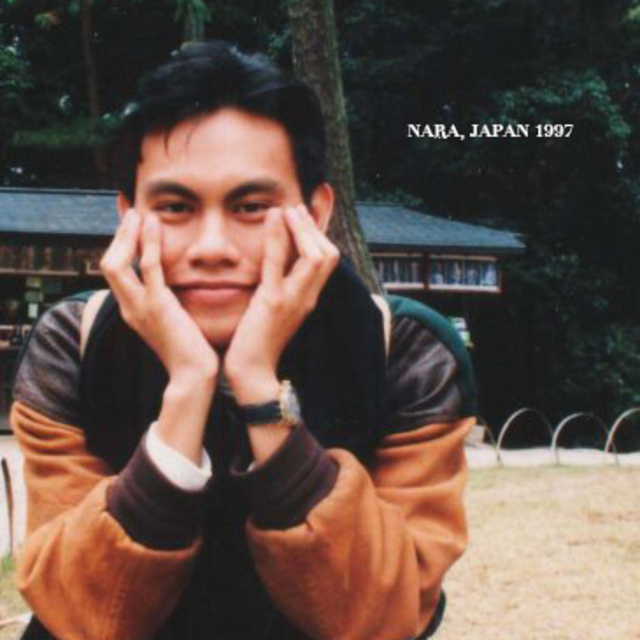
Bala, lipstick at Ladlad
In the Philippines, at least in popular culture, to be gay was defined largely by the movies—and for about 50 years since Nemesio E. Caravana toyed ever so lightly with the notion of queer attraction in Kaaway ng Babae (1948), to be gay for the Filipino was to live out a phase awaiting eventual heterosexual conversion, such as in Tony Cayado’s Kaming Mga Talyada (1962). Or to wallow in guilt and ennui (and camp), such as in Danny Zialcita’s suite of queerness in Si Malakas, Si Maganda, at Si Mahinhin (1980), Mahinhin vs. Mahinhin (1981), T-Bird at Ako (1982), and Lalakwe (1985). Or to identify with Dolphy’s definitive caricature of the sissy in Jack and Jill (1954), which would generate decades-long copycats in many movies starring Roderick Paulate, Joey de Leon, and Herbert Bautista. In 1994, Paulate famously played twins separated at birth in Maryo J. de los Reyes’ Bala at Lipstick, where one twin is a tough guy and the other an enterprising shrill running a beauty parlor.
Also read: 10 Philippine LGBTQ+ Books To Read This Pride Month
The year also saw Mel Chionglo release Midnight Dancers, a spiritual sequel to Lino Brocka’s Macho Dancer (1988), which also largely defined the Filipino gay experience as one that is seen largely through the eyes of (an often straight) male stripper. The early 1990s were not a good time to find complex gay representation in Filipino pop culture.
I was a budding cineaste then and definitely heard of Chionglo’s film—which came to me in bootleg VHS through God knows what source. (Perhaps a neighborhood video store?) I must have played that movie a hundred times on the family VCR, always discreetly and in the dark cloak of night—hoping my Born Again mother would not rouse from her sleep and catch me.
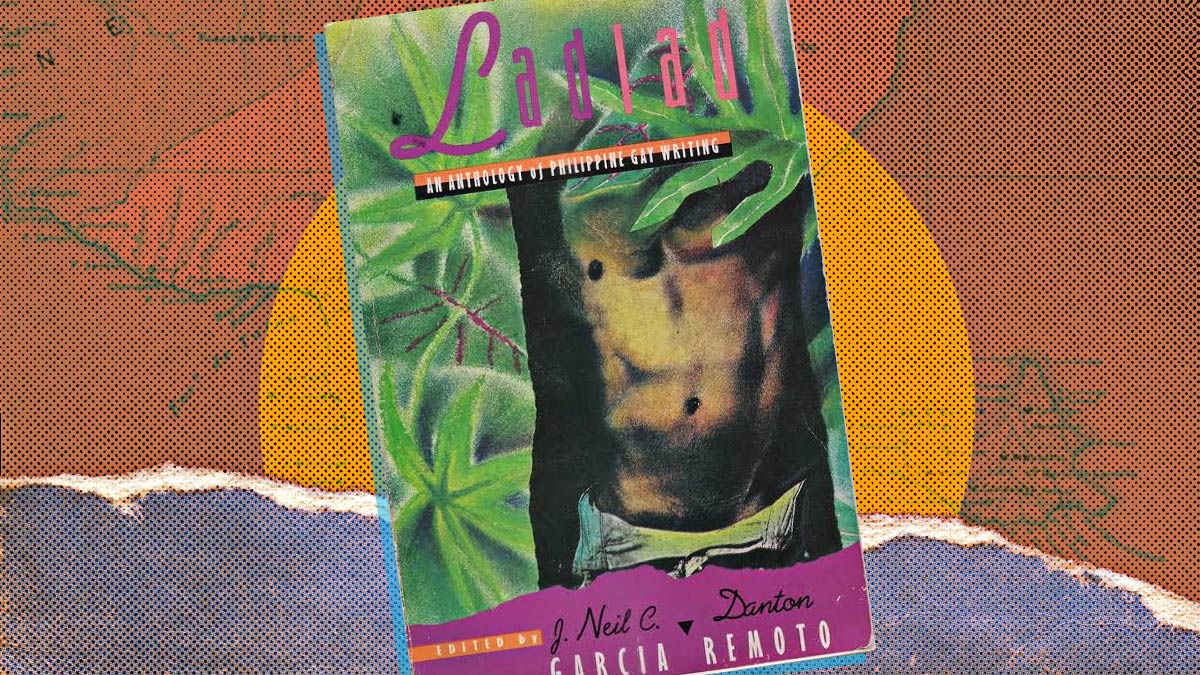
It was with the same delicious trepidation that I would come across a copy of the first Ladlad, which described itself in its subtitle, and in such an arrestingly forward manner, as an “anthology of Philippine gay writing.” There was no mistaking it for anything other than what it declared itself to be. The simplicity of that admission would create such an upheaval that thirty years later it would be difficult to ignore the fact that for many gay people in the Philippines, the publication of this book could very well be our own version of the brick thrown at Stonewall Inn. (If we allow Rizal’s Noli Me Tangere as the book—a book!—that created the Philippine nation, we can allow Ladlad to occupy the same defining place in our history, albeit in queer terms.)
My brother, my smuggler
I was in my first years at college in Dumaguete City when Anvil Publishing came out with Ladlad, and I had seen it on a visit with family to Cebu City where one of my regular stopovers happened to be the National Bookstore along Mango Avenue. In those days, I was beginning to entertain the idea that I could be a writer, and was slowly devouring what books caught my eye at the Filipiniana section. The cover—of a man’s alluringly naked torso hidden by bright foliage, punctuated by the suggestion of the open zippers of his denim pants—was catnip for me. I remember taking the book off the shelf, beholding the editors’ holy names, and absorbing the description at the back cover—and felt only electricity. I had to have it.
But how? I had no money. Not the kind the price tag asked for anyway. And I could not of course ask my mother to buy it for me, the way I had asked her to buy me the soundtrack [in cassette tape] of Jurassic Park, which came out also that year. I put the book back on the shelf, my interest stoked, my desire to open its pages ravaging.
Back home in Dumaguete, I had casually asked my brother Edwin if he could get the book for me on one of his regular trips to Cebu without telling him what it was all about. But I knew he would understand. He was also gay, like me—although he never would officially come out to the family. (I have five older brothers, and three of us are fabulous.) When he came back home, he handed me the package without ceremony, and there it suddenly was, the book wrapped in brown paper like contraband.
I was blind but now I see
I must have read the entirety of that book in one long breathless night. A queer world I had not known before suddenly opened up before me in the way only literature can. It introduced me to poets, many of whom would soon come to be friends— Danton Remoto, J. Neil C. Garcia, Ronald Baytan, Ralph Semino Galan, Nicolas Pichay, R. Zamora Linmark, and Vim Nadera, among others. Remoto’s sad and elegiac “The Way We Live” suddenly became an anthem for me—painting a gay world I did not know about that was all ennui and loss: “Bang the drum slowly, baby, / let us roll tremors / of sound to wake / the Lord God of motion / sleeping under the skin.” I felt my own skin shaking awake.
The three one-act plays the book featured—“Kuwan” By Jun Lana, “Last Full Show” by Chris Martinez, and “Esprit de Corps” by Auraeus Solito—dramatized the horrors and the hallelujahs of gay existence in the country. Michael L. Tan’s essay “Sickness and Sin: Medical and Religious Stigmatization of Homosexuality in the Philippines” provided vital information of the social milieu of understanding queerness someone like me then could never come across, even if I tried. (The internet was still in its infancy—a rumor of technological wonders in our corner of the world.)
And then there were the stories, 13 in all—four of them my favorites. Honorio Bartolome De Dios’ “Geyluv” tantalizingly followed the trajectory of a friendship between a gay man and his straight best friend—with all the usual complications that kind of a relationship often entailed. Jimmy Alcantara’s “Red ang Luha ni Michael” allowed me insight into a dark and comic story about a gay couple whose lives are upended by mental illness, but somehow told in deep notes of tenderness. Earl Navarro’s “Ang H.P. at si Danny” gave me a map on cruising in department stores, a reality lightyears before Grindr. Jaime An Lim’s “Hedonicus” ushered me into the bowels of a bathhouse, which terrified me. And Vicente Garcia Groyon’s “Boys Who Like Boys” gave me stirringly rendered episodes of a young boy’s sexual awakening that somehow mirrored my own—that nipple-pinching locker room play among boys? that encounter in a magazine of the famous Calvin Klein ad with Marcus Schenkenberg in the shower? that foreign film on videotape being watched by friends suddenly showing a scene with two guys kissing? And that immortal ending: “Your pretty girlfriend flickers for a moment in your mind. But she is whisked helplessly away as you think how much you like being with him and as, unwilled, your eyes begin to sparkle for real.”
My eyes sparkled for real when I finished reading Ladlad for the first time. I was blind, like so many others like me before 1994—but I could finally see. In pink.
On the verge of a pink revolution
J. Neil C. Garcia and Danton Remoto’s groundbreaking anthology came at the right time, when the world was quietly changing and popular culture was on the verge of a pink revolution. “I wanted to have a book on homosexuality that was not on psychology or so-called spirituality. I wanted gay men to talk about their experiences in their own voices,” Remoto remembers of that first idea to come out with the anthology. It did just that—with authors for the first time bearing their by-lines without the usual cloak of anonymity.
“Why was I interested in gathering gay texts by Filipinos together, and getting them published? Simple: because it was the right thing to do!” Garcia says. “Even then, Danton and I knew that making available to our young ‘queer’—let’s use this word now, since it’s more germane and in many ways better because conceptually more capacious—readers the very best stories, poems, essays, and plays that openly and proudly talk about the reality and truth of queer life and love was the right thing to do. Then as now, these texts can serve as lifelines to our queer kids, who need to be empowered to believe in the value of their own truths, of their own desires and longings—their own embodied self-understandings, their own lives.”
Indeed, Ladlad was my lifeline—and my portal to understanding who I was as a man with a nascent queer identity.
Ladlad was followed closely in 1996 by Garcia’s academic tome, Philippine Gay Culture: Binabae to Bakla, Silahis to MSM, and both books provided the charge that led to a closer—and sympathetic—examination of gay lives. Ladlad led to other gay books, notably Tibok: Heartbeat of the Filipino Lesbian, edited by Anna Leah Sarabia in 1998. It led to a profusion of gay movies that moved beyond the usual sissy or macho dancer narrative, like Carlos Siguion-Reyna’s Ang Lalaki sa Buhay ni Selya (1997), Gil Portes’ Miguel/Michelle (1998), Joel Lamangan and Eric Quizon’s Pusong Mamon (1998), Maryo J. de los Reyes’ Sa Paraiso ni Efren (1999), Crisaldo Pablo’s Duda (2003), Brillante Mendoza’s Masahista (2005), Auraeus Solito’s Ang Pagdadalaga ni Maximo Oliveros (2005), Joselito Altarejos’ Ang Lalaki sa Parola (2007) and Ang Lihim ni Antonio (2008), Francis Xavier Pasion’s Jay (2008), and Adolfo Alix Jr.’s Daybreak (2008)—a ten-year wave of outstanding and influential Filipino gay films that could be considered a kind of a golden age.
Also read: 10 Happy LGBTQ Movies
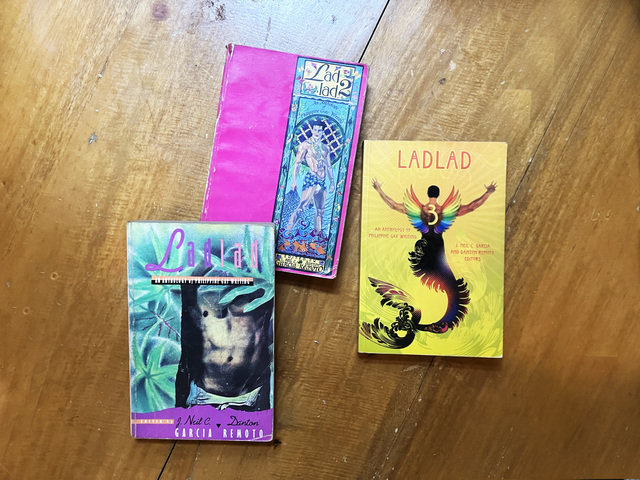
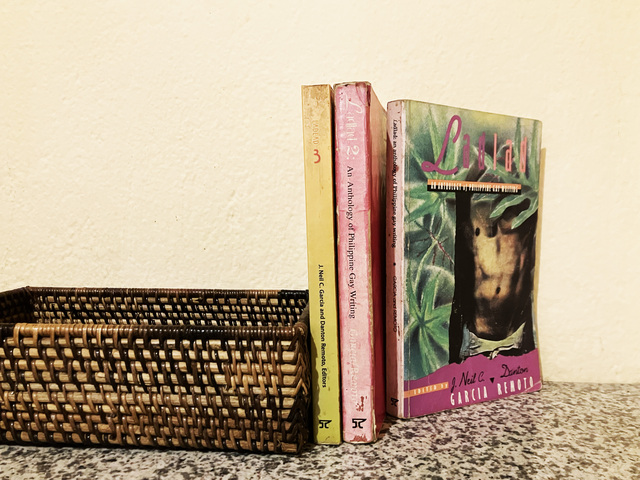
The book led to a college course on gay culture in 1994, a first at the University of the Philippines (or elsewhere), taught by Garcia—an educational sea change so peculiar for its time it invited news cameras to cover the class. It led to a political party, also called Ladlad, founded in 2003 by Remoto himself. It also led to two sequel anthologies, Ladlad 2 (in 1996) and Ladlad 3 (in 2007), where I would finally be able to contribute my own piece, a gay children’s story. The Best of Ladlad would come out in 2014, for the first book’s twentieth anniversary. The first remains a veritable bestseller.
Unfurling of the cape
Its place in Philippine literature and culture is sacrosanct. “The strongest legacy [of Ladlad] is [giving] a platform—in a book by a major publisher—for gay writers in English, Filipino, and the regional languages,” Remoto says. “We especially solicited for writings in Filipino and writings from the regions to balance the predominant language—English—and the geographical origin of many of the writers, which was Luzon and Metro Manila.”
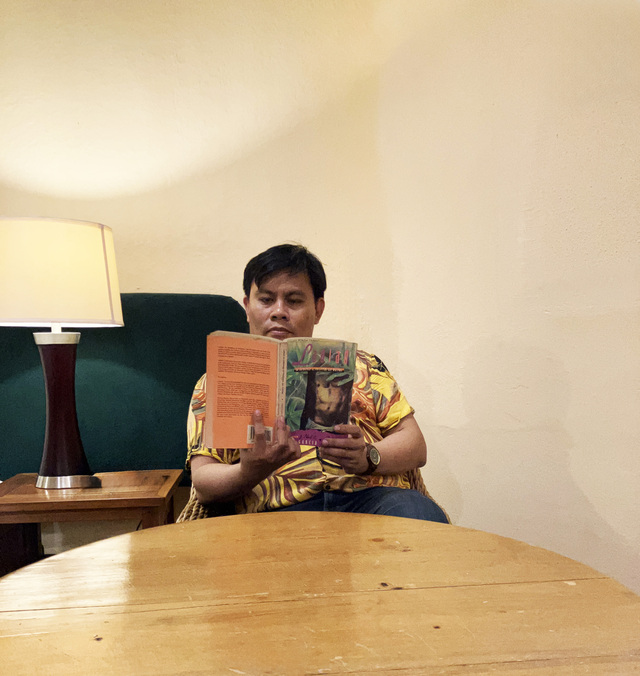
For Garcia, its continuing relevance is its biggest legacy. “Being our country’s earliest published showcase of outstanding queer literary creativity, the Ladlad books, even then, aside from opening political, academic, and cultural doors to our queer creatives and arguably jumpstarting the Philippine LGBTQIA+ movement—by, among other things, articulating queer-affirmative intuitions and thematizing in the public sphere identifiably queer issues like coming out, self-acceptance, familial connections, spirituality, erotic love, etc.—already beautifully and powerfully performed this truth into being. Because copies of these books are possibly still kicking around (in our bookstores, or online), hopefully they still are— along with all the other fabulous and amazing queer art works and books being produced by our people, that they doubtless ethically and aesthetically enabled or inspired—continuing to beautifully and powerfully perform this truth even now.”
The word “ladlad” is Tagalog for “coming out,” from the swardspeak “pagladlad ng kapa,” which is literally, “unfurling one’s cape.” Thirty years later, I like all the subtle play of words the title of this pathbreaking book took on. The book was veritably our “coming out” in the Philippines, and like that image of the unfurling of a cape rooted in its etymology, it did it so fabulously.
Ian Rosales Casocot is an award-winning writer of fiction, drama and poetry.