

These Are the Jeepney Routes Affected by Feb. 1 Deadline
Here's how to check if your commute route will still exist.

(SPOT.ph) Nearly 2,000 jeepneys and UV Express routes may be discontinued by February 1 based on available information from the Land Transportation Franchising and Regulatory Board. This development follows the expiration of the temporary extension provided by the LTFRB for jeepney drivers to either register individually or join cooperatives, a step in implementing the government's Public Utility Vehicle (PUV) Modernization Program.
"Unconsolidated jeepneys have been granted a temporary extension to operate in areas with less than 60 percent consolidation until January 31. After this date, they will be barred from routes with over 60 percent consolidated PUVs," Memorandum Circular No. 2023-052 from LTFRB said. After this date, routes with low consolidation rates will be discontinued unless other consolidated PUVs take over or the vehicles continue to operate without formal approval, known colloquially as "colorum" vehicles.
As of January 25, the deadline for jeepney consolidation has been moved to April 30.
Jeepney and UV Express routes affected by the consolidation deadline:
LTFRB has yet to publicize a complete list of jeepney routes affected by the deadline for consolidation. However, news networks like GMA Integrated News Research and Rappler have developed an estimated database based on the available LTFRB data. Numbers have reached a total of 1,948 routes for both jeepneys and UV Express nationwide.
Up to 395 jeepney and 108 UV Express routes in Metro Manila alone can be wiped out, according to Rappler. GMA Integrated News Research counted it to be 320 affected routes for jeepneys.
You can check if your usual commute route is affected through Rappler's database. Just key in the street, barangay, or city, and then the status of the consolidation rate is indicated. Those with "No Consolidated Entities" are highlighted in red, which means that the route will possibly be wiped out.
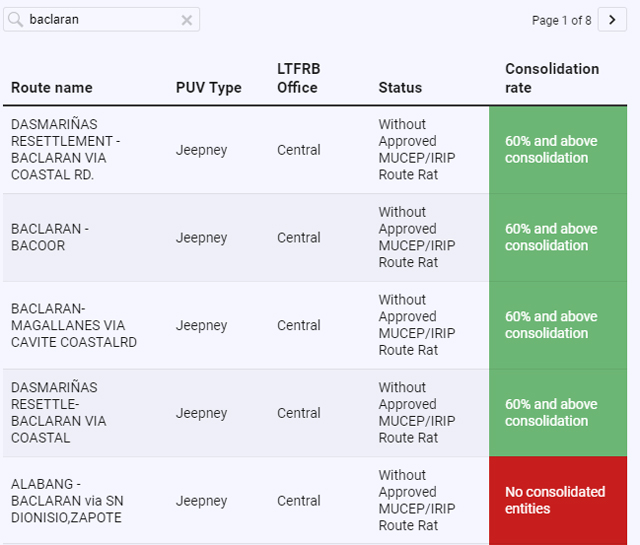
Here are the number of routes per region without consolidated jeepneys, according to GMA:
- NCR - 320 affected routes
- Ilocos - 189
- Cagayan - 74
- Central Luzon - 62
- Calabarzon - 166
- Mimaropa - 140
- Bicol - 451
- Western Visayas - 69
- Central Visayas - 0
- Eastern Visayas - 23
- Zamboanga - 57
- Northern Mindanao - 35
- Davao - 13
- Soccsksargen - 0
- CAR - 93
- Caraga - 0
Here are the number of routes per region without consolidated UV Express units, according to GMA:
- NCR - 76 affected routes
- Ilocos - 15
- Cagayan - 2
- Central Luzon - 4
- Calabarzon - 6
- Mimaropa - 4
- Bicol - 7
- Western Visayas - 3
- Central Visayas - 0
- Eastern Visayas - 21
- Zamboanga - 2
- Northern Mindanao - 7
- Davao - 1
- Soccsksargen - 0
- CAR - 1
- Caraga - 0
Drivers, operators, and commuters have already expressed their concerns about the PUV Modernization program, including mobility issues. Critics have also voiced out fears of massive job losses amid jeepney phaseout, fare hike, and disruptions in public transportation. Meanwhile, transport group PISTON has warned of a potential "mass transport disaster" as thousands of drivers and operators face displacement.
Despite these concerns, the Department of Transportation (DOTr) maintains that there will be no transportation crisis. LTFRB Chairman Teofilo Guadiz told CNN Philippines' The Source that they have two backup plans: one is the availability of rescue vehicles for one to two weeks, and the second is allowing jeepneys to ply the adjoining route through special permits should there be a need.
Transportation Secretary Jaime Bautista has indicated that a 65% consolidation rate nationwide would be sufficient to progress with the jeepney modernization efforts. The government plans to rationalize the routes by potentially eliminating those that overlap with longer, consolidated routes.
UPDATED (January 25, 11:45 a.m.): This article has been updated to include the deadline extension on April 30.