
PAGASA Releases Typhoon Names in the Philippines for 2024
Find out how the weather bureau names typhoons.

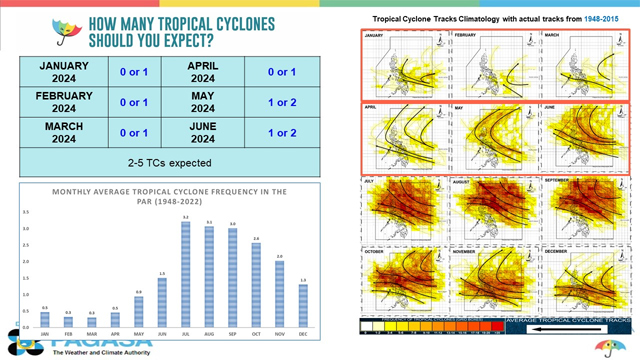
(SPOT.ph) As the Philippines braces itself for another year of weather disturbances, the Philippine Atmospheric, Geophysical, and Astronomical Services Administration has released the names of typhoons for 2024. With an average of 20 typhoons hitting the archipelago annually, the names become crucial to public safety announcements, news updates, and community alerts.
Typhoon Names in the Philippines for 2024
- Aghon
- Butchoy
- Carina
- Dindo
- Enteng
- Ferdie
- Gener
- Helen
- Igme
- Julian
- Kristine
- Leon
- Marce
- Nika
- Ofel
- Pepito
- Querubin
- Romina
- Siony
- Tonyo
- Upang
- Vicky
- Warren
- Yoyong
- Zosimo
In case we use up the initial list of 25 tropical cycles, the weather agency also has 10 backup names of typhoons:
- Alakdan
- Baldo
- Clara
- Dencio
- Estong
- Felipe
- Gomer
- Heling
- Ismael
- Julio
Also read: Why Does PAGASA Name Typhoons After People?
History of Typhoon Names in the Philippines
Then called the Philippine Weather Bureau, the local weather agency started naming storms within the Philippine Area of Responsibility in 1963 using female Filipino names ending in "ng." Some of the most notable ones were Yoling (197), Sisang (1987), and Diding (1991). This was patterned after the practice of the Joint Typhoon Warning Center in the Western Pacific, which used only female names from 1945 to 1979. The Philippine Weather Bureau was abolished in 1972, and all duties were transferred to the new PAGASA.
By 2000, the monitoring in the Western was transferred to the Japan Meteorological Agency (under the World Meteorological Organization), which uses a list of names contributed by 14 nations in the region. They have 140 names, which are used in order and not restricted by year. These are the international names you would often hear on news reports alongside the local name of the typhoon. The following year, PAGASA revised its scheme to have a longer list and more mixed names, not limited to female ones.
PAGASA's naming scheme, on the other hand, has four sets of 25 names arranged alphabetically. Every typhoon season (or every year) begins with the first name on the list, which obviously starts with the letter A. Whether or not all the names in the list (and backup list) are exhausted, the following year will use the next set.
Other names are retired and replaced, and this is specific to when a tropical cyclone causes at least 300 deaths and/or P1 billion worth of damage to agriculture and infrastructure. The decommissioned name is replaced by another name starting with the same letter.
The 2024 set, previously used in 2020, has decommissioned Typhoon Ambo, Typhoon Quinta, Super Typhoon Rolly, and Typhoon Ulysses. The new names are Aghon, Querubin, Romina, and Upang.
Understanding Weather Disturbances: When Do They Get a Name
Before a weather disturbance is named, it goes through several stages, each with its classification criteria in PAGASA's Tropical Cyclone Intensity Scale.
Low-Pressure Area (LPA)
An LPA is a weather system with lower atmospheric pressure than its surrounding locations. It can develop into a more severe weather disturbance without organized circulation.
Tropical Depression
Once an LPA shows organized circulation and sustained winds of up to 61 kilometers per hour (kph), it becomes a tropical depression and receives a name.
Tropical Storm to Severe Tropical Storm
If the system intensifies, reaching sustained winds of 62 to 88 kph, it becomes a tropical storm. Further intensification with winds exceeding 89 kph classifies it as a severe tropical storm.
Typhoon
When the system has sustained winds from 118 to 184 kph, it is classified as a typhoon.
Super Typhoon
A super typhoon is a term only used by PAGASA when sustained winds exceed 185 kph. This classification indicates an extremely dangerous system with potential for widespread damage. Before 2022, a super typhoon was defined as a weather disturbance with sustained winds not lower than 220 kph. The range was later revised.
Also read:
The Category Is Depression: Tropical Cyclones, Other Bagyo Terms Explained
The SPOT.ph Guide to What to Do Before, During, and After a Typhoon