
Hello, PhilHealth Contributors: Your Health Insurance May Last Only Until 2027, Says Exec
Amid the annual premium increase and the P15 billion issue.
(SPOT.ph) The Philippine Health Insurance Corporation (a.k.a. PhilHealth), the country's health insurance program, is once again making the headlines. Why? Because it seems our state-run health insurance only has until 2027 to live, according to PhilHealth officer-in-charge Eli Dino Santos during the House Committee on Appropriations hearing on Monday, September 12. And that's the situation even with funding from the Philippine Amusement and Gaming Corporation and the Philippine Charity Sweepstakes Office. Santos was joined by PhilHealth PCOO Walter Bacareza during the hearing at Nograles Hall.
What did PhilHealth's Santos say about funding?
At the 3:58:56 mark of the public hearing's recorded video, Anakalusugan party-list Representative Ray Florence Reyes asked the PhilHealth executives: "Do we already have...We asked last week if we already have the actual fund life of PhilHealth, basically the fund that we have for PhilHealth so we can continue our services."
Santos tried to defer the question to senior vice president Nerissa Santiago, but committee vice chairperson and Marikina 2nd District Representative Stella Quimbo and Reyes pushed him to answer the inquiry. "That kind of information should already be available, especially to people who are already in this meeting," Reyes added.
"I have here part of the submission of PhilHealth," he started after a member of the staff handed him a tablet. "If PhilHealth receives the government subsidy for indirect contributors as well as the Philippine Amusement and Gaming Corporation (PAGCOR) share and the Philippine Charity Sweepstakes Office (PCSO) share, we estimate that we will survive beyond 2027," Santos told the committee.
"We have another scenario, Madam chairperson, if we will only receive PAGCOR and PCSO support for 2023, per DBM-recommended (Department of Budget and Management) NEP (National Expenditure Program) the subsequent years, we will have until 2027, Madam chairperson. But if we have no further support, Madam chairperson, by 2027, based on the projection of PhilHealth, we will only be until 2027." he continued. But he requested that they be allowed to confirm this information with Santiago.
The PhilHealth officer-in-charge explained that they "will last beyond the year 2027" if they "receive all subsidies from the government and implement the programs of PhilHealth."
Reyes asked how they can "extend the life of this fund," to which Santos reiterated the necessary support from the national government, PCSO, PAGCOR, and sin tax revenue.
Baguio City Representative Mark O. Go also asked why there's an increase in PhilHealth's request for budget, from P80 billion pesos in 2022 to P100 billion pesos in 2023. This, according to Santos, is supposed to cover the PWD, the unemployed, "financially incapable" members, and senior citizens; then later clarified that the request for a budget increase is for the "improvement of the benefit packages of PhilHealth."
Also read:
Everything You Need to Know About PhilHealth
All the Times PhilHealth Came Under Fire for Alleged Fraud
A P100 Million Laptop, 130-Year-Old Members + More Strange Things Happening in PhilHealth
Quimbo says otherwise about PhilHealth's fund life
Later in the same hearing, however, Quimbo warned PhilHealth executives about making such pronouncements.
When she asked how much PhilHealth's net income was for 2021, Santos said that they had P171.2 billion worth of income. Deducting P140.2 billion as benefit expenses and P7.8 billion as operational expenses, then adding P9.7 billion from other income, the net income is at P32.8 billion, as detailed in an Inquirer report.
"So that’s good news—because every time we ask about the actuarial life of PhilHealth, you always tell us that PhilHealth is about to die," Quimbo said.
PhilHealth's Fund Life Until 2027
But this isn't the first time that PhilHealth revealed that its existence would last only until 2027.
In September 2021, Santiago also said during a House hearing that the insurance program's projected actuarial life is only until 2027. This is due to projected net losses, which were estimated to reach P57 billion given the COVID-19-related claims.
Back then, Quimbo questioned why PhilHealth was shouldering the medical consultation package, which should have been paid for by the Department of Health.
So, what's up with PhilHealth now?
Who Pays for PhilHealth
At present, PhilHealth—aside from the two mentioned government agencies—is getting funding from "Direct Contributors," who pay a premium (either through salary deduction or voluntary payment) for their membership in the health insurance program.
The "Direct Contributors" are:
- Employees with formal employment
- Kasambahays
- Self-earning individuals; professional practitioners
- Overseas Filipino Workers
- Filipinos living abroad and those with dual citizenship
- Lifetime members
- All Filipinos aged 21 years and above with the capacity to pay
"Indirect Contributors"—which Santos mentioned during the hearing as an additional source of revenue through government subsidy, do not pay for anything, but can receive benefits from PhilHealth should the need arises.
The "Indirect Contributors" are:
- Indigents identified by the Department of Social Welfare and Development
- Beneficiaries of Pantawid Pamilyang Pilipino Program
- Senior citizens
- Persons with disability
- Sangguniang Kabataan officials
- Previously identified at point-of-service / sponsored by LGUs
- Filipinos aged 21 years old and above without the capacity to pay premiums
How Much Are We Paying for PhilHealth
For the formally employed, PhilHealth premium is automatically deducted from the monthly basic salary. Rates increased in 2022, based on the "Premium Contribution Schedule in the National Health Insurance Program (Revision 1)". The adjusted premium rate was effective starting in June; and those who have already paid their contributions at 3% for the months from January to May can settle the differential until December 31, according to PhilHealth.
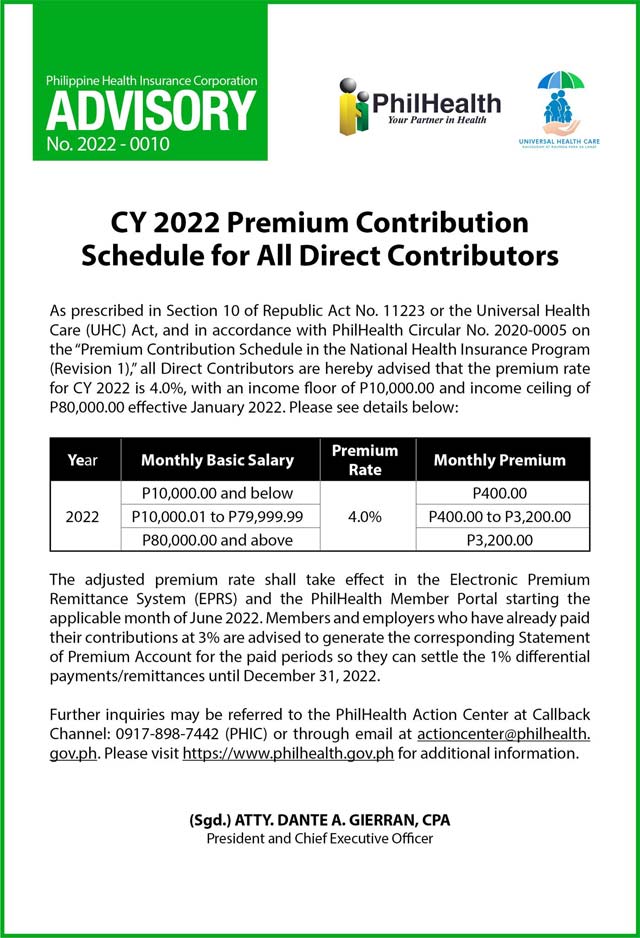
There was also a PhilHealth premium increase in 2020, which was at 3% higher than the previous year. The increase in monthly premium was scheduled to happen every year in increments by .5% from 2020 to 2024, except for 2021 when the scheme was temporarily suspended.
What happened to the P15 Billion?
In August 2020, PhilHealth was put under investigation for alleged "widespread corruption." A former anti-fraud legal officer by the name of Thorsson Montes Keith testified: "Naniniwala po ako na ang perang winaldas at ninakaw ay humigit kumulang P15 billion." The issue became so widespread it became more than a meme: see Tinda Tinda Shop's all-black tote bag, which has the text: "Walang laman na P15 Billion."
In March 2021, PhilHealth released on social media what looked like a liquidation of the P15 billion in question. "Properly accounted po ito. Sa katunayan ay P14.21 bilyon o 95% na ang na-liquidate o naisulit na ng mga ospital, katunayang pinakinabangan ito ng mga pasyente at hindi ng bulsa ng sinoman," they said in the caption on Facebook. The post earned tens of thousands of "haha" reactions.