
The SPOT.ph Guide to Cameras
Check out everything you need to know.

(SPOT.ph) Filipinos are big fans of the Internet saying, “pics or it didn't happen." And where terms like "Kodakan" once reigned supreme, we've stayed true to character by becoming a "selfie capital" of sorts—it's really no surprise that photography has become part of our daily lives. That doesn't mean we're all experts, though; hence this article.
In this article, let’s talk about the history of cameras, their different types and variants, what to look for when buying a brand-new or secondhand device, plus some tips to make your photos better.
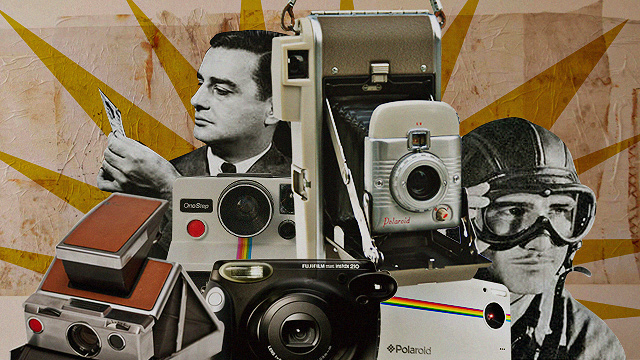
Also read: No Filter Needed: How a Toddler Helped Invent the Instant Film Camera
History of Cameras
When we talk about the history of cameras, all existing documents will point to the camera obscura (the Latin term for “dark room”) as the device’s forerunner. This natural optical phenomenon occurs when an image of a scene (on the other side of a screen or wall) is projected through a small hole that forms an inverted image on the opposite surface of the opening.
Mozi, a Han Chinese philosopher who lived circa 470 to 391 BC made the oldest known record of camera obscura and correctly asserted that the image is inverted because light travels in straight lines from the source.
Arab physicist Ibn al-Haytham (or Alhazen) wrote books related to optics that contain his experiments with light through a small opening in a darkened room during the 11th Century.
It was not until circa 1550 when the use of a lens in the opening of a wall or closed window shutter of a darkened room to project images was used as a drawing aid. Portable camera obscura devices in tents and boxes were introduced as drawing aids sometime in the late 17th Century. The first truly portable (and relatively small) camera was conceptualized by Johann Zahn in 1685 and it took some 150 years later for the device to be actually made.
In 1727, German scientist Johann Heinrich Schulze conducted experiments to demonstrate that the darkening of silver salts used in photography for hundreds of years before that era was due to light alone, contrary to what many believed was that it was caused by heat or exposure to air. This finding was further attested by Carl Wilhelm Scheele, who in 1777 showed that silver chloride was susceptible to darkening from light exposure, and once darkened will become insoluble in an ammonia solution.
Joseph Nicéphore Niépce is recognized to have taken the world’s first permanent photograph of a camera image in 1825. Niépce used a sliding wooden box camera made by Charles and Vincent Chevalier in Paris for his experiments since 1816 and called his process “heliography”.
When the subject of discussion is photography, one term will always be mentioned: “Kodak”. George Eastman pioneered the use of photographic film and started manufacturing paper film sometime in 1885. He then switched to the use of celluloid sometime between 1888 to 1889 and called his camera the “Kodak,” which went on sale in 1888. The “Kodak” was a simple box camera with a fixed-focus lens and a single shutter speed intended for use by an average consumer. The camera package came with a 100-exposure film and required sending back to Eastman’s factory for processing and eventual reloading. Eastman, later on, introduced several other device models for mass-market photography that included folding cameras.
The popular 35mm film camera was first made available to the general public in 1913 (Tourist Multiple) and 1914, the Simplex. Around that same period, German inventor and photographer Oskar Barnack started investigating the use of 35 mm cine film for still cameras in an attempt to build a compact camera capable of producing high-quality enlargements. His prototype 35mm camera was called the Ur-Leica, which was later on commercialized after the end of WWI.
Japanese-made cameras started to gain popularity in 1936 when the Canon Rangefinder (35mm) emerged as an improved version of the Kwanon prototype (1933). After the Korean War, U.S. soldiers stationed in Japan would bring home Japanese cameras, making them popular in the West.
Another Japanese camera maker, Nikon, made the first operational prototype of an SLR-type (Single-Lens Reflex) digital camera or what was known then as a Still Video Camera. This prototype used a magnetic floppy diskette stuck inside the camera and allowed to record between 25-50 black and white images. In 1998, Nikon finally released the world’s first commercial DSLR (Digital SLR) camera the QV-1000C.
Based on statistics, digital cameras have continuously outsold film cameras since 2003. The following year, Kodak decided that they would no longer sell Kodak-branded film cameras and eventually filed for bankruptcy in 2012.
Types & Variants
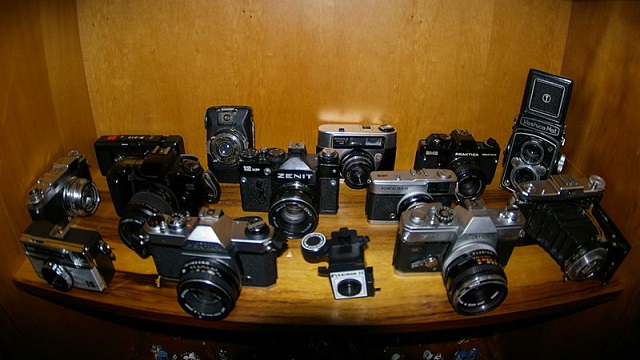
With a multitude of camera types and variants, let’s try to simplify things. In a general sense, we can classify modern cameras into the following types.
Traditional Film Cameras
In the digital era that we are in today, there is still a market for traditional film cameras. These types of cameras give us a nostalgic look and feel and are capable of producing incredibly high-resolution images. When everything can be done in an instant and in real-time today, some people still prefer to have the images taken by their cameras developed in a film laboratory.
Medium Format Cameras
Medium format cameras use the 120 film size (format) and can take pictures bigger than what 135mm or full-frame sensor cameras can produce, but slightly smaller than large format size of 102mm x 127mm, thanks to their very large sensor.
Compact Cameras
Compact cameras can further be sub-categorized as Standard Compact Cameras, Zoom Compact Cameras, and Advanced Compact Cameras.
Standard Compact Cameras are also known as Point-and-Shoot cameras. These devices are reasonably affordable, lightweight, easy to use, and as their name implies: point-and-shoot.
Zoom Compact Cameras are Standard Compact Cameras with greater zooming capabilities. They do not have interchangeable lenses, therefore not considered a professional cameras, but can match the zoom range of a 28-300mm shooter.
Advanced Compact Cameras allow exposure manipulation, thus they are not as affordable as Standard Compact Cameras. Some units of this type have interchangeable lenses.
DSLR Cameras
When it comes to modern-day, creative photography and videography the primary choice of professionals is DSLRs (Digital Single-Lens Reflex) cameras. These kinds of units deliver professional-level sharpness if the user knows have to manipulate the manual camera settings coupled with interchangeable lenses. DSLRs work by allowing light to enter a single lens before hitting a mirror that reflects the light into the viewfinder. DSLRs usually have a 35mm full-frame sensor or an APS-C crop sensor.
Mirrorless Cameras
Mirrorless cameras are a worthy alternative to DSLRs. As the name implies, this type of camera lacks a mirror to reflect the light to the sensor. Instead, the light goes straight to the sensor, which automatically limits the camera shake compared to DSLRs. Also, since there are lesser moving parts with a Mirrorless Camera, they are quieter than the uber-mechanical DSLRs. The only downside, for now, with Mirrorless Cameras: limited lens options.
Action Cameras
Also called Adventure Cameras, Action Cameras are often used for sports and outdoor photography/videography. These kinds of devices are usually weather and shockproof, small and lightweight, and have super durable glass sensors. Action Cameras had been synonymous with GoPro, a popular brand producing adventure cameras and software.
360 Cameras
360 Cameras are similar to Action Cameras, except that they utilize back-to-back lenses to produce 360-degree footage. These kinds of cameras are used best for adventure photography or videography if you want to capture reality series-style images.
Also read: Best of Both Worlds: Film Meets Digital in This Cool New Instax Camera
Things to Look Out For (Specs)
As a hobby photographer (in my own right), I believe in the saying, “It’s not the camera, it’s the photographer.” When asked for recommendations on which camera models to purchase, I ask the following first:
1. What are you going to use the camera for? Will it be for a hobby or business?
2. Why do you need a separate camera when you already have a mid/high-end smartphone?
3. What is your budget?
Photography is an expensive hobby. Some of the recently-launched smartphones can match the photos produced by digital cameras.
Should you decide that you really need to have a camera (apart from your smartphone), the choice of camera type will rest to your liking. Among the specifications and features that you need to consider are speed and performance (measured in FPS or frames per second), image resolution (megapixels or MP), body type (ergonomics; weight), image stabilization, and a wide array of available lenses.
Other things to consider are the likes of the camera having different shooting modes, support for raw image formats, built-in WiFi and GPS, and protection (weatherproof, dustproof, freezeproof, etc.). I’m not that brand-conscious type of a person, but I often suggest that one get the brand of camera that most of his family or friends use. In doing so, you can always borrow or swap lenses from/with them.
Popular Brands, Usual Prices & Where to Buy
Among the popular brands locally available in the Philippines now are Canon, Fujifilm, GoPro, Leica, Nikon, Olympus, Samsung, and Sony. All of these brands offer a wide array of choices when it comes to both Analog and Digital Camera categories. Be ready to cough out somewhere between a low of PHP5,000 to as high as PHP500,000 (high-end professional DSLRs).
Most of these brands have physical stores and service centers around the country. And at the same time, they also have an online presence in their official stores on local eCommerce platforms.
Tips When Buying Secondhand Cameras
When buying a secondhand camera, particularly a DSLR, aside from scrutinizing the physical appearance of the device and how it was used by the previous owner/s, it is also prudent to check on the camera’s Shutter Count. Experts say that most cameras will have a lifespan of just around 200,000 shutter actuations. If someone is selling you a secondhand camera with more than 50,000 on its shutter count, better think twice before purchasing it.
Also read: New Lab on the Block: The Grain House Hopes to Rebuild the Film Community in Cebu + Beyond
Additional Tips
Have I mentioned that photography is an expensive hobby? Should you decide to buy yourself a camera, you may want to have the best protection you could offer it. If you are buying a camera from established sellers or brands, it will not hurt to ask them if they can throw a freebie padded camera bag with it. Don’t settle for just any camera bag, be sure to get the padded one for utmost protection.
For accessories, the standards for photography are tripods and extra batteries. As for the lenses, instead of buying, why not borrow from your friends and family who own the same brand of your camera?