
NASA Predicts a Total Solar Eclipse Will Loom Over Mayon Volcano in 2042
Do you think you'll be here to witness it?

If you're still alive on April 20, 2042, you can witness a phenomenon that may never happen ever again: A solar eclipse that will trace its darkest shadow over the entire stretch of Palawan, going eastward over Masbate and then finally exiting the Philippines over Albay, where Mayon, the world's most perfect cone-shaped volcano, is located.
The shadow of the moon will pass over the Philippines at approximately 1 p.m. in Palawan and 1:30 p.m. in Albay. The eclipse will also be prominent in Indonesia's Sumatra Island, Eastern Malaysia, and Brunei.
Also read:
10 Free Mobile Apps to Make Stargazing More Fun
10 Campsites In and Around Antipolo for Stargazing
Predicted Path of the Solar Eclipse on April 20, 2042

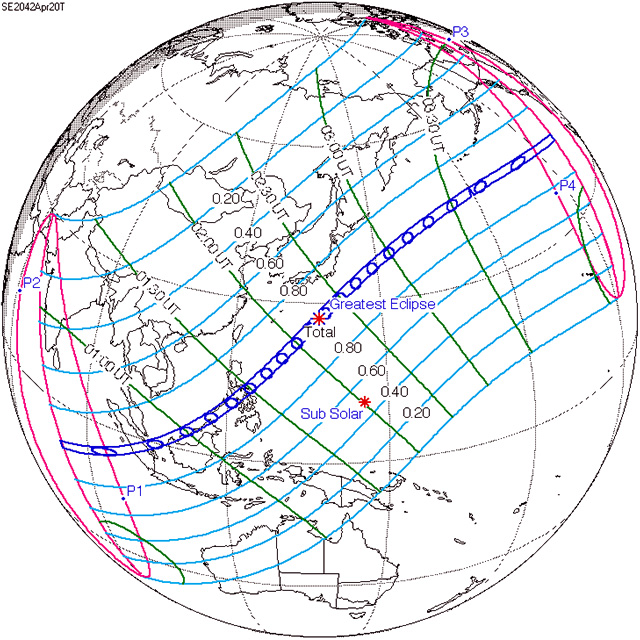
Astronomers refer to the April 2042 eclipse as a part of "Saros 139," which is a series of 71 solar eclipses that happen every 18 years, 11 days, and eight hours. The first of this series occurred in 1501. The last of the series will end in 2763. Although this series of eclipses is repeating, the locations on Earth where the total solar eclipses are observed vary.
Eclipses in Philippine Mythology
In Philippine mythology, there are several interpretations of eclipses. The ancient Maranao people believed there was a great beast called Arimaonga that lived in the sky. Whenever the beast gets boisterous, it swallows up the moon, resulting in a lunar eclipse. The ancient legend passed down from the T'Boli ancestors says that a great serpent in the sky devours the sun. To make the sun come back, they have to play instruments to attract a legendary monkey that will slay the serpent and force it to regurgitate the sun.
Across the archipelago, similar beasts of the sky were believed to swallow the sun or the moon, resulting in eclipses. In Hiligaynon, that beast is called Bawa, Bauta, or Olimaw.
In Tagalog mythology, that beast was named Laho, which has several meanings in the Ancient Tagalog language: a very dark cloud, extinction, or eclipse. It is the root word of paglaho or disappearance.