
Memories Are Pieced Into Modern Japanese Plates at This New QC Private-Dining Spot
The menu is both a personal journey and an ode to Chef Jorge Mendez' loved ones.

Mōdan
Unit 3 Level 1 Escalades East Tower, 20th Avenue, Cubao, Quezon City
Instagram: www.instagram.com/modan.mnl
Open from 6 p.m. onwards, Friday to Sunday
(SPOT.ph) We all know that scene from Ratatouille. Food critic Anton Ego notoriously has a heart (and taste buds) of stone, but he takes a bite of the film’s namesake dish, a dish his mother would make in his younger years, and is immediately transported back to his childhood—thus evoking all the emotions and recollections that come with that period of his life.
The phenomenon is one most of us can relate to, and Chef Jorge Mendez is no different. At Mōdan—Mendez’ highly anticipated private-dining degustation spot in Quezon City—the young chef draws from his memories and pays ode to people that have played important roles in his life, through the lens of his modern Japanese cooking.
Also read: The SPOT.ph Guide to Japanese Food
Chef Jorge Mendez takes on Japanese cuisine with a progressive lens at his new private dining spot in Quezon City:
You may know Mendez as the culinary brains (slash hands) behind Ohayo Ramen and Maki Bar, Eats Chow Chew, and Byrd Tubs. The chef also had stints working at local establishments Ninyo and L’Incontro; and internationally, alongside the likes of Taiwanese bigwig André Chiang as well as staging and doing events in Japan, Singapore, and New York. At the end of the day, it’s Japanese cuisine that brings him comfort. After all, it was the cuisine his mom—who formerly worked in the Land of the Rising Sun—would cook for him as a kid.
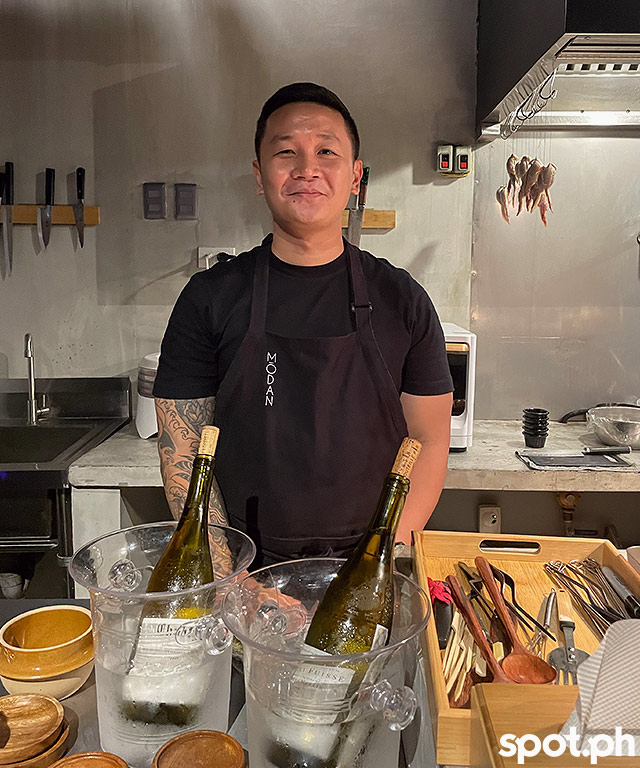
Over at Mōdan (a play on the word "modern" in the Japanese phonetic system), Mendez describes his approach as neo- or “progressive” Japanese—that is, Japanese in primary motif and flavor, but updated in form or presentation or with the use of novel techniques. This, he explains, is not to be mistaken for fusion, which relies more deliberately on melding different cuisines. But you will find global elements here and there, always in ways that fit perfectly with everything else, not unlike a jigsaw puzzle.
You’ll find the 12-seater dining spot not in the typical fine-dining hotspots of Makati or BGC, but in the cozier part of the city that is Cubao. With a communal table taking up much of the space, bordered by a small open kitchen and a bookshelf of related cookbooks on the side, Mōdan is intimate as can be—and this well fits how the rest of the 10-course set menu (P4,500) unfolds, because it’s a highly personal look into Mendez’s journey getting to where he is now.
Every dish at Mōdan, however small or big, is dedicated to a person, a group, or a place that played a significant role in Mendez’s life. That is, he takes elements he associates with the said figures and incorporates them into the dish in some form, with the servers explaining the stories behind them as they’re placed on your table.
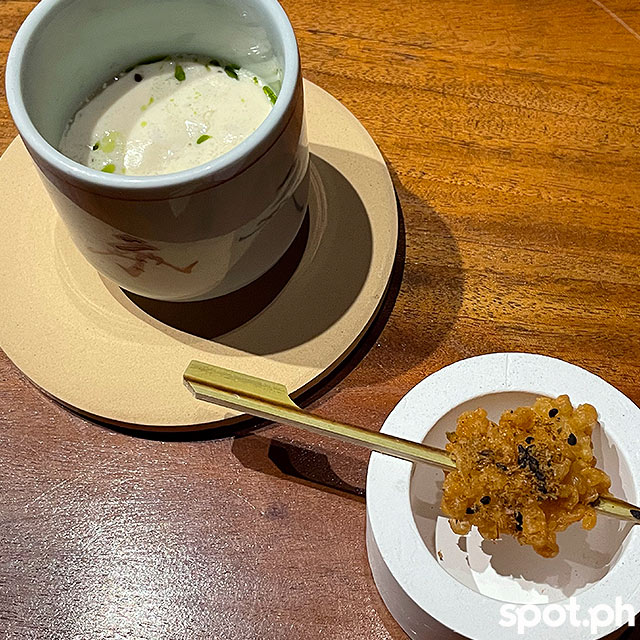
The setup and flow can be loosely compared to that of kaiseki, though Mendez clarifies that it’s more “deconstructed and refined, progressive even.” With that, the meal’s official opening act is a love letter to Mendez’s mom for introducing him to Japanese cuisine: dubbed the Soup, this tandem of tendon tempura and nira (chive) oil-lined, taro foam-topped onion tea is based on dishes his mom would make for him in the kitchen.
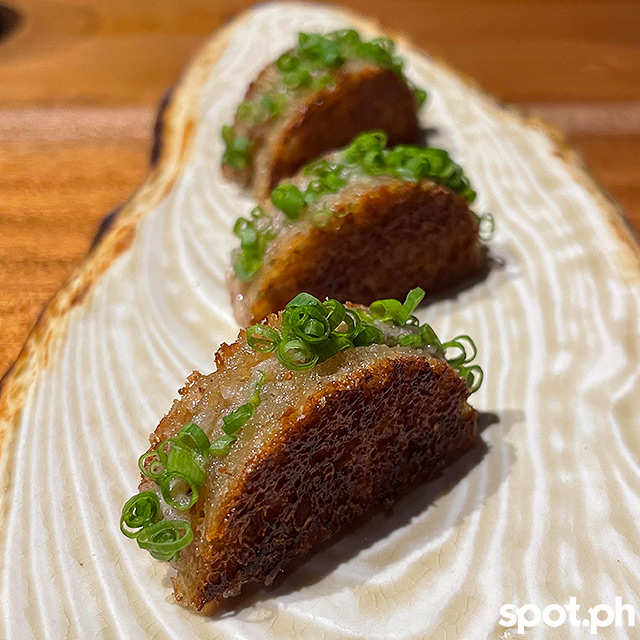
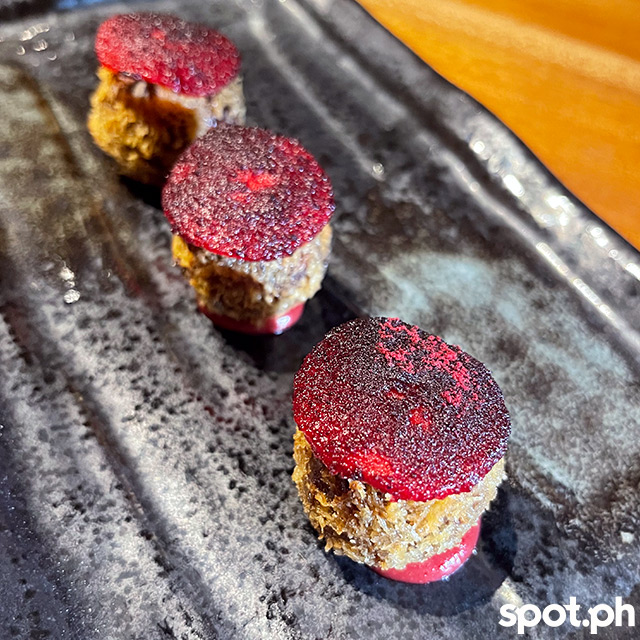
Following this are Snacks that also showcase Mendez’s playful side, beginning with the Takoyaki—which serves as an ode to Mendez’s takoyaki-loving wife. Name aside, it has crab in place of octopus, the latter being a seafood Mendez loves to work with but personally dislikes in certain applications—hence, this compromise they can both enjoy. The Chuutoro Toast has buttery “toasts” filled with toro (tuna)—pointing to his first job where he got to work with tuna "on his own terms" for the first time. Especially eye-catching are the Gyu Kakuni Korokke, croquettes of shredded Wagyu short rib dressed with sweet-tart apple tsukemono and wasabi-imbued beets, as a way of thanking Hapag chefs Thirdy Dolatre, Kevin Navoa, and Kevin Villarica for always encouraging him to “push the envelope” when it comes to food.
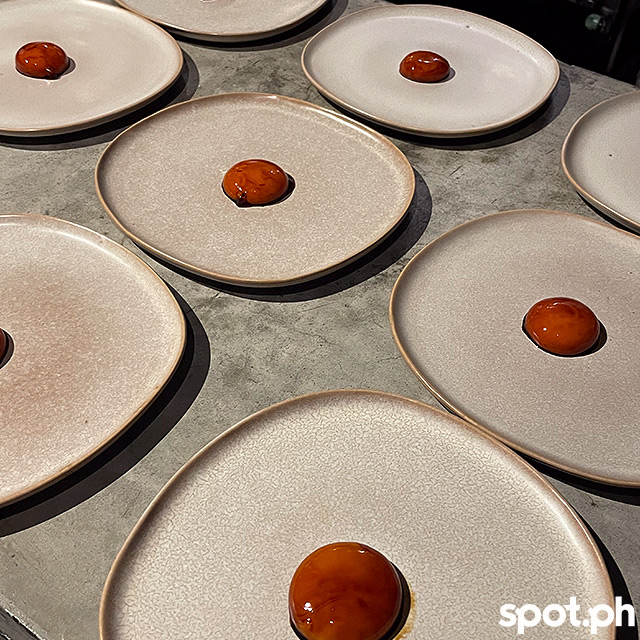
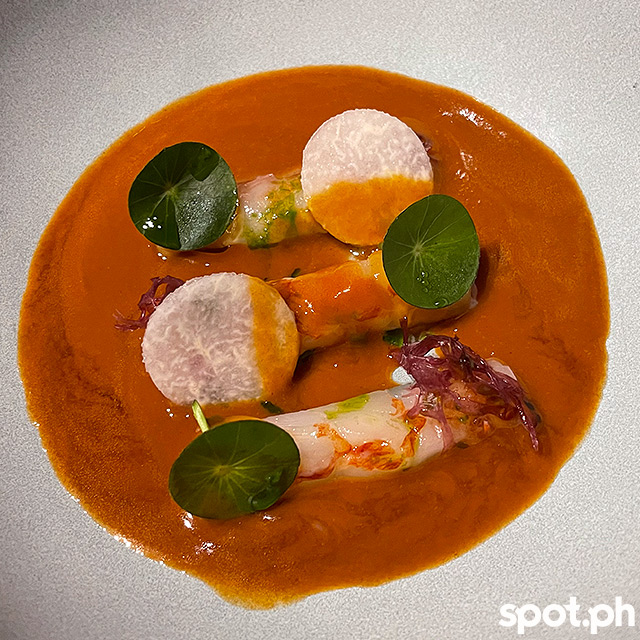
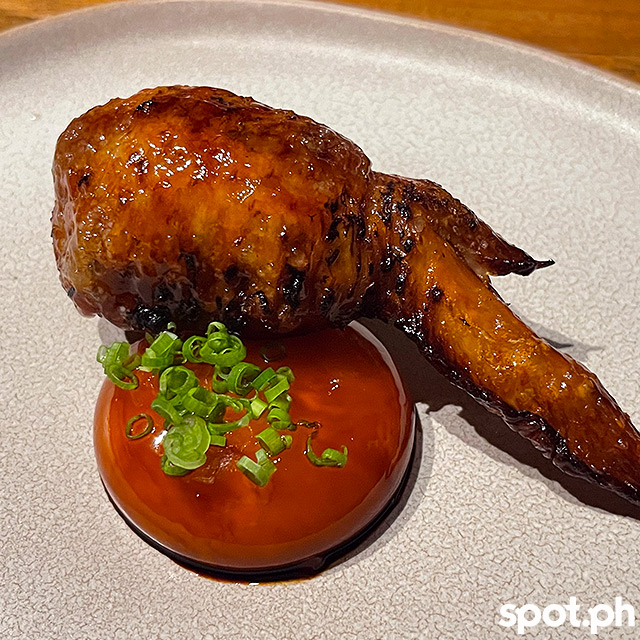
Mendez goes on to share how 2016 Asia’s Best Female Chef Margarita Fores helped him tremendously in his career as she brought him over to different countries—Japan included—where he would find great opportunities to work and stage at known establishments. Paying tribute to Fores, then, is the vibrant-tasting Amaebi—the eponymous sweet shrimp (introduced to Mendez by Fores!) often enjoyed raw, given a tiradito-esque execution with a zippy red-pepper sauce as well nira oil, pickled jicama, gotu kola, and lemon zest. Following it is a plate more on the deeply savory, umami end: the Debasaki, a chicken-and-egg situation meant to honor Mendez’s colleagues from when he made a similar dish for an event that ended up “failing.” This redemption dish of sorts instead has lumpfish caviar rice inside chicken wings (tebasaki); the wings are then grilled such that the skin is rendered thin and crisp while the interiors stay juicy. Soy-cured egg yolks underneath—which serve as the sauce of sorts for mopping up as we consume the wings with our hands as instructed—make for even richer bites. All good stuff. To say the original idea was redeemed is an understatement.
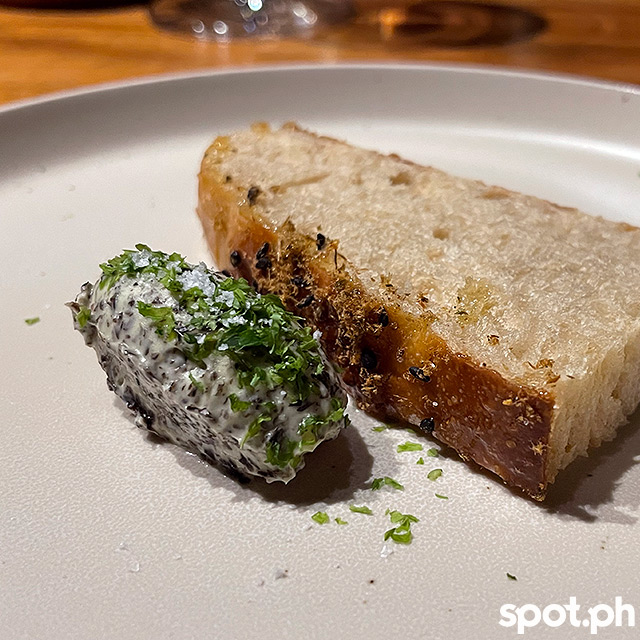
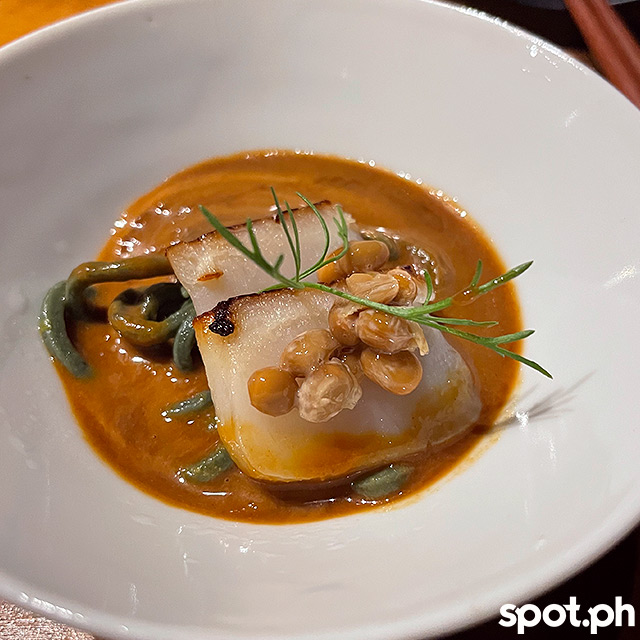
Chef Richie Manapat, baking extraordinaire who famously illuminated Manila folks to the art of great bread, also inspired Mendez and taught him the many possibilities available when it comes to the yeasted carb. With that, Mendez fashions the Bread. By no means your regular old Western bread basket, though, the course features slices of Japanese-style focaccia that’s softer and tighter in crumb versus the Italian stuff, paired with butter infused with nori and topped with nutty, umami ol' furikake. The Scallop follows; while succulent seared scallops are indeed the dish’s crowning glory, the true star is the house-made matcha soba underneath. This, after all, is Mendez’s way of showing his appreciation to Kito Nakawara, a ramen master he worked with in Japan to whom Mendez credits his noodle-making know-how. With the al-dente, slightly earthy character of the soba—which is then matched with a soulful paitan broth that clings onto each strand—we’re sure the ramen master would be proud.
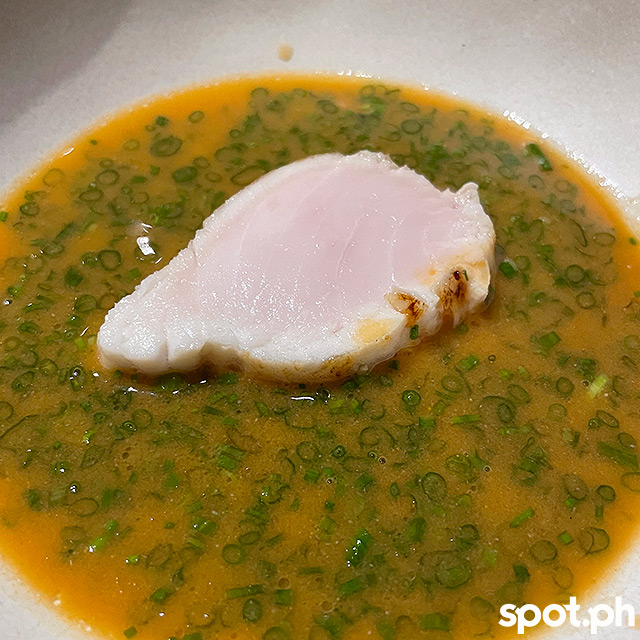
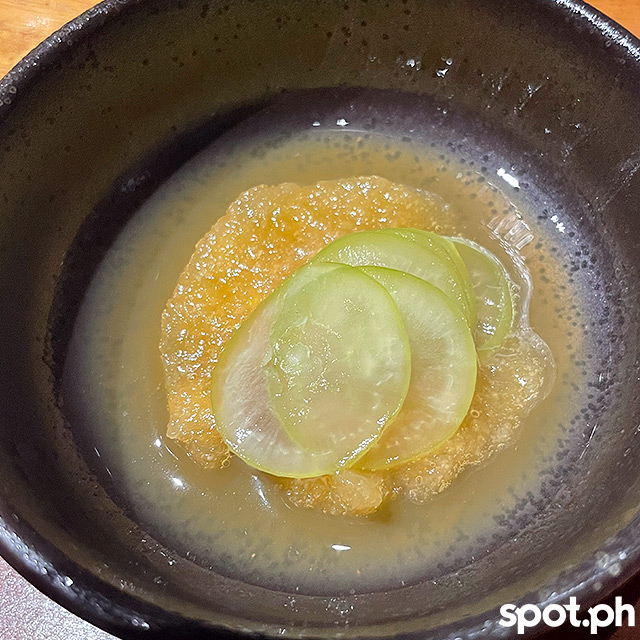
Next up in the concert is the Gindara—a tribute to Chef Josh Boutwood of Helm and The Test Kitchen (among other establishments) and a nod to his way of whipping up sublime wholes even with minimal parts. Boutwood, of course, is known for his experiments with aging and fermenting ingredients; likewise, the fish here is aged (to trap in the moisture, we’re told—which we think could be the reason behind its meatier, juicier character), seared, and paired with a deeply savory miso bisque and negi. A bowl of Kakigori succeeds this; this small bowl of melon soda granita, thin slices of muscat grapes, and mentaiko (yup, the cured pollack roe) is dedicated to Mendez’s muscat-loving son, and works to cleanse our palates with its sprightly profile.
Rice is a Japanese staple and it’s at this point that the Mōdan team soon brings out the big gun that is the Nabe. This is dedicated to multiawarded fine-dining spot Den in Japan, where he also learned the technique of making the dish—though Mendez makes it his own with added techniques. In communal-dining fashion, it comes as a giant clay pot placed at the center of the table for everyone to share. Uncover the pot and smoke comes out, which soon makes way to the treasures inside: rice, each grain brunette in color and glistening against the light, as well as jeweling embellishments of Wagyu short ribs, unagi, and negi.
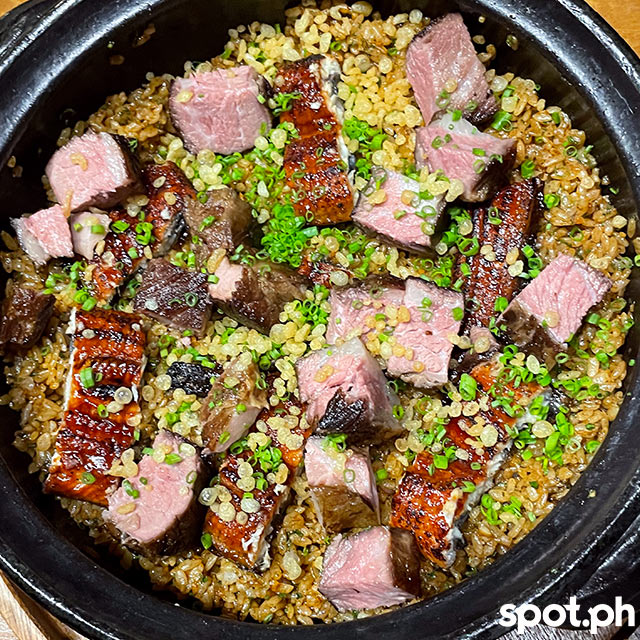
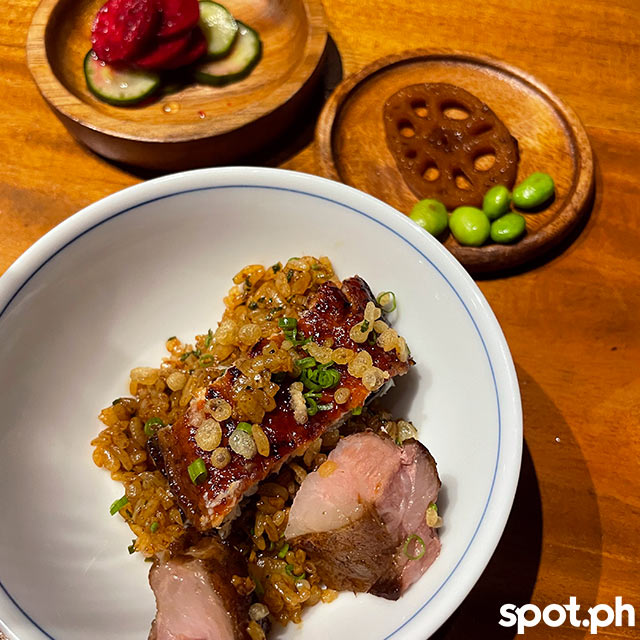
We scoop helpings onto our bowls and dig in. It's pure bliss in a bowl. The rice underneath has a deeply savory character all its own but also takes beautifully to the tender beef and smoky grilled eel topping it—the richness of which we balance out by nibbling on the tsukemono and braised renkon keeping the dish company. Worth noting, too, is the note of burnt garlic that lends subtle Filipino flair to the dish without taking over.
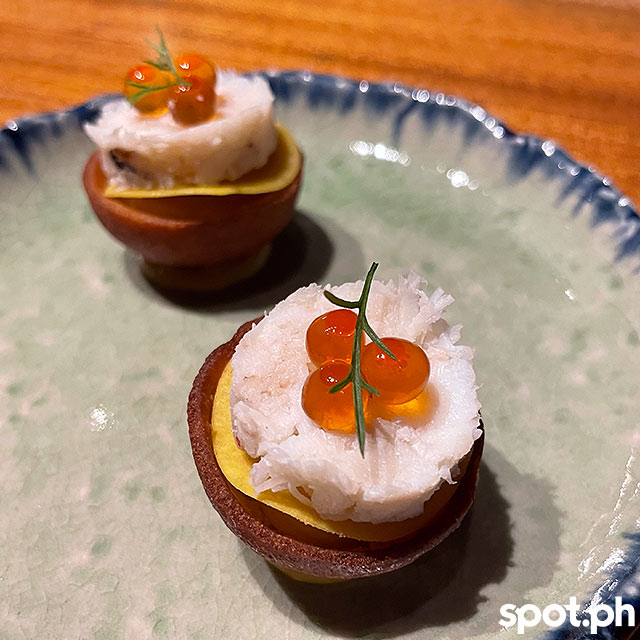
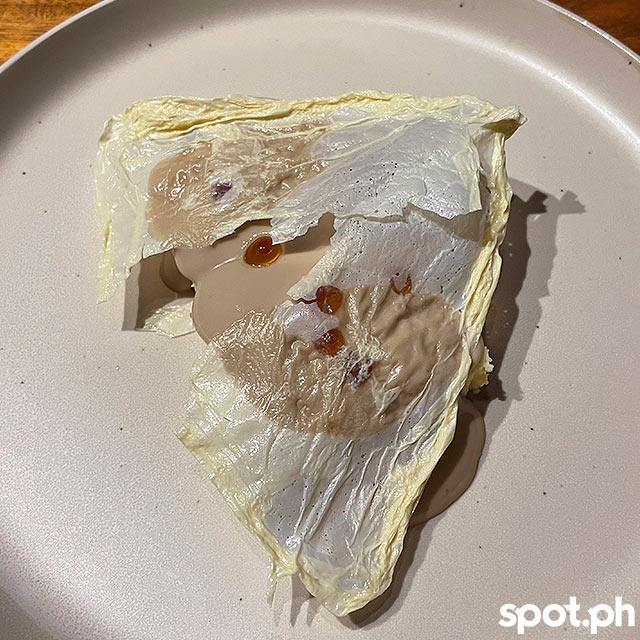
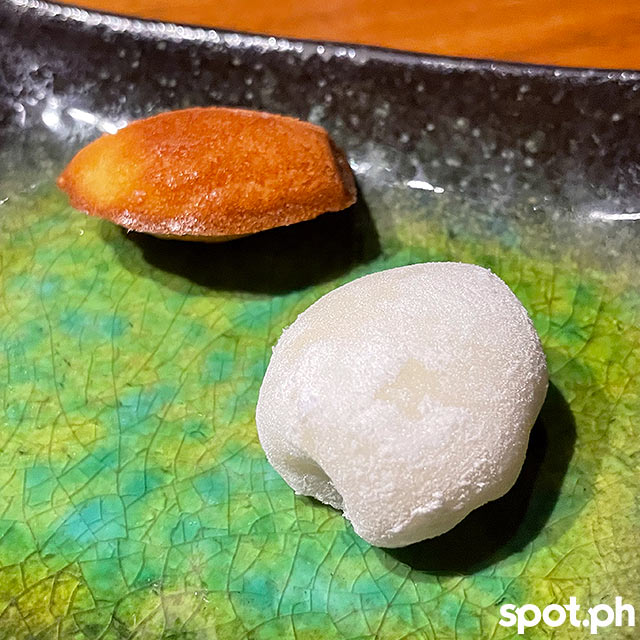
Mōdan eventually has us crossing over to the sweet realm—that is, with the aptly named Dessert course, which Mendez dedicates to his daughter. “She likes her all of her food with cheese,” we’re told. Chef Jorge takes Hokkaido milk and—with a similar technique used to make yuba—whips up a thin, crisp sheet of dairy. Crack into it and you’ll be met with a cheesecake-castella hybrid that melts in the mouth, along with kuromitsu cream for depth and ikura for a surprise savory burst. (We're all for the play of savory on sweet.) It doesn’t take too long before Mendez brings out the nightcap of petit fours paying ode to food and travel writer Angelo Comsti, inspired by dishes they had tried and enjoyed together: nutty sesame castella shaped into madeleines, and tiny blobs of mochi with a ricotta-cheesecake interior.
Memories, as we’ve seen, manifest themselves not just as memories, but through other sensory modalities: sounds, smells, and of course, taste. But these aren’t just any memories that Mendez composes the menu after. Rather, the chef transcends himself by focusing on memories in relation to others, even devoting entire courses to those around him. “Sila, [for example], Margarita Fores, Josh [Boutwood], Angelo [Comsti], [and so on].... parang I couldn’t imagine kung wala [sila], ‘di ko makukuha ‘yong doors na binigay nila sa’kin,” he muses. That is, Mōdan isn’t just a showcase of Mendez as an individual. It is an exploration of Mendez as a chef embedded in the world, and a way of showing gratitude to those who’ve helped pave the way for it.
Hey, Spotters! Check us out on Viber to join our Community and subscribe to our Chatbot.